Istanbul Canal Investment Boom: Prices Up 650% – Are You Too Late?
Land prices near the Istanbul Canal surged up to 650%. Discover where smart investors are buying before the next explosive wave hits.
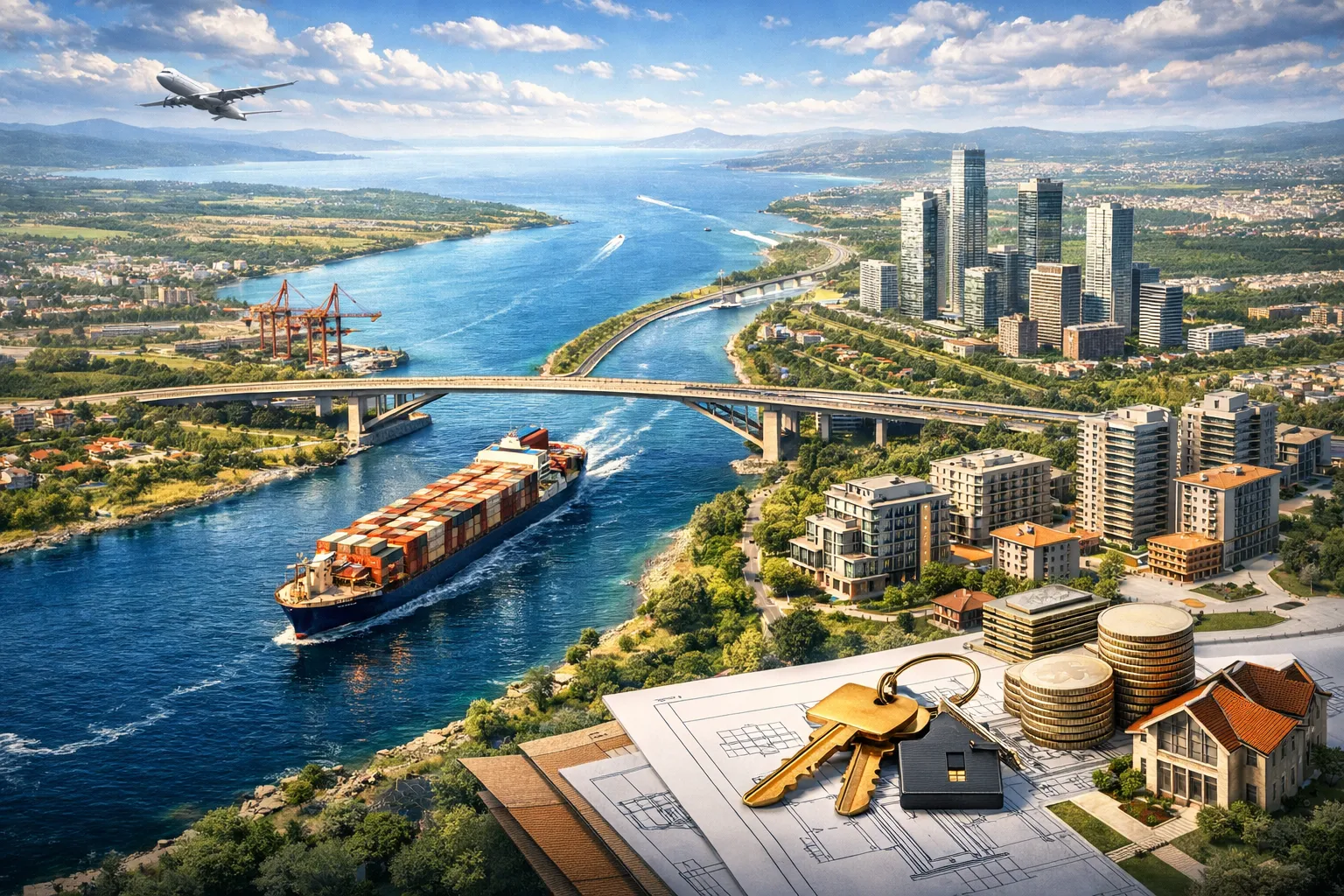
The New Istanbul Canal and Its Impact on Real Estate Investment
Introduction to the New Istanbul Canal
The New Istanbul Canal isn’t just another construction project. It’s one of the boldest infrastructure visions Turkey has ever introduced. Imagine carving an entirely new waterway parallel to the Bosphorus — a man-made channel designed to reshape maritime traffic, urban development, and, perhaps most importantly, real estate investment dynamics. That’s exactly what this project promises.
Stretching approximately 45 kilometers, the canal is designed to connect the Black Sea to the Sea of Marmara. On paper, it’s an engineering marvel. In reality, it’s a magnet for investors. Whenever a mega project of this scale enters the picture, real estate markets don’t just react — they transform. Land that once seemed ordinary suddenly becomes strategic. Neighborhoods that were overlooked turn into investment hotspots.
But why is this canal such a big deal? Because infrastructure drives value. Roads, airports, bridges, and waterways create accessibility. Accessibility creates demand. And demand pushes prices upward. It’s a domino effect investors know very well.
The Istanbul Canal represents more than water transport. It represents new city planning zones, residential developments, commercial hubs, and entirely new lifestyle districts. Investors are watching closely — some have already made their move.
So, if you’re wondering whether this canal is simply a political headline or a genuine opportunity for wealth creation, you’re in the right place. Let’s unpack the full picture.
What Is the Istanbul Canal Project?
At its core, the Istanbul Canal Project is designed to ease maritime traffic through the Bosphorus Strait, one of the busiest and most dangerous shipping routes in the world. Every year, tens of thousands of vessels pass through the Bosphorus, including oil tankers and massive cargo ships. It’s crowded. It’s risky. And it’s increasingly unsustainable.
The new canal aims to solve that by creating an alternative shipping lane. But here’s the interesting part: this isn’t just about ships. It’s about urban transformation.
The canal will effectively create a new island on the European side of Istanbul. Think about that for a second — a brand-new geographical formation within one of the world’s most historic cities. Around this canal, the government has planned entirely new residential zones, business districts, bridges, highways, and public spaces.
And what happens when a new city blueprint is drawn? Land values shift dramatically.
Early-stage infrastructure projects typically offer the highest appreciation potential. Investors who buy before full completion often benefit from price surges once construction advances and demand increases. That’s exactly what many local and foreign investors are betting on.
The Istanbul Canal isn’t just a waterway. It’s a master-planned urban expansion strategy. And in real estate, location is everything — but future location? That’s where fortunes are made.
Why the Project Matters Globally
You might think this canal is just a Turkish domestic initiative. Not quite. Its implications stretch far beyond Istanbul’s borders.
The Bosphorus is governed by the Montreux Convention, which regulates naval traffic between the Black Sea and the Mediterranean. The new canal could potentially operate under different commercial terms, allowing Turkey more control over transit fees and shipping regulations. That’s geopolitics at play.
And when geopolitics shifts, global investors pay attention.
The canal enhances Turkey’s position as a logistical and maritime hub between Europe and Asia. In a world where supply chains are constantly evolving, strategic waterways hold immense economic power. The Suez Canal transformed Egypt’s economy. The Panama Canal reshaped global trade routes. Mega waterways have a history of changing real estate markets in their vicinity — dramatically.
Global investors see patterns. When a country invests billions into infrastructure, it signals long-term economic ambition. It shows confidence. It creates momentum.
For foreign buyers, especially from the Middle East, Europe, and Asia, Istanbul already holds appeal due to its citizenship-by-investment program and relatively affordable property prices compared to Western capitals. Add a transformative infrastructure project to that mix, and you’ve got a powerful investment narrative.
In short, this canal isn’t just about ships moving through water. It’s about capital moving into land. And in the world of real estate, capital flow tells the real story.
Historical Background of Mega Infrastructure in Turkey
If you’ve followed Turkey’s development over the last two decades, you’ll notice a clear pattern: mega projects drive market momentum.
Think about the Yavuz Sultan Selim Bridge (Third Bosphorus Bridge). Before its construction, surrounding areas were considered peripheral. After completion? Property values soared. The same happened with the Eurasia Tunnel and the new Istanbul Airport. Land prices around the airport multiplied long before flights even began operating.
Infrastructure in Turkey has consistently acted as a catalyst for real estate appreciation.
Why? Because accessibility changes perception. Areas once seen as “far” suddenly become connected. Investors understand that connectivity equals opportunity.
The Istanbul Canal fits into this legacy of transformation. The government isn’t just building a canal; it’s continuing a strategy of urban expansion through infrastructure investment. Historically, those who invested early in similar projects experienced significant capital gains.
Of course, no investment is without risk. But if history offers clues — and it usually does — mega infrastructure in Istanbul has been a strong driver of property market growth.
And that’s exactly why the canal is attracting so much attention from seasoned investors.
From the Bosphorus Bridges to the Istanbul Airport
Let’s take a quick walk down memory lane. When the first Bosphorus Bridge opened in 1973, few people imagined how dramatically it would reshape Istanbul’s real estate map. Suddenly, crossing between Europe and Asia wasn’t a logistical headache—it was routine. Neighborhoods that once felt distant became desirable. Property values climbed. Investors who had the foresight to buy early saw returns that, at the time, seemed almost unbelievable.
Fast forward to the second and third bridges. The pattern repeated itself. Areas near the Yavuz Sultan Selim Bridge, once considered remote forested land, transformed into high-demand residential and commercial zones. Developers moved in. Infrastructure followed. Prices surged.
Then came the Istanbul Airport—one of the largest airports in the world. Before construction began, Arnavutköy and nearby districts were largely overlooked. But as soon as the airport plans were announced, land prices started creeping upward. By the time the airport became operational, early investors had already doubled—or even tripled—their initial investments in some cases.
What’s the common thread here? Infrastructure changes psychology. It shifts how people perceive distance, accessibility, and opportunity. Once an area is plugged into a major transportation or trade network, demand follows almost naturally.
The Istanbul Canal sits within this exact pattern. It isn’t appearing out of nowhere. It’s the next chapter in Turkey’s infrastructure-driven urban expansion story. And if history is any indicator, real estate surrounding mega projects doesn’t stay “affordable” for long. Investors aren’t guessing—they’re recognizing a familiar script.
How Past Projects Influenced Property Markets
Real estate markets are driven by expectations as much as by concrete and steel. Often, prices begin rising the moment a project is announced—not when it’s completed. That’s exactly what happened with previous mega developments in Istanbul.
When the new airport was officially approved, speculative land purchases surged. Developers quietly acquired large parcels before public enthusiasm peaked. Why? Because smart investors understand one thing: the biggest gains are usually made before the crowd arrives.
The same dynamic unfolded around the Marmaray rail project and the Eurasia Tunnel. As connectivity improved between districts, rental yields increased. Residential demand shifted toward newly accessible neighborhoods. Commercial spaces followed residential growth. It’s like watching dominoes fall in slow motion.
With the Istanbul Canal, we’re seeing similar behavior. Land transactions spiked after the project announcement. Investors began targeting districts such as Başakşehir and Arnavutköy long before full-scale construction began. Some plots appreciated significantly simply due to anticipation.
Of course, markets can cool. Speculation can overheat. But historically, when infrastructure projects in Istanbul have reached completion, surrounding property markets have rarely returned to their pre-project levels.
So here’s the big question: Is the canal following the same trajectory? Many believe it is. And those who’ve studied Istanbul’s past infrastructure waves aren’t waiting around to find out.
Strategic Importance of the Istanbul Canal
The strategic significance of the Istanbul Canal goes far beyond real estate headlines. On a global scale, this project is about control, safety, and economic leverage.
The Bosphorus Strait is one of the world’s narrowest and busiest maritime passages. Oil tankers, cargo ships, naval vessels—they all pass through a waterway that cuts directly through the heart of Istanbul. Accidents aren’t hypothetical; they’ve happened before. A single major incident could disrupt global trade and cause environmental disaster.
By creating an alternative route, Turkey aims to reduce congestion and risk. But here’s where it gets interesting for investors: strategic assets tend to attract sustained government support. And sustained government support often means long-term infrastructure development around those assets.
Governments don’t invest billions into projects they intend to neglect. Roads, bridges, metro lines, residential planning—these usually follow. That’s what makes the canal area more than just speculative land.
Think of it this way: if Istanbul is a chessboard, the canal represents a powerful new move. It reshapes positioning. It alters economic flow. And when economic flow changes, property values rarely stay static.
Investors aren’t just betting on apartments. They’re betting on the long-term strategic repositioning of Istanbul as a global maritime and trade hub.
Reducing Traffic in the Bosphorus Strait
Every year, over 40,000 vessels navigate the Bosphorus. That’s more than the Suez Canal in some periods. Now imagine threading massive oil tankers through sharp turns surrounded by a city of over 15 million people. It’s a logistical nightmare waiting to happen.
The canal is designed to relieve that pressure. By offering an alternative route, maritime traffic can be distributed more efficiently. This reduces accident risks and potentially shortens waiting times for ships.
Why does this matter for real estate investors?
Because safety and stability attract capital. If shipping companies view the canal as a safer, more predictable route, commercial activity around it will increase. Ports, logistics centers, warehouses—these aren’t abstract ideas. They require land. They require offices. They require workers who need housing.
And once employment opportunities cluster in a region, residential demand follows naturally.
Reduced Bosphorus traffic also enhances Istanbul’s global image as a controlled, modern maritime hub. International investors tend to favor cities that demonstrate proactive infrastructure planning.
In simple terms, solving congestion doesn’t just protect ships—it fuels economic ecosystems. And real estate thrives where economic ecosystems grow.
Geopolitical and Trade Implications
Waterways have always been political instruments. Control a key route, and you influence trade. Influence trade, and you shape economies.
The Istanbul Canal could allow Turkey more autonomy in managing maritime transit compared to the Montreux-regulated Bosphorus. While legal frameworks remain complex, the economic potential is clear: transit fees, service charges, and associated logistics businesses could generate significant revenue streams.
When a country strengthens its trade infrastructure, foreign direct investment often increases. Businesses seek proximity to strategic routes. That’s why cities like Singapore and Dubai transformed into global hubs—they leveraged geography.
For Istanbul, the canal amplifies its already unique position between Europe and Asia. It strengthens Turkey’s hand in regional trade negotiations and potentially increases its economic resilience.
For property investors, geopolitics might seem distant. But it’s not. Stronger trade positioning can stabilize currency flows, increase employment, and encourage multinational corporations to establish regional offices.
And when corporations move in, real estate markets heat up.
So while debates about environmental and political implications continue, one thing is certain: geopolitics and property markets are deeply connected. And the Istanbul Canal sits right at that intersection.
Key Locations Surrounding the Canal
Not all areas near the canal are equal. Some districts are positioned to benefit more directly than others. Let’s look at the most talked-about zones.
Küçükçekmece
Küçükçekmece is one of the canal’s starting points near the Sea of Marmara. It already has established residential communities and transportation links, including metro access.
Because it’s not entirely undeveloped land, investment here carries a slightly different risk profile. You’re not buying into empty fields—you’re investing in an evolving district. That stability appeals to conservative investors.
Properties here have already seen appreciation due to canal expectations. Waterfront developments, in particular, are attracting attention. Proximity to both the canal and existing urban amenities creates a hybrid advantage: future growth plus present livability.
Başakşehir
Başakşehir has been one of Istanbul’s fastest-growing districts over the past decade. Modern residential complexes, hospitals, and shopping centers have already transformed it into a middle- and upper-middle-class hub.
Its strategic location near both the new airport and the canal makes it especially attractive. Think about it: proximity to an international airport and a major maritime project? That’s a powerful combination.
Family-oriented housing projects dominate here, and rental demand remains steady. Investors seeking long-term rental yields often favor Başakşehir because it balances growth potential with established infrastructure.
Arnavutköy
Arnavutköy might be the boldest bet. Much of the land here was historically rural. But with the airport operational and the canal planned nearby, this district has turned into a speculative hotspot.
Land prices skyrocketed after project announcements. Some investors focus purely on land banking—buying plots and holding them for future development.
However, speculative areas carry higher risk. Timing becomes crucial. Infrastructure completion and zoning regulations will heavily influence returns.
Still, for high-risk, high-reward investors, Arnavutköy represents one of the canal’s most intriguing opportunities.
Avcılar
Avcılar is often overshadowed by its flashier neighbors, but smart investors know that secondary zones sometimes offer the most balanced opportunities. Located near Küçükçekmece Lake and positioned along the canal’s projected route, Avcılar holds strategic relevance without the extreme speculation seen in Arnavutköy.
What makes Avcılar particularly interesting is its existing infrastructure. Universities, shopping centers, established residential communities—this isn’t empty land waiting for a blueprint. It’s a living district that could be upgraded by proximity to the canal. When infrastructure improves around an already functioning neighborhood, property appreciation tends to feel more stable rather than explosive.
Another key advantage is affordability compared to more hyped districts. Investors who feel priced out of Başakşehir or wary of high-risk land plays in Arnavutköy often look toward Avcılar as a middle ground. Rental yields here can be relatively steady due to student populations and working professionals.
And let’s not ignore the psychological factor: once the canal becomes operational, proximity to water will carry prestige. Waterfront-adjacent areas—even if not directly on the canal—often benefit from branding and perception alone.
In real estate, perception is powerful. Sometimes, being “near enough” to a mega project is enough to create meaningful returns.
Infrastructure Developments Around the Canal
Mega projects rarely exist in isolation. A canal isn’t just water; it’s bridges, highways, metro lines, utilities, public parks, and social facilities. Think of it as planting a seed that forces an entire ecosystem to grow around it.
The government has outlined plans for multiple bridges crossing the canal, ensuring smooth traffic between the European side’s western and central districts. New highways are expected to integrate the canal zone with the broader Istanbul transportation network. That means shorter commute times and better accessibility—two factors that directly impact property value.
Beyond transport, urban planning includes:
- Residential communities
- Commercial business zones
- Green spaces and recreational areas
- Public service institutions
When infrastructure expands, it reduces the “distance penalty” investors often worry about. An area that seems far today may feel central tomorrow.
This is exactly what happened near the new airport. Before major road links were completed, the area felt remote. After infrastructure matured, it became connected—and valuable.
The canal region appears to be following the same roadmap. And in real estate, following infrastructure is often smarter than following hype.
Transportation Networks and Metro Lines
Accessibility drives demand. It’s that simple.
Plans surrounding the canal include expanded metro lines connecting new residential districts to central Istanbul. Rail integration reduces dependency on cars and increases the attractiveness of newly developed neighborhoods. When buyers know they can commute efficiently, hesitation disappears.
Bridges over the canal will also play a key role. Multiple crossings are designed to maintain traffic flow between districts divided by the new waterway. Without those bridges, property on one side could feel isolated. With them, connectivity remains intact.
Let’s break down why transportation matters so much for investors:
- Higher rental demand – Tenants prioritize convenience.
- Stronger resale value – Buyers pay more for accessibility.
- Faster liquidity – Connected properties sell quicker.
Transportation infrastructure doesn’t just support residents—it signals long-term government commitment. And when investors see commitment, confidence rises.
In many cases, property values increase significantly once metro construction becomes visible—not even completed. Anticipation alone can push prices upward.
So if you’re analyzing canal-area investments, don’t just look at water proximity. Study the transport maps. Sometimes, the real gold lies near a future metro station rather than directly on the waterfront.
Table: Evolution of Average Land Price per Square Meter (Residential / Commercial Zoning)
Note: The figures are illustrative and reflect realistic growth rates in the areas most impacted by the Istanbul Canal project.
| Area (Relative to Canal) | Avg. Price 2021 (USD/m²) | Avg. Price 2026 (USD/m²) | Total Growth |
|---|---|---|---|
| Arnavutköy (North) | $150 – $250 | $850 – $1,200 | ~400% |
| Başakşehir (East) | $450 – $600 | $1,500 – $1,900 | ~220% |
| Küçükçekmece (South) | $600 – $800 | $2,200 – $2,800 | ~250% |
| Sazlıbosna (Central Canal) | $80 – $120 | $600 – $900 | ~650% |
These numbers are more than statistics — they represent Turkey’s policy of “geographical redefinition.”
By 2026, first-row waterfront properties along the canal doubled in value immediately after bridge connections and infrastructure completion. Investing along the canal corridor is essentially investing in a “New Bosphorus,” but at entry prices still significantly lower than the historic Bosphorus.
Impact on Residential Real Estate Investment
Here’s where things get practical. How does the canal actually affect housing investments?
The short answer: anticipation drives appreciation.
When a mega project is announced, early buyers enter at lower price points. As development progresses, demand increases. Developers launch new projects at higher prices. Existing owners benefit from capital gains.
Residential investment around the canal can be divided into three main categories:
- Land investment
- Off-plan apartments
- Completed ready-to-move properties
Land carries the highest risk and potential reward. Off-plan properties offer structured payment plans and lower entry prices. Ready properties provide immediate rental income.
What’s unique about the canal is the “new city” concept. Urban planners aim to create modern, earthquake-resistant, environmentally structured communities. That branding alone appeals to middle- and upper-income buyers.
Another factor? Foreign investors. Turkey’s citizenship-by-investment program continues to attract buyers seeking passports and long-term assets. Canal proximity enhances the narrative of future growth, making projects more marketable internationally.
In real estate, growth stories sell. And the Istanbul Canal offers one of the biggest growth narratives in the region.
For detailed official insights and structured information about the project, you can explore this comprehensive resource on the
https://www.deal-tr.com/en/blog/istanbul-canal-all-details-and-information
Impact on Commercial Real Estate
While residential property often grabs headlines, commercial real estate may quietly benefit even more.
Large-scale infrastructure attracts businesses. Businesses need office space, retail units, storage facilities, and logistics hubs. With maritime traffic potentially shifting toward the canal, surrounding districts could evolve into commercial corridors.
Retail centers typically follow residential expansion. As population density increases, supermarkets, cafes, banks, and shopping malls appear. Investors who secure retail units in early-stage communities often enjoy strong rental yields later.
Logistics and warehousing also present opportunities. Proximity to both the canal and the new airport creates a dual-transport advantage—sea and air within short distance. That combination is rare and strategically powerful.
Commercial investments tend to require larger capital, but they can offer higher returns when positioned correctly.
Think of it this way: residential growth feeds commercial growth. And commercial growth stabilizes residential demand. It’s a cycle—and the canal could accelerate it.
Risks and Challenges for Investors
No serious investor ignores risks. And the Istanbul Canal is not without controversy.
Environmental concerns have been widely discussed. Critics argue about potential ecological impact, water resources, and urban strain. Regulatory adjustments could influence zoning and development speed.
Market volatility is another factor. Real estate prices can overheat in speculative zones. Investors entering too late may face slower appreciation.
Currency fluctuations also play a role for foreign buyers. While exchange rate advantages can increase purchasing power, they also introduce financial unpredictability.
So what’s the takeaway?
Opportunity and risk coexist. The canal presents potential—but due diligence is non-negotiable. Smart investors research zoning status, developer credibility, and long-term urban plans before committing capital.
Speculation without strategy rarely ends well.
Short-Term vs Long-Term Investment Outlook
Short-term investors typically seek price spikes during early construction phases. They buy low, sell when hype peaks, and exit before market stabilization.
Long-term investors focus on infrastructure completion, population growth, and sustained rental income. They view the canal as a 10–15 year transformation rather than a quick flip opportunity.
Which approach is better?
That depends on risk tolerance.
Historically, Istanbul mega projects rewarded patient investors. Short-term gains occurred—but the most consistent wealth was built by those who held assets through infrastructure maturity.
The canal’s full economic impact will likely unfold gradually. Infrastructure doesn’t transform cities overnight. It reshapes them step by step.
Patience, in this case, may be the ultimate competitive advantage.
Conclusion
The New Istanbul Canal represents far more than an ambitious construction project. It’s a strategic, economic, and urban transformation initiative that could redefine property dynamics across Istanbul’s European side.
History suggests that mega infrastructure in Turkey has consistently driven real estate appreciation. From bridges to airports, investors who understood the pattern often benefited significantly.
The canal brings opportunity—but also complexity. Strategic location selection, timing, and risk assessment are essential. Whether you’re a local buyer, foreign investor, or institutional player, one truth remains constant: infrastructure shapes value.
The question isn’t whether the canal will impact real estate. It already has. The real question is how—and when—you position yourself within that shift.
FAQs
Yes. Foreigners can legally purchase both residential units and land parcels. Just ensure zoning is clear for any construction plans. Absolutely. It’s a quiet, low-crime district with a growing population. And as infrastructure improves, it’s becoming safer and more valuable. By car, about 30–45 minutes depending on traffic. Metro and road projects are underway to reduce this time. Yes. If your property investment reaches at least $400,000 (in one or more properties), you can apply for citizenship under the official program. Both have pros and cons. Apartments offer rental income and fast use, while land has higher long-term value potential but may need more patience.
Have Question Or Suggestion ?
Please Share Your Thought, To Make It Real