Istanbul Earthquake Risk Map 2026: Property Buyer’s Guide
Discover Istanbul’s 2026 earthquake risk zones, safest areas, soil quality, building codes, and what property buyers must check before investing.
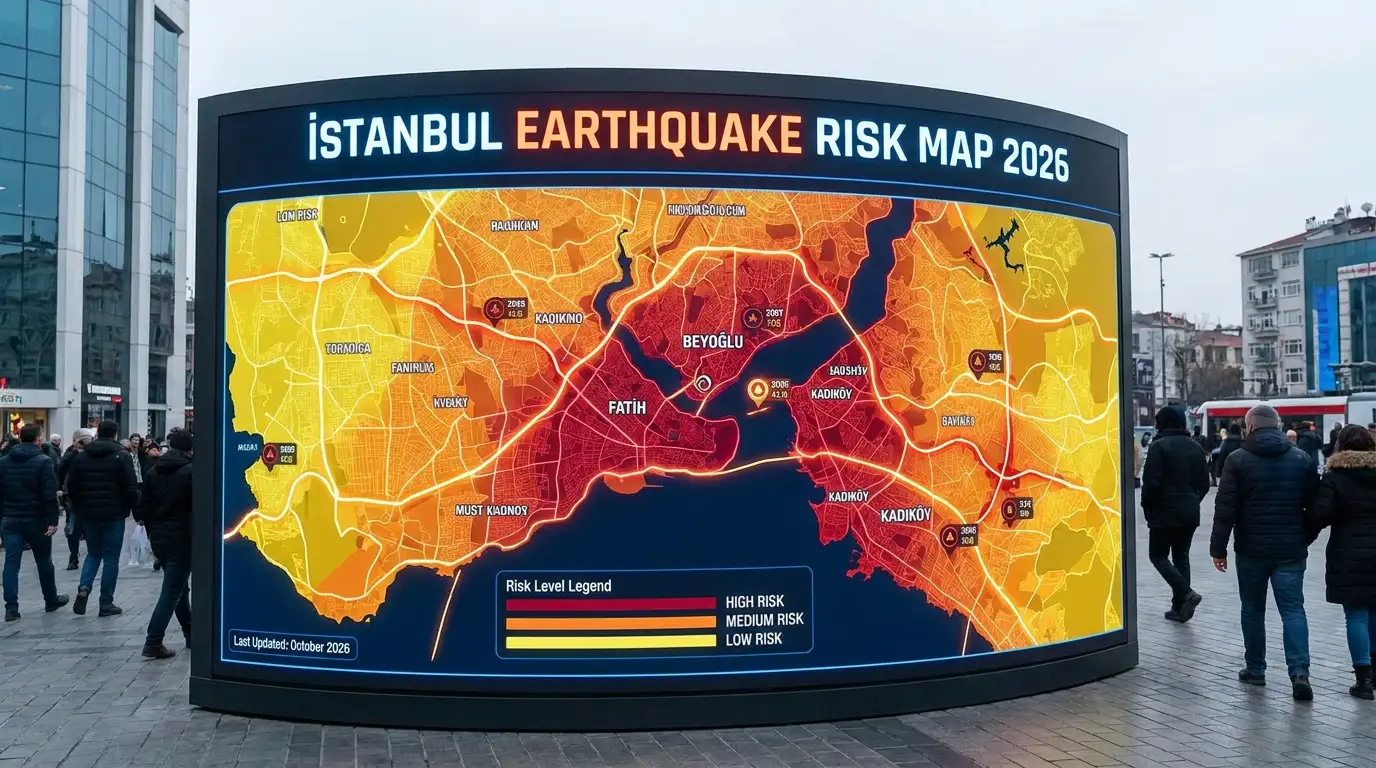
Istanbul Earthquake Risk Map 2026: The Definitive Guide for Property Buyers
Buying property in Istanbul has always involved balancing location, lifestyle, price, rental potential, and long-term appreciation. In 2026, however, serious buyers need to add another factor near the top of that list: earthquake resilience. Istanbul lies within a highly active seismic region influenced by the North Anatolian Fault system, and scientists have spent decades studying the potential for a major Marmara earthquake. That does not mean Istanbul should be treated as one giant danger zone. Quite the opposite: earthquake exposure changes considerably according to geology, soil conditions, building design, construction quality, structural modifications, and even the precise location of a property within the same neighborhood. A simplistic map coloring entire districts red, yellow, or green can therefore be useful as an initial screening tool, but it should never substitute for site-specific engineering analysis.
For property buyers, that distinction is enormously important. Two apartments selling for similar prices only a few kilometers apart can present very different risk profiles. Even two buildings standing across the road from one another may perform differently because one is newer, has an appropriate foundation system, was properly inspected, and has not undergone dangerous alterations, while the other may contain structural vulnerabilities. Likewise, apparently favorable geology cannot rescue a seriously deficient structure. Think of earthquake safety as a chain: regional seismic hazard, local ground conditions, structural engineering, construction quality, maintenance, and regulatory compliance are individual links. Your investment is only as resilient as the weakest one.
This Istanbul earthquake risk map 2026 guide therefore takes a buyer-focused approach rather than pretending that district names alone can predict earthquake performance. We will examine the Marmara fault system, ground conditions, broad district patterns, Turkish seismic codes, urban regeneration, soil reports, occupancy documentation, and investment implications. Most importantly, we will distinguish between relative geological advantage and an unsupported promise that any particular property is “earthquake-proof.” That distinction can protect both your capital and your family.
Understanding Istanbul’s Seismic Profile
Istanbul’s earthquake risk begins with geography, but geography is only the opening chapter. The city sits north of the Marmara Sea, close to an active system of faults associated with the North Anatolian Fault Zone (NAFZ). Turkey’s official disaster-management authorities and scientific institutions have produced seismic hazard and ground-related studies that buyers can use, while Istanbul Metropolitan Municipality has also published district-level earthquake-loss estimation work. These resources are much more meaningful than viral social-media maps that simply label whole neighborhoods “safe” or “dangerous.” An official seismic hazard map tells you something about expected ground shaking; geological and microzonation studies tell you more about local ground behavior; neither one, by itself, certifies the structural safety of the apartment you are considering.
This distinction becomes clearer when you imagine Istanbul as a huge table covered with buildings. During an earthquake, the table does not move identically everywhere. Local geological conditions can change the frequency, duration, and amplification of shaking experienced at the surface. Soft sediments may behave differently from competent rock, while groundwater conditions can create additional problems in susceptible soils. Building characteristics then determine how those movements translate into structural demand. Height, structural system, irregularities, foundation design, materials, workmanship, age, deterioration, and unauthorized alterations can all matter.
For that reason, buyers should resist a tempting shortcut: “Which Istanbul district is completely safe?” There is no district-level label that can guarantee the safety of an individual building. Even comparatively favorable ground does not eliminate seismic hazard, and a newer construction date does not independently prove engineering quality. A sensible 2026 buying strategy uses location as the first filter and building-specific technical due diligence as the decisive filter. If you remember only one principle from this guide, make it this one: buy the building and the ground together, not the postcode alone.
The North Anatolian Fault Line Explained
The North Anatolian Fault is one of the world's major active strike-slip fault systems. It stretches across northern Turkey and has produced a sequence of destructive earthquakes during modern history. In the Marmara region, important fault segments lie beneath the sea to the south of Istanbul. This offshore geometry sometimes creates a misleading psychological effect: because residents cannot physically see the fault, it can feel abstract. For engineers and seismologists, however, the Marmara system is a central component of Istanbul’s seismic hazard and has consequently been the subject of extensive monitoring, modeling, and preparedness planning.
For a property investor, the important concept is not simply “distance from the fault.” Earthquake damage does not spread outward in perfectly uniform circles like ripples in a swimming pool. Rupture characteristics, earthquake magnitude, depth, directionality, local geology, basin effects, and structural response influence what happens at a particular location. A neighborhood farther from a fault segment can still experience severe shaking, while local ground characteristics can amplify motion. Conversely, relatively stronger geological conditions may reduce certain site effects, although they never make a building immune to earthquake forces.
This is also why predictions about the exact date of Istanbul’s next major earthquake should be treated skeptically. Seismic hazard can be estimated probabilistically, but an exact future earthquake date, hour, and magnitude cannot currently be forecast in the way weather is forecast. For buyers, probabilities are less useful than preparation. You cannot negotiate with a fault, but you can choose a better site, demand technical documentation, commission independent structural advice, check the legal status of the building, and avoid purchasing purely because a glossy development brochure uses phrases such as “earthquake resistant.”
The practical lesson is straightforward. Use authoritative resources such as AFAD’s Türkiye Earthquake Hazard Map, municipal geological or microzonation information where available, and qualified engineering assessment. Then investigate the parcel and building. A map should start your questions rather than end them.
Why Soil Quality Matters More Than Distance
Soil is where Istanbul’s complicated seismic story becomes intensely local. Buyers often assume that moving another five or ten kilometers away from the Marmara coastline automatically makes a property safer. Distance can influence shaking exposure, but local ground conditions can materially alter seismic response, so distance alone is an inadequate purchasing criterion. Deep or soft sedimentary deposits can amplify certain earthquake motions compared with competent rock. Areas containing loose, saturated granular soils may also be susceptible to liquefaction, although actual liquefaction potential must be determined through site-specific geotechnical investigation rather than assumptions based simply on proximity to water.
Liquefaction sounds technical, but the basic idea is surprisingly intuitive. Certain loose, water-saturated soils can temporarily lose a significant amount of strength when intense earthquake shaking increases pore-water pressure. Imagine vigorously shaking a container containing wet sand: its behavior can change dramatically even though the grains themselves have not disappeared. In an urban environment, susceptible ground can contribute to settlement, lateral spreading, foundation movement, or other forms of deformation. Engineers address these hazards through investigation and appropriate design measures, which may include ground improvement, suitable foundation systems, piles where engineering calculations require them, or other site-specific solutions.
This is where sweeping claims such as “a building 20 kilometers from the fault on sand is always riskier than one 10 kilometers away on rock” become problematic. The principle behind the comparison is useful—ground conditions matter enormously—but real seismic risk cannot be ranked from those two variables alone. The building on rock could be structurally deficient; the building on softer ground could have been engineered specifically for its site conditions. Earthquake engineering is a system, not a single-variable equation.
When inspecting an Istanbul property in 2026, therefore, ask what lies underneath it. Request the zemin etüdü, identify the foundation type, understand whether groundwater or liquefaction was considered, and have technical documents interpreted by an independent geotechnical or structural professional. A sea view tells you what is outside the window. A soil investigation tells you something much more important about what is underneath your investment.

2026 District-by-District Risk Breakdown
A district-by-district Istanbul earthquake map is useful only when we acknowledge its limitations. Istanbul’s 39 districts cover enormous and geologically diverse areas. Some stretch from coastal zones into substantially different inland terrain, while others contain filled ground, valleys, slopes, sedimentary basins, and stronger formations within the same administrative boundary. Consequently, describing an entire district as uniformly “red,” “yellow,” or “green” would create false precision. The categories below should be understood as buyer-oriented screening categories, not official engineering classifications or guarantees of expected damage.
The official starting points should be AFAD hazard information and Istanbul Metropolitan Municipality studies, including available microzonation and district earthquake-loss estimation resources. A buyer can then narrow the investigation to the neighborhood, parcel, and ultimately the building itself. This sequence matters because maps operate at different scales. A national hazard map is designed for one purpose; a municipal ground study serves another; a site investigation used by an engineer designing a particular foundation operates at a much finer resolution.
For property investors, a useful way to think about Istanbul is therefore through three broad filters. First are coastal, reclaimed, alluvial, or otherwise potentially challenging ground environments where site effects deserve heightened scrutiny. Second are heterogeneous urban districts where geological conditions can change significantly and building stock becomes especially important. Third are northern or inland locations that may include comparatively competent ground in many places, but which still remain inside an earthquake-prone metropolitan region. None deserves a literal green light.
The following breakdown deliberately uses “higher scrutiny,” “mixed,” and “lower relative geological concern” thinking behind the familiar colors. It is more cumbersome than a viral map, but property worth hundreds of thousands—or millions—of dollars deserves more than a traffic-light shortcut.
🔴 The Red Zone (High Risk): Coastal & Alluvial Districts
When buyers discuss Istanbul’s higher-concern areas, Avcılar frequently enters the conversation, partly because of its experience during the 1999 İzmit earthquake despite being far from the epicentral area. Parts of Istanbul’s southern and western coastal belt contain softer sediments or other conditions that warrant careful investigation. Depending on the exact parcel and local geology, buyers may also pay heightened attention to portions of Küçükçekmece, Bakırköy, Zeytinburnu, Büyükçekmece, Beylikdüzü, Tuzla, and other coastal or low-lying areas. But calling every square meter of these districts “high risk” would be scientifically irresponsible. Administrative boundaries and geological boundaries simply do not line up that neatly.
The correct investor response is therefore not “never buy near the coast.” It is raise the due-diligence threshold. If a project occupies potentially challenging ground, ask how engineers characterized the site and designed for it. Was liquefaction susceptibility assessed where relevant? What does the geotechnical investigation show? What foundation solution was selected, and why? If piles were used, what engineering problem were they designed to solve? Was ground improvement required? These questions turn a vague fear about coastal property into a technical investigation with documents and professional accountability.
Building quality can radically change the investment equation. A carefully engineered modern development designed according to contemporary requirements on a challenging site may represent a more rational purchase than a poorly maintained older structure sitting on apparently better ground. The reverse can also be true. This is why buyers should never infer structural performance simply from the prestige of the developer, apartment price, exterior finish, or neighborhood.
Coastal Istanbul offers genuine advantages—transport links, established neighborhoods, views, amenities, and often deep rental markets. Those benefits do not disappear because seismic hazard exists. But if you are paying a premium for the Bosphorus or Marmara lifestyle, spend a fraction of the acquisition budget on independent technical review. Marble lobbies can be replaced. Foundations cannot.
🟡 The Yellow Zone (Moderate Risk): Inland & Mixed-Soil Areas
Central districts present a different challenge: variability. Areas such as Şişli, Beşiktaş, Kadıköy, Üsküdar and Ataşehir contain extremely desirable residential and commercial markets, but it would be misleading to assign each one a single soil-risk label. Topography and geology can change across relatively short distances, and building stock ranges from aging apartment blocks to sophisticated new developments. That combination means investors need to look below the district name. In these markets, the address may create the rent, but the individual building increasingly determines whether safety-conscious tenants and future buyers will accept the asset.
Consider Şişli. It is one of Istanbul’s most established urban centers, encompassing neighborhoods with very different construction eras and property types. A buyer might encounter an older apartment building that has undergone decades of alterations only streets away from a modern engineered development. Beşiktaş is similarly diverse, and coastal versus elevated sections should not be treated as geotechnically identical. Kadıköy has seen substantial urban regeneration in neighborhoods such as Fikirtepe and elsewhere, while its broad administrative area includes varied building ages and ground conditions. Ataşehir, known for modern residential towers and Istanbul’s financial ecosystem, also demands project-specific assessment rather than automatic confidence based on architectural modernity.
In these mixed urban markets, structural due diligence becomes a competitive investment skill. Buyers should examine construction dates, permits, occupancy status, structural plans where obtainable, known modifications, visible deterioration, and professional assessments. Ground-floor commercial units deserve particular attention because historic removal or alteration of structural components can be consequential. A beautifully renovated apartment tells you almost nothing about the reinforced-concrete frame behind the paint.
These districts can still be compelling for investors because employment, transport, education, entertainment, and established tenant demand support liquidity. The objective is not to eliminate seismic exposure—an unrealistic goal in Istanbul—but to avoid accepting unknown structural risk merely to secure a fashionable postcode.
🟢 The Green Zone (Lower Relative Risk): The Northern Rock Bed
Northern Istanbul is often presented online as the city’s “safe zone.” That description needs qualification. Parts of northern and inland Istanbul include relatively competent geological formations and may avoid some of the soft-soil issues associated with particular coastal or basin environments. Districts commonly considered by safety-conscious buyers include parts of Sarıyer, Beykoz, Başakşehir and Eyüpsultan, among others. Yet none should be described as universally low-risk without examining the precise location. These districts are geographically large, local conditions vary, and slope stability, fill, construction quality, and site-specific geology can introduce risks that a district-level color cannot capture.
What northern locations can offer is another layer of risk management. If a buyer combines comparatively favorable ground with a modern structure designed under contemporary seismic requirements, professionally documented construction, suitable foundations, and good maintenance, the overall proposition may be attractive. Families choosing newer master-planned communities often value this combination alongside green space, parking, schools, security, and larger apartments. Başakşehir, for example, has a substantial supply of comparatively recent residential development. Sarıyer and Beykoz, meanwhile, serve very different premium segments and contain everything from established neighborhoods to luxury housing.
There is also an investment trade-off. Moving north for geological reasons can mean sacrificing proximity to some traditional employment and entertainment centers, although Istanbul’s evolving transport infrastructure changes that calculation continually. Luxury buyers may value privacy and perceived resilience, while tenants who commute daily may prioritize metro access and centrality. The best geological choice is not automatically the best ROI choice.
Most importantly, green must never mean guaranteed. An inadequately engineered building on favorable rock remains an inadequately engineered building. Treat comparatively stronger ground as an advantage, not a substitute for structural verification. In earthquake-aware real estate, the winning combination is good ground and good engineering, not one or the other.
Building Age and the Turkish Seismic Codes
After location and geology, building age is one of the fastest filters available to an Istanbul buyer—but it needs careful interpretation. Turkey’s regulatory framework has evolved substantially following major earthquakes and advances in engineering knowledge. The devastating 17 August 1999 İzmit earthquake became a profound turning point in public awareness, enforcement discussions, construction practice, and the country’s approach to seismic resilience. However, “built after 1999” is not itself an engineering certificate. Regulations, design quality, inspection, workmanship, materials, structural configuration, and subsequent alterations all influence performance.
A property investor should think of construction year as a clue. Older buildings may have been designed under earlier standards, may contain material degradation, or may predate improvements in regulation and oversight. Some, however, may have been competently designed, strengthened, or comprehensively assessed. Conversely, a recently completed building can still contain defects. The date on the brochure cannot tell you whether concrete was placed correctly, reinforcement matches approved plans, or unauthorized changes occurred later.
The most valuable question is therefore not “Is it new?” but “What evidence demonstrates how it was designed and built?” Documentation may include permits, approved architectural and structural projects, geotechnical reports, construction-supervision records where applicable, occupancy permission, and technical assessments. Buyers considering high-value assets should engage an independent engineer who represents their interests rather than relying exclusively on statements made by the seller or sales office.
This approach also changes negotiations. If two comparable apartments compete for your capital and one offers transparent engineering documentation while the other relies on verbal reassurance, that difference has economic value. In Istanbul’s increasingly earthquake-aware property market, transparency itself can become part of an asset’s quality.
Pre-1999 vs. Post-2018 Construction Standards
Turkey’s seismic-regulation history cannot accurately be reduced to only two dates, but 1999, 2007, and 2018 are useful milestones for buyers to understand. Regulations existed before 1999, including the 1998 earthquake regulation, so it would be wrong to imply that pre-1999 Turkey had no seismic design requirements. The 1999 disaster nevertheless transformed national attention toward construction quality, inspection, and earthquake preparedness. Later regulatory developments strengthened the framework, while the 2007 Turkish Earthquake Code became an important benchmark for seismic design and assessment.
The next major milestone was the 2018 Turkish Building Earthquake Code (Türkiye Bina Deprem Yönetmeliği), which entered into force on 1 January 2019. That date matters. Properties are frequently marketed as “post-2018 code,” but buyers should understand that the regulation was published in 2018 and became effective in 2019. It introduced a modern framework incorporating updated seismic hazard information and detailed requirements for structural design and evaluation. Calling it a “gold standard” may sound attractive in marketing copy, but a more accurate statement is that it represents Turkey’s current modern seismic design framework and reflects contemporary earthquake-engineering approaches.
Does that mean every building constructed since 2019 is safe? No. A code establishes requirements; actual performance depends on implementation. Design, construction supervision, material quality, workmanship, site conditions, structural configuration, maintenance, and later interventions remain relevant. Similarly, age alone cannot establish that an older building is unsafe. Only appropriate technical evaluation can determine an existing structure’s condition with meaningful confidence.
As an investor, use these dates as filters rather than verdicts. Newer buildings designed under current requirements may offer meaningful advantages, but request evidence. When purchasing an older property, especially one from a significantly earlier construction era, budget for professional structural due diligence instead of assuming an attractive renovation has solved the underlying questions.
The Role of Kentsel Dönüşüm (Urban Regeneration)
Kentsel dönüşüm, or urban transformation/regeneration, has become one of the most important forces reshaping Istanbul’s housing stock. In earthquake-risk discussions, the term often refers to replacing or transforming vulnerable older structures under Turkey’s urban-transformation framework, including processes associated with Law No. 6306. For investors, this creates an interesting intersection between safety, scarcity, and location. Established central neighborhoods frequently possess excellent transportation, schools, retail, and cultural infrastructure but also contain aging buildings. Replacing an older structure with a properly engineered contemporary building can therefore combine mature-location economics with modern construction.
That does not mean every regeneration project is automatically an exceptional investment or automatically safe. Investors still need to examine the developer, approved project, soil investigation, structural design, legal status, construction supervision, title arrangements, completion risk, and occupancy documentation. Regeneration can also create complex ownership and contractual situations, particularly during redevelopment. Buying a completed unit with clean documentation is a very different risk proposition from purchasing into a project whose legal, financing, or construction process remains unresolved.
From an ROI perspective, successful regeneration can be powerful. A new apartment in an established neighborhood may compete against older surrounding inventory with inferior parking, insulation, layouts, common facilities, and perceived seismic resilience. That differentiation can support resale demand and rental desirability. Yet investors should avoid assuming that “new” automatically justifies any price premium. Calculate the premium relative to comparable properties and ask how much of it is supported by location, usable area, construction quality, amenities, transport, and documented resilience.
Think of urban regeneration as a bridge between Istanbul’s past and its future. The opportunity is real, but the strongest investments are projects where engineering improvement and financial logic meet.
The Investor’s Due Diligence Checklist
Earthquake-aware purchasing becomes practical when you turn abstract risk into documents, inspections, and professional opinions. Before transferring a substantial deposit, buyers should build a due-diligence file covering both the land and the structure. At minimum, investigate title status, municipal records, construction and occupancy permissions, geotechnical documentation, approved project information, building age, structural history, and known modifications. For an expensive property—or an older building—an independent structural engineer should be part of the process. The engineer works for you, not for the developer, broker, or seller.
The distinction between legal due diligence and technical due diligence is important. A property can have a valid title yet still raise structural concerns. Conversely, a technically impressive apartment can present title, zoning, condominium, encumbrance, or occupancy issues. Foreign buyers should be especially careful because unfamiliar terminology can make a clean-looking sales package seem more comprehensive than it actually is. A translated brochure is not a substitute for checking government and municipal records.
Your review should also look for changes made after construction. Has a ground-floor shop expanded openings? Have walls or structural elements been removed? Has the building suffered previous damage? Are there obvious signs of corrosion, persistent water intrusion, foundation settlement, or poorly executed additions? None of these observations alone necessarily proves a building is dangerous, but they can tell an engineer where to investigate.
Finally, avoid asking sellers binary questions such as “Is this earthquake-proof?” Buildings are generally designed for defined performance objectives under specified seismic actions; “earthquake-proof” is not a responsible blanket guarantee. Ask for evidence instead. Evidence travels with the asset, can be reviewed by experts, and is far more valuable when you eventually become the seller.
Verifying the Zemin Etüdü (Soil Investigation Report)
The zemin etüdü, broadly understood as the site or geotechnical investigation, is one of the most valuable documents in earthquake-conscious property selection. Before engineers can design an appropriate foundation and structural system, they need to understand the ground supporting the building. Depending on the project and applicable requirements, investigation can involve boreholes, field testing, laboratory testing, groundwater observations, geological interpretation, and geotechnical calculations. The resulting information helps engineers evaluate parameters relevant to foundation design and seismic behavior.
As a buyer, you do not need to become a geotechnical engineer overnight. You do, however, need to know what questions to ask. Does the report correspond to the actual parcel and development? What soil or rock units were encountered? Was groundwater identified? Were liquefaction-related considerations assessed where applicable? What foundation recommendations were made? Did the final project follow those recommendations? If the building uses a raft foundation, piles, ground improvement, or a combined system, what engineering conditions drove that decision?
Be particularly wary of marketing shorthand. Piled foundations are not automatically “safer” than every shallow foundation. Engineers select foundation systems according to loads, soil conditions, settlement requirements, seismic considerations, groundwater, neighboring structures, and other factors. A well-designed raft foundation on suitable ground can be entirely appropriate, while piles installed without adequate design or quality control do not magically solve every geotechnical problem.
For a serious acquisition, give the soil report and relevant structural documentation to an independent professional. A competent engineer can identify whether the investigation appears appropriate for the site and whether the foundation concept makes sense in context. That review may feel like another transaction cost, but compared with the price of Istanbul property, it is closer to buying a detailed medical examination before committing to a marathon.
Checking the İskan (Occupancy Permit)
The Yapı Kullanma İzin Belgesi, commonly called the iskan, is another key document for Turkish property buyers. Broadly speaking, it is an occupancy/use permit issued through the relevant authority after the building process and indicates that the structure can legally be used in accordance with applicable approvals and procedures. Buyers should verify its existence and scope rather than relying on a salesperson saying, “The project has iskan.” Ask to see the document and have your lawyer confirm how it relates to the specific building and unit.
There is, however, an important misconception to avoid: an iskan should not be treated as a standalone certificate guaranteeing future earthquake performance. Regulatory approval and inspection are meaningful, but seismic safety depends on engineering realities that cannot be reduced to one administrative document. The occupancy permit should sit inside a larger evidence package that includes the construction permit, approved plans, soil investigation, structural information, supervision records where relevant, and an examination of the existing condition.
Buyers should also examine the title structure. Terms such as kat irtifakı and kat mülkiyeti frequently arise in Turkish property transactions and can affect how ownership is recorded. The relationship among title status, project completion, occupancy permission, and municipal records can become technical, so qualified Turkish legal counsel is valuable—particularly for foreign investors. Do not let an agent translate complex legal status into a casual “everything is fine.”
The strongest transaction is one where legal and technical evidence reinforce each other. You want a property that exists correctly on paper and makes engineering sense in the real world. When both sides align, the asset becomes easier to finance, insure, rent, hold, and eventually resell.
How Earthquake Risk Impacts Real Estate ROI in 2026
Earthquake resilience is increasingly more than a safety consideration; it can influence the economics of Istanbul property. Buyers and tenants who have experienced recent Turkish earthquakes or followed their consequences often ask questions that were once secondary: When was the building constructed? Which regulation applied? Has it been assessed? What is the ground like? Is there an occupancy permit? These questions can influence which apartments make a shortlist, especially among families, professionals, international tenants, and purchasers planning a long holding period.
From an investment perspective, this creates what might be called a resilience premium. A well-located modern building with credible documentation can potentially differentiate itself from older competing stock. That does not guarantee higher returns, because rent and resale prices remain driven by employment access, transportation, neighborhood prestige, apartment size, views, amenities, interest rates, housing supply, inflation, and broader economic conditions. But when two otherwise similar apartments compete, documented modern construction may influence tenant and buyer preference.
Risk can affect expenses as well as income. Turkey has compulsory earthquake insurance known as DASK for covered residential properties, while owners may choose broader insurance protection depending on their needs. Investors should understand coverage limits, exclusions, rebuilding costs, common-area considerations, and any additional policies rather than assuming compulsory insurance eliminates financial exposure. Likewise, an older building may face future strengthening or redevelopment decisions that create costs, delays, disputes, or temporary loss of rental income.
ROI calculations should therefore include resilience as part of asset quality. Instead of asking only, “What rent can I achieve this year?” ask, “How competitive will this building look to a cautious buyer ten years from now?” In a seismic city, future marketability and structural confidence are connected.
The “Safety Premium” in Tenant Demand
The phrase “safety premium” describes a plausible market preference rather than a fixed percentage that applies across Istanbul. Claims that compliant buildings automatically command dramatically higher rents or experience “near-zero vacancy” should be treated cautiously unless supported by property-specific market evidence. Tenants rarely make decisions based on one variable. A new earthquake-conscious building that is badly located, overpriced, or poorly connected can still sit empty. Meanwhile, an older apartment in an exceptional neighborhood may maintain substantial demand despite concerns about its age.
Still, safety awareness can change the filtering process. A corporate tenant relocating employees may prefer professionally managed modern developments. Families may prioritize recent construction and documentation after considering schools and commute times. Wealthier local tenants may willingly pay more for a development that combines parking, security, modern systems, amenities, and perceived structural resilience. Foreign tenants unfamiliar with Istanbul may also favor recognizable newer projects because they simplify decision-making. In all these cases, building age and earthquake-related confidence become part of a larger premium package.
For landlords, this suggests a smarter marketing strategy: sell evidence, not fear. Instead of making unsupported claims such as “100% earthquake-proof,” provide the construction year, relevant permits, professionally verified information, foundation and project documentation where appropriate, and clear building-management records. Transparency can distinguish a property without exploiting anxiety.
Investors should test the premium before purchasing. Compare asking and achieved rents where data are available for modern versus older buildings in the same micro-location. Calculate the gross yield after dues, taxes, maintenance, management, vacancy assumptions, and acquisition costs. If you are paying 30% more for newer stock but can obtain only a small rental premium, resilience may still justify the purchase personally—but the financial rationale should be understood rather than assumed.
Strategic Investment Takeaways
A sensible Istanbul property investment strategy in 2026 does not require choosing between safety and returns as though they are opposing goals. Instead, build a hierarchy of filters. Begin with macro-location: employment centers, transport, tenant demographics, supply pipeline, neighborhood quality, and long-term demand. Next examine local geology and available hazard or microzonation information. Then investigate the building’s age, regulatory context, structural system, foundation, documentation, condition, and history. Finally, price all of those factors into the acquisition rather than paying purely for branding or postcode prestige.
For conservative buyers, parts of northern and inland Istanbul may deserve attention where local geological conditions are comparatively favorable and newer housing supply is available. Başakşehir can fit certain family-oriented or long-horizon strategies, although every parcel and project still requires verification. Sarıyer or Beykoz can appeal to higher-budget buyers seeking lower-density lifestyles, but entry prices and rental-yield mathematics differ substantially. Investors focused on centrality may instead consider newer, well-documented projects in Ataşehir, Şişli, Kadıköy, Beşiktaş, or other established employment and lifestyle hubs, provided both ground and building characteristics survive technical scrutiny.
The key phrase is “well documented.” “Post-2018” should not become a magical investment label. Remember that the 2018 Turkish Building Earthquake Code entered into force in 2019, and compliance must be implemented through actual design and construction. A professional should verify what can reasonably be verified.
Perhaps the best investment rule is also the simplest: never buy an Istanbul apartment solely because someone tells you its district is safe. Buy because independent evidence shows that the location, site, building, legal status, price, and expected income collectively make sense. Seismic resilience should strengthen the investment thesis, not replace one.
Conclusion
The Istanbul earthquake risk map for 2026 is best understood not as a static red-yellow-green picture, but as a layered decision-making framework. Istanbul faces genuine seismic hazard associated with the North Anatolian Fault system and the Marmara region. Yet that hazard does not translate into identical risk for every property. Local geology affects ground motion; susceptible soils can create additional geotechnical problems; structural engineering determines how buildings respond; construction quality determines whether the design becomes reality; and maintenance or later modifications can alter the equation again.
For buyers, that complexity is actually useful because many components can be investigated before purchase. Start with official hazard information from authorities such as AFAD and relevant Istanbul Metropolitan Municipality resources. Investigate neighborhood and parcel-level ground conditions rather than relying on district reputation. Request the zemin etüdü and understand its conclusions. Verify the iskan and other legal documentation. Establish which seismic regulations applied to the building and when it was designed. For significant investments, commission independent legal and engineering professionals who owe their duty to you.
Be equally skeptical of extremes. “Never buy on Istanbul’s coast” is too simplistic, while “this northern district is completely earthquake-safe” is equally misleading. Likewise, an old construction date does not automatically prove failure, and a shiny new tower does not automatically prove flawless engineering. Earthquake resilience comes from multiple layers working together.
For an investor, the strongest property is therefore not necessarily the one sitting farthest from the Marmara Sea. It is the property where good location, appropriate site conditions, competent engineering, verified documentation, sensible pricing, and durable tenant demand overlap. Find that intersection, and earthquake due diligence stops being merely defensive. It becomes part of buying a higher-quality asset.
Recommended Guides for Property Buyers
If earthquake safety is one of your priorities when buying property in Istanbul, these additional guides can help you make a more informed decision.
Read our detailed guide on buying earthquake-resistant apartments in Istanbul to understand what to check in the building structure, foundation, construction standards, and technical documentation before investing.
You should also review our guide to DASK earthquake insurance in Turkey to understand compulsory earthquake insurance, what it covers, its limitations, and what property owners should know before purchasing a home.






Have Question Or Suggestion ?
Please Share Your Thought, To Make It Real