Turkey Real Estate vs Gold vs Bitcoin: Which Investment Wins in 2026?
Compare Turkey real estate, gold, and Bitcoin across returns, inflation protection, risk, liquidity, and income to find the smarter investment in 2026.
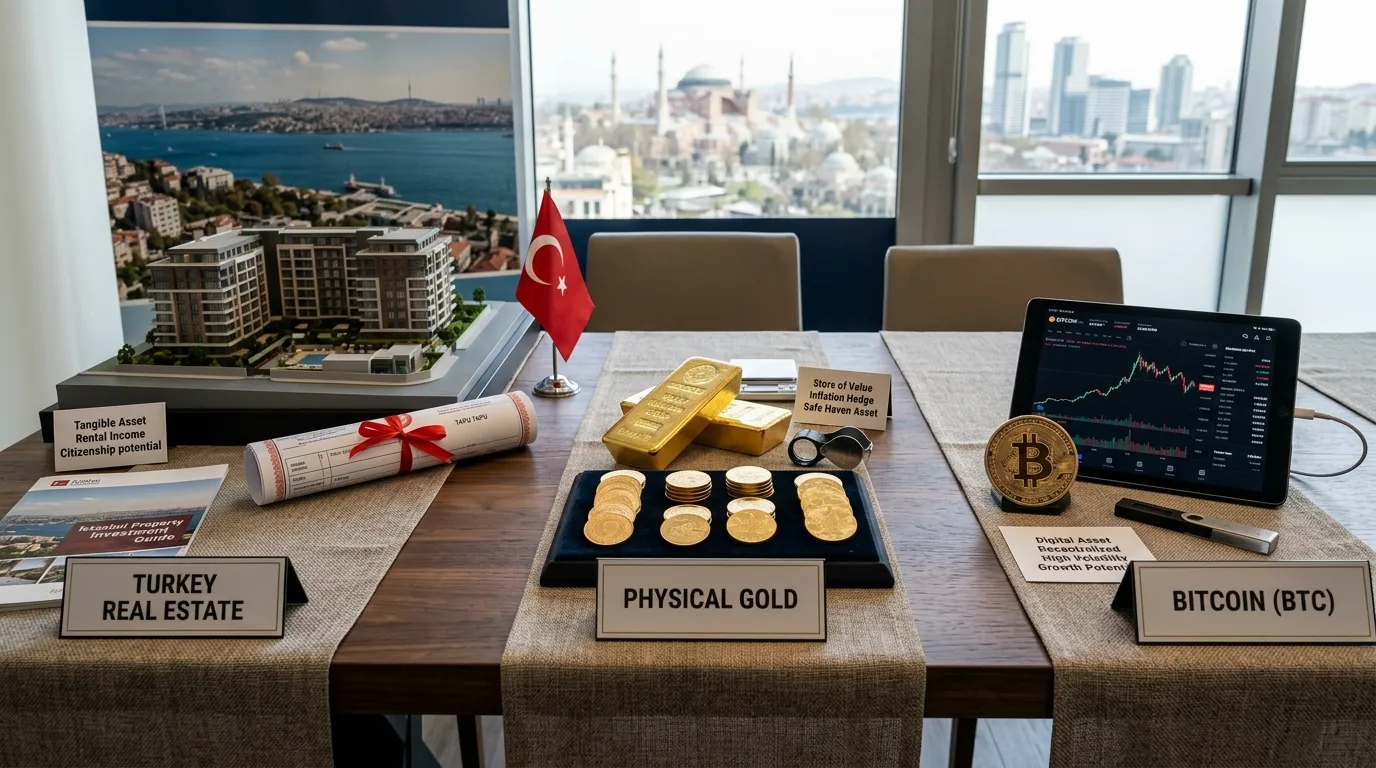
Turkey Real Estate vs Gold vs Bitcoin: Which Investment Makes More Sense?
Choosing between Turkey real estate, gold, and Bitcoin looks simple until you try to compare them properly. One is a physical asset that can provide shelter and rental income, another has served as a store of wealth for centuries, and the third is a digitally scarce asset capable of moving more in a week than property sometimes moves in a year. For investors dealing with Turkish lira inflation, currency depreciation, changing interest rates, and geopolitical uncertainty, the comparison becomes even more important. Looking only at which asset rose the most recently can produce exactly the wrong decision because the three investments solve different problems.
The central question is therefore not simply, “Which one gives the highest return?” A more useful question is: which asset gives the best combination of return, inflation protection, liquidity, income, risk, and practical usefulness for your circumstances? Turkish property can produce rent and provide a real-world utility that neither a gold bar nor a Bitcoin wallet can match. Gold, meanwhile, can be bought and sold relatively easily and has deep cultural roots in Turkey. Bitcoin brings global portability and mathematically limited supply, but it also introduces extreme price volatility, custody risks, and regulatory uncertainty that conservative investors may find difficult to tolerate.
There is another complication: measuring returns in Turkish lira can be deceptive. Imagine that an investment doubles in TRY while the lira loses a substantial amount of purchasing power against major currencies and domestic prices rise sharply. The nominal return looks spectacular, yet the investor's improvement in real purchasing power may be much smaller. Anyone making a Turkey real estate vs gold vs Bitcoin comparison should therefore consider nominal TRY returns, inflation-adjusted returns, foreign-currency performance, costs, and cash flow rather than relying on a single headline percentage.
This guide approaches the comparison from that wider perspective. Rather than declaring one universal winner, we'll examine what each investment actually does well, where it can fail, and why a portfolio combining assets may sometimes make more sense than betting everything on one horse. Historical performance is useful evidence, but it is not a promise about tomorrow. The best investment ultimately depends on your time horizon, need for liquidity, risk tolerance, cash-flow requirements, currency exposure, and ability to manage the asset.
Why Turkish Investors Keep Comparing Property, Gold, and Bitcoin
Turkey creates an unusually interesting environment for this comparison because inflation, currency movements, household saving habits, and a strong property culture all collide in the same marketplace. When cash loses purchasing power rapidly, simply leaving money idle can feel like watching an ice cube melt on a summer pavement. Investors naturally search for assets whose prices can adjust upward as the currency weakens. Historically, Turkish households have often turned toward property, foreign currency, and gold for precisely this reason, while cryptocurrency has added a newer and far more volatile option to the menu.
Gold occupies a special place in Turkish financial culture. It is not merely an investment product sitting on a brokerage screen. Gold has traditionally appeared in weddings, family savings, gifts, and household wealth. That familiarity matters because investment decisions are rarely driven by spreadsheets alone. People tend to trust assets they understand and have seen previous generations own. When uncertainty rises, the psychological comfort of a globally recognized precious metal can be almost as important to some savers as its historical price performance.
Property has a similarly powerful appeal, but for different reasons. An apartment in Istanbul, Ankara, Antalya, Izmir, or another Turkish market can be seen, rented, renovated, occupied, inherited, or sold. It feels concrete. During inflationary periods, both property values and rents may adjust, although not necessarily at the same speed as inflation and certainly not uniformly across locations. A badly chosen property can stagnate even while national averages rise, while a scarce apartment in a highly desirable neighborhood may behave very differently.
Then Bitcoin enters the room and changes the conversation. It has no tenant, no roof, and no jewelry value, yet it can be transferred globally and has a protocol-defined maximum supply of 21 million bitcoin. That scarcity narrative naturally attracts investors worried about fiat-currency debasement. The trade-off is brutal volatility. This is why Turkey real estate vs gold vs Bitcoin remains such a compelling comparison: all three can be used as alternatives to holding depreciating cash, but the route each takes—and the risks you accept along the way—could hardly be more different.
Understanding the Three Investment Choices
Before comparing returns, it helps to recognize that these assets belong to fundamentally different categories. Real estate is productive in the sense that it can generate rental income and provide usable space. Gold is primarily a monetary commodity and store of value. Bitcoin is a digitally scarce network asset. Comparing them solely through price charts is like comparing a rental business, an insurance policy, and a technology-based monetary asset using only their resale prices. The numbers matter, but they don't tell the entire story.
Real estate is local. The value of an apartment can depend on the street, building age, earthquake resilience, transportation links, tenant profile, title status, floor, view, maintenance, and dozens of other variables. Two homes separated by a few kilometers can deliver dramatically different results. Investors also have leverage available through mortgages, meaning property returns can be amplified when borrowed money is involved. Of course, leverage works in both directions and can transform an ordinary decline into a serious financial problem.
Gold is much more standardized. An ounce of investment-grade gold in Turkey derives much of its underlying value from a global market, although the TRY price also reflects the lira's exchange rate. That makes gold particularly interesting for someone whose expenses and income are denominated in Turkish lira. A weaker lira can push local gold prices upward even during periods when gold's dollar price is relatively calm. Investors should still distinguish between bullion, coins, jewelry, exchange-traded products, and bank-based gold accounts because fees and spreads differ.
Bitcoin is even more global in pricing but much younger as an asset. It trades continuously, has no central issuer, and can be self-custodied. Those characteristics create both freedom and responsibility. Lose control of your private keys without a backup and there may be no institution capable of reversing the mistake. Keep Bitcoin with an intermediary and you introduce counterparty risk. So before asking which asset “wins,” investors should understand that they are choosing not just a return profile but an entirely different ownership experience.
Turkey Real Estate as a Tangible, Income-Producing Asset
The strongest argument for Turkish real estate investment is that a well-selected property can potentially deliver two sources of return: capital appreciation and rental income. If an apartment rises from TRY 5 million to TRY 6 million, the owner has a TRY 1 million unrealized capital gain. If the property also generates rent throughout the year, the total economic return is higher. That dual engine distinguishes property from gold and Bitcoin, neither of which naturally sends the owner a monthly cash payment merely for holding it.
Yet property returns are routinely overstated because people remember purchase and sale prices while forgetting everything that happened between them. Acquisition costs, taxes, agent commissions, maintenance, insurance, renovations, periods without a tenant, building fees, and financing costs can eat into returns. A gross rental yield that looks attractive on a listing can become much less impressive after real expenses are included. Investors should therefore calculate net rental yield, not just gross rent divided by purchase price.
Location selection is equally important. “Turkish property” is not one homogeneous asset any more than “European stocks” represent one company. Istanbul's districts can have different demand drivers from Antalya's tourism-oriented areas, while university cities, industrial regions, coastal markets, and Ankara's government-centered economy may respond differently to economic conditions. Earthquake risk and building standards also deserve serious attention in Turkey. A cheaper building is not automatically a better investment when structural quality, insurance, future repair obligations, and marketability are considered.
Real estate does have one advantage that is difficult to express on a price chart: utility. You can live in the property. A family buying a primary residence may effectively hedge part of its future housing costs while gaining security of tenure. That is economically different from buying an investment apartment, however, and buyers should avoid mixing lifestyle value with investment return when comparing alternatives. Property can be an excellent wealth-building tool, but it rewards careful selection and active management rather than blind faith that “houses always go up.”
Gold as Turkey’s Traditional Store of Value
Gold's greatest strength is not that it always rises. It doesn't. Its strength is that it has survived countless monetary systems, political regimes, banking crises, and technological changes while remaining globally recognizable as an asset. For Turkish savers, that history combines with an additional currency effect: the TRY price of gold is influenced by both the international gold price and the lira's value against currencies such as the US dollar. Consequently, local gold can appreciate sharply when the lira weakens even if global bullion prices are moving less dramatically.
That characteristic makes gold feel like a financial life jacket during periods of currency stress. It is relatively liquid, widely understood, divisible, and available through multiple channels. Investors can hold physical bars and coins, use certain bank products, or gain exposure through market instruments where available and suitable. Each method carries different costs and risks. Physical gold avoids some intermediary exposure but creates storage and theft concerns; financial products can be convenient but introduce institutional, fee, or tracking considerations.
Gold also has weaknesses that enthusiastic buyers sometimes overlook. A bar of gold produces no rent, dividend, or interest. Your return depends largely on someone eventually valuing the metal at a higher price in the currency that matters to you. During long periods of stable currencies, positive real interest rates, or strong risk appetite, gold can underperform productive assets. Jewelry is an even more complicated investment because craftsmanship and retail markups may not be recovered when the item is sold.
Still, gold's role does not need to be “highest-return asset” to be useful. Think of it more like a shock absorber than a turbocharger. In a diversified portfolio, an asset that behaves differently from property or speculative markets can have value even if it isn't always leading the performance table. For Turkish investors especially, gold combines global pricing, cultural familiarity, and comparatively easy liquidity. That explains why Bitcoin's arrival did not simply make gold obsolete; the two assets may appeal to some of the same fears, but their risk profiles remain worlds apart.
Bitcoin as a Digital, High-Volatility Alternative
Bitcoin's investment case begins with scarcity. The network's issuance rules ultimately cap supply at 21 million BTC, and its decentralized architecture allows ownership without relying on a traditional central issuer. Supporters often describe it as “digital gold,” arguing that a scarce, portable asset could preserve value in an increasingly digital economy. For investors in countries that have experienced significant currency depreciation, the possibility of holding an asset traded globally rather than exclusively within a domestic monetary system can be particularly appealing.
But the phrase “digital gold” can hide an enormous difference: Bitcoin has historically been much more volatile than gold. Its price has experienced repeated boom-and-bust cycles, including drawdowns that would be psychologically and financially intolerable for many conservative investors. An investor who can calmly hold gold through a 10% decline may discover that a 50% or greater Bitcoin drawdown feels completely different. High historical upside does not cancel this risk; it is inseparable from it.
Bitcoin also introduces operational risks unfamiliar to traditional property owners. Investors need to understand wallets, private keys, exchange security, scams, phishing, transaction finality, and custody. Self-custody removes dependence on an exchange but makes the owner responsible for securing credentials. Exchange custody feels easier but means trusting another organization with the asset. Regulation and taxation can also evolve, so Turkish residents should check current rules and obtain professional guidance rather than assuming yesterday's framework still applies.
The most sensible way to evaluate Bitcoin is therefore not as a guaranteed shortcut to wealth but as a high-risk, potentially high-return asset with unusual monetary properties. Its liquidity and portability are outstanding compared with real estate, and its historical growth has been extraordinary across certain long periods. Yet entry price matters enormously, and past returns cannot establish future returns. For someone who needs predictable capital preservation over the next year, Bitcoin may be a poor fit. For a long-horizon investor capable of absorbing severe losses, a measured allocation can serve an entirely different purpose.
Turkey Real Estate vs Gold vs Bitcoin at a Glance
A side-by-side comparison quickly reveals why there is no universal winner. Property dominates when you value rental cash flow and practical utility. Gold stands out when the priority is simplicity, established monetary history, and comparatively easy access to a globally priced defensive asset. Bitcoin excels in portability, continuous trading, and upside potential, but it comes with the highest price volatility of the three. Each strength has a corresponding cost.
| Factor | Turkey Real Estate | Gold | Bitcoin |
|---|---|---|---|
| Income potential | High if rented | None inherently | None inherently |
| Liquidity | Low | High | Very high in major markets |
| Typical volatility | Lower visible price volatility | Moderate | Very high |
| Transaction complexity | High | Low to moderate | Low to moderate |
| Maintenance | Property upkeep required | Storage/custody | Digital custody/security |
| Inflation-hedge potential | Potentially strong over long periods | Historically important | Possible, but less established |
| Currency diversification | Indirect | Strong global-price link | Strong global-market link |
| Leverage availability | Common | Possible but unnecessary | Possible but extremely risky |
| Cash-flow generation | Yes | No | No |
| Portability | Very low | Moderate | Extremely high |
| Useful outside investment | Housing/commercial use | Jewelry/industrial uses | Network-based digital asset |
| Main risk | Location, liquidity, costs | Opportunity cost, price cycles | Volatility, custody, regulation |
The table also highlights an important distinction between visible volatility and actual risk. Property prices are not quoted every second. If your apartment's market value fell 8% this afternoon, no screen would flash red to tell you. Bitcoin, by contrast, provides a continuous market price, making every swing impossible to ignore. Real estate can therefore feel calmer partly because valuation happens slowly. That does not mean property is risk-free; illiquidity can actually make a loss harder to escape.
Gold sits between those extremes. Its price is transparent and moves continuously in global markets, but historically it has not displayed Bitcoin-like volatility. It also doesn't burden owners with tenants, leaking pipes, renovation decisions, or neighborhood-specific risks. Yet the absence of cash flow means gold investors need price appreciation to generate a positive nominal investment return.
The comparison becomes much more useful when you rank the factors according to your own needs. Someone buying a home for 15 years should weight utility and housing security heavily. Someone who may need the money in three months should care enormously about liquidity. Someone pursuing aggressive capital growth with money they can genuinely afford to lose may accept volatility that would be unacceptable to a retiree. The best asset is contextual, not absolute.
Returns: Which Investment Has the Strongest Growth Potential?
Return comparisons are where investors most often fall into the rear-view-mirror trap. Bitcoin has produced astonishing gains over portions of its history, gold has delivered powerful returns during certain inflationary and crisis periods, and Turkish property prices have experienced major nominal increases during periods of high inflation and lira weakness. Pick the right starting date and almost any preferred asset can be made to look brilliant. Pick another date and the ranking may change dramatically.
A proper comparison needs a common measuring stick. If you purchase a Turkish apartment for TRY 4 million and sell it years later for TRY 10 million, the nominal return sounds spectacular. But what happened to consumer prices over that period? What happened to USD/TRY? How much rent did you collect? What did renovations, taxes, fees, and financing cost? Once these elements are included, the real total return can look very different from the simple price increase.
The same discipline applies to gold. A Turkish investor may see gram gold rise strongly in TRY terms, but part of that move may reflect lira depreciation rather than an equivalent increase in gold's international purchasing power. Bitcoin requires the same dual perspective. A huge TRY return can result from both BTC appreciation and currency weakness. For investors whose future goals involve imported goods, international education, overseas travel, or foreign-currency expenses, measuring everything solely in TRY can obscure the result that actually matters.
Future growth potential is also different from historical return. Bitcoin's smaller and more speculative nature can create extraordinary upside but also deep losses. Real estate can benefit from population shifts, scarcity, construction costs, rental growth, and credit conditions, yet individual properties remain tied to local demand. Gold responds to factors such as real interest rates, central-bank demand, currency confidence, and global risk sentiment. Rather than asking which asset had the best chart, investors should ask which return drivers they understand and are prepared to own through a full market cycle.
Real Estate Returns Depend on More Than House Prices
Property investors should think in terms of total return, not headline house-price appreciation. The basic equation is straightforward: price appreciation plus net rental income, minus ownership and transaction costs. Leverage can then magnify the return on the investor's own equity, although interest expense must be included. This sounds obvious, yet property discussions frequently ignore half the equation.
Suppose an apartment appreciates substantially but requires major earthquake-related strengthening, recurring repairs, months of vacancy, and expensive renovations between tenants. The sale-price chart will never show those cash outflows. Conversely, a property with moderate appreciation but excellent occupancy and strong rent growth may create a better long-term economic result. This is why serious buyers investigate rent-to-price ratios, net yield, vacancy, building condition, local supply, and tenant demand before falling in love with projected appreciation.
Turkish real estate also needs to be analyzed in real terms. During high inflation, construction inputs, labor, land, and replacement costs can all rise, helping push nominal property prices higher. But if home values increase by less than general inflation, owners may still lose purchasing power despite seeing a higher number on the sale listing. Currency-adjusted returns add another layer. Foreign investors and Turkish residents with international financial goals may care more about euro or dollar returns than TRY appreciation.
Finally, leverage deserves respect. A mortgage allows an investor to control a larger asset with less initial equity, which can dramatically improve returns when property values rise faster than financing and ownership costs. Yet debt creates mandatory payments regardless of whether a tenant pays rent or a property appreciates. Rising financing costs or income disruption can turn leverage from a lever into an anchor. Real estate's strongest growth potential therefore tends to emerge when the investor combines a good location, sensible purchase price, sustainable financing, rental economics, and a long enough holding period to absorb transaction costs.
Gold Returns Often Reflect Currency and Crisis Risk
Gold's Turkish-lira return can be thought of as having two major moving parts: what gold does internationally and what the lira does against the currency in which global gold is quoted. This relationship helps explain why gold can appear especially powerful in countries experiencing currency depreciation. Even when international gold is relatively stable, a weaker domestic currency can increase its local price. When both global gold and USD/TRY move upward together, the TRY result can be particularly strong.
That doesn't make gold a guaranteed inflation hedge over every short period. Inflation and gold prices do not move in a perfectly synchronized dance. Central-bank policy, real interest rates, investor positioning, geopolitical risk, official-sector purchases, and movements in the US dollar can all influence bullion. There can be stretches when consumer prices rise but gold disappoints, especially depending on the currency and starting valuation. Hedging inflation is a long-horizon concept, not a promise that gold will match this month's inflation report.
Gold also has no internal compounding engine. A profitable company can reinvest earnings. A rental property can generate cash that the owner reinvests. A bar of bullion remains a bar of bullion. Investors depend on market repricing for capital gains, which means the opportunity cost of holding gold can become significant when productive assets are performing strongly.
Still, this apparent weakness is part of gold's appeal. It is not dependent on a tenant paying rent, a company generating earnings, or a blockchain network maintaining investor enthusiasm. Gold's role is often defensive. Turkish investors who hold it may be less interested in beating every bull market than in maintaining an asset outside pure TRY exposure. When judged by that objective rather than by maximum possible return, gold can make considerably more sense.
Bitcoin Offers Explosive Upside With Equally Serious Drawdowns
Bitcoin's historical record has created fortunes, but focusing only on the beginning and ending points hides the journey. Between major peaks and subsequent recoveries, Bitcoin has repeatedly experienced severe declines. Investors who bought near euphoric highs sometimes waited years to recover their nominal investment. Some sold during crashes because their risk tolerance turned out to be far lower than they imagined when prices were rising.
This is the paradox of Bitcoin investing: the potential return that attracts people is connected to the volatility that drives many of them out. A hypothetical asset capable of multiplying rapidly cannot reasonably be expected to behave like a savings account along the way. Bitcoin reacts to liquidity conditions, regulation, institutional adoption, market leverage, risk appetite, technological developments, and the recurring psychology of fear and greed. Around-the-clock trading can intensify the emotional experience because there is never a closing bell that forces the market to go home.
Bitcoin's fixed maximum supply creates a compelling scarcity argument, but scarcity alone does not guarantee price appreciation. Demand matters. A rare object nobody wants can remain cheap forever. Bitcoin's investment thesis therefore depends partly on continued network adoption, investor demand, market infrastructure, perceived usefulness, and confidence in its monetary characteristics. Those assumptions may prove correct, partially correct, or wrong, and investors should size positions accordingly.
For a Turkish investor, Bitcoin can also provide exposure to a globally traded asset outside direct TRY pricing. Yet that benefit should not be confused with safety. An investment can diversify currency exposure while simultaneously increasing portfolio volatility. A sensible Bitcoin allocation is therefore usually determined not by excitement about the upside but by the amount of downside the investor can survive without being forced to sell, borrow, or abandon the strategy at the worst possible moment.
Investors interested in combining digital assets with tangible investments can also explore how to buy property in Turkey with crypto, including the practical steps involved in converting cryptocurrency wealth into Turkish real estate.
Inflation and Turkish Lira Depreciation: Which Asset Protects Wealth Best?
Inflation protection is arguably the heart of the Turkey real estate vs gold vs Bitcoin debate. When the purchasing power of cash falls, investors want something whose supply cannot simply expand at the same rate. Property offers physical scarcity, particularly in desirable locations. Gold has naturally limited supply and a long monetary history. Bitcoin has algorithmic scarcity built into its protocol. On paper, all three appear to have an anti-inflation story—but the mechanisms are very different.
Real estate can respond to inflation through replacement costs, land values, and rents. If materials, labor, and land become more expensive, building equivalent new housing costs more, potentially supporting existing property prices. Rents may also rise over time, giving landlords an income stream that can adjust. Yet regulation, affordability constraints, tenant protections, local oversupply, building quality, and economic weakness can interrupt this relationship. A property is therefore an imperfect but potentially productive inflation hedge.
Gold's advantage is its global monetary character. Because it is internationally priced, it can help reduce dependence on the purchasing power of a single domestic currency. Turkish investors have historically been attracted to precisely that characteristic. Gold also has a much longer history than Bitcoin, allowing investors to observe its behavior across radically different monetary environments. The cost of that maturity is that gold may not offer the asymmetric growth potential sought by aggressive investors.
Bitcoin presents perhaps the cleanest supply narrative: issuance follows protocol rules and the maximum supply is capped. Yet its short history and extreme volatility mean that calling it a reliable short-term inflation hedge goes too far. Bitcoin can fall dramatically even while inflation remains elevated. Over a sufficiently long period, advocates argue that scarcity and adoption may protect purchasing power, but the evidence covers a much shorter period than gold's history. For investors primarily seeking stability against TRY depreciation, gold may feel more defensive; for income and tangible utility, property has stronger attributes; for asymmetric upside linked to digital scarcity, Bitcoin occupies its own higher-risk category.
Cash Flow and Passive Income: Where Real Estate Stands Apart
If your investment goal includes regular income, real estate changes the comparison immediately. A properly rented apartment, office, shop, or other property can generate recurring cash flow. Gold and Bitcoin generally cannot do this without introducing additional strategies and risks. You can sell small portions of either asset to create cash, but that is liquidation, not income generated by the underlying holding. This distinction matters enormously for retirees, income-focused investors, and anyone trying to build a portfolio that helps pay monthly expenses.
Rental income can also create a partial inflation adjustment over time. As market rents rise, a landlord may eventually earn more TRY from the same physical asset, subject to leases, regulation, tenant affordability, and applicable legal restrictions. A strong rental market can therefore provide a second line of defense when property-price growth slows. Investors should never confuse gross rent with spendable profit, though. Maintenance, vacancies, taxes, insurance, management, repairs, and common-area charges all need to be considered.
“Passive income” is also a slightly misleading phrase when applied to direct property ownership. Anyone who has dealt with a broken boiler, a late-paying tenant, renovation work, or an urgent building problem knows that property can suddenly become very active indeed. Hiring a property manager can reduce the workload but adds another expense. Gold sitting securely in custody demands far less operational attention, while properly secured Bitcoin can similarly require little day-to-day management after the investor establishes a sound custody system.
This means real estate's cash-flow advantage comes with labor and illiquidity attached. For investors willing to manage those complications, the ability to earn rent while retaining ownership of the underlying asset is powerful. For someone who values simplicity above income, gold may be more attractive. For someone pursuing capital appreciation and accepting substantial volatility, Bitcoin may deserve consideration. The right choice depends partly on whether you want your investment to pay you while you hold it or whether you are comfortable waiting for price appreciation to deliver the return.
Liquidity: Gold and Bitcoin Have a Clear Advantage
Liquidity is easy to ignore until you urgently need money. A property worth millions of lira cannot normally be converted into cash with a few taps. Selling involves finding a buyer, negotiating a price, completing legal procedures, and potentially waiting weeks or months. If you must sell quickly, you may have to accept a meaningful discount. That makes real estate poorly suited to money that could be needed for emergencies or short-term obligations.
Gold is dramatically more liquid. Turkey has a deep cultural and commercial ecosystem around precious metals, and common investment forms can often be converted into cash relatively easily. The exact spread between buying and selling depends on the product, dealer, institution, market conditions, and time of transaction, so liquidity should not be confused with zero cost. Still, selling a modest amount of gold is generally much simpler than selling 8% of an apartment. Divisibility is an underrated advantage.
Bitcoin takes divisibility even further. A bitcoin can be divided into 100 million satoshis, allowing investors to sell almost any desired fraction. Major cryptocurrency markets operate around the clock, so liquidity is available outside conventional business hours. Yet investors need to distinguish market liquidity from access to cash. Exchange outages, banking transfer limits, compliance checks, custody arrangements, or unusually stressed market conditions can complicate conversion at precisely the wrong moment.
Liquidity therefore has both a financial and psychological value. Investors with sufficient liquid reserves can often hold long-term assets through difficult periods rather than selling under pressure. Someone whose entire net worth is tied up in one Turkish apartment may be asset-rich but cash-poor. A diversified structure containing accessible reserves alongside property can reduce that vulnerability. If immediate convertibility is a priority, gold and Bitcoin clearly outperform direct real estate, although Bitcoin's superior trading flexibility comes with much greater price risk.
Risk, Volatility, and the Possibility of Permanent Loss
Risk is not simply “how much does the price move?” Bitcoin demonstrates why. Its volatility is obvious because the market constantly publishes a new price. Real estate seems calmer because transactions are infrequent and individual properties aren't marked to market every minute. Yet a building can suffer structural problems, a neighborhood can decline, regulation can change, tenants can default, or an owner can discover that buyers simply won't pay the expected price. Low-frequency pricing can hide risk rather than eliminate it.
Gold's risks are different. Physical holders face theft, loss, counterfeit products, and storage considerations. Investors using intermediaries face whatever counterparty and product-specific risks accompany those arrangements. Gold can also experience long periods of disappointing real returns. If an investor buys at an expensive point and needs the money during a weak market, “safe haven” does not mean “guaranteed profit.”
Bitcoin adds another layer: technological and behavioral risk. Sending coins to the wrong address, exposing a seed phrase, falling for a phishing attack, or trusting an unreliable intermediary can create losses unrelated to Bitcoin's market price. Regulation can affect access and sentiment. And the price itself can move violently. Position sizing is therefore a risk-management tool, not an afterthought. A 60% fall in an asset representing 5% of a portfolio is painful but manageable for many investors; the same fall when it represents 80% of wealth is a completely different event.
Permanent loss deserves more attention than temporary volatility. A diversified, high-quality property in a durable location may recover from a market downturn, but structural defects can permanently impair value. Gold may decline but retains a globally recognized physical market. Bitcoin can recover from cyclical crashes, as it has before, but no investor should assume future recovery is guaranteed. Good investing is not about finding an asset with no risk. It is about choosing risks you understand, can afford, and can survive.
Taxes, Transaction Costs, Security, and Practical Ownership
Headline returns become less exciting once friction enters the picture. Real estate generally carries the heaviest friction of the three assets. Buyers and sellers may encounter title-deed-related charges, agent fees, taxes, valuation expenses, insurance, maintenance, renovation, financing expenses, and other transaction or ownership costs depending on the circumstances. Tax treatment can also depend on holding periods, residency, income, and current law. Because regulations change, investors should verify current requirements with Turkish authorities and qualified tax or legal professionals before acting.
Gold tends to have lower operational complexity, but costs still exist. Physical products carry dealer spreads, and jewelry can include workmanship premiums that may not be recovered on resale. Secure storage may cost money. Financial gold products can have account, trading, management, or tracking-related costs depending on their structure. Comparing the displayed market price with the actual buy price and resale price is essential.
Bitcoin trading can look inexpensive, but costs appear in several places. Exchanges may charge trading and withdrawal fees, blockchain transactions carry network fees, and spreads can widen in less liquid venues. Custody deserves special attention. Keeping everything on an exchange is convenient but creates counterparty exposure; self-custody gives greater control while making security your responsibility. Hardware wallets and well-designed backup procedures can reduce some risks, but poor handling can create new ones.
Taxes and regulation around digital assets can evolve quickly, which makes old blog posts a poor substitute for current professional advice. The same principle applies to foreign property ownership and investment structures. Investors should compare assets on an after-tax, after-cost basis, because that is the return they actually keep. A property gaining 20%, gold gaining 15%, and Bitcoin gaining 30% cannot be meaningfully ranked without considering the holding period, income generated, transaction costs, taxation, financing, and the currency in which the investor measures success.
Which Investment Is Best for Different Types of Investors?
Different investors can look at the same three assets and rationally choose different winners. A family planning to live in Istanbul for the next 15 years may place enormous value on owning its home. The property provides shelter, eliminates certain rental uncertainties, and creates an asset that can potentially appreciate. A young professional who may move countries next year could find the same property inconvenient because the capital becomes difficult to relocate. Personal circumstances are not a footnote to investment analysis; they are part of the equation.
For a conservative investor focused on wealth preservation and liquidity, gold may be the easiest of the three to understand and manage. It does not eliminate price risk, but it avoids property-management responsibilities and Bitcoin's extreme volatility. Someone with a balanced long-term approach might prefer income-producing real estate as a core asset while holding gold as a defensive reserve. The property can provide cash flow while gold supplies liquidity and currency diversification.
An aggressive investor with a long horizon and high tolerance for drawdowns may find Bitcoin more attractive. The crucial phrase is “tolerance for drawdowns.” It is easy to claim high risk tolerance during a bull market. The test arrives when an investment loses half its value and headlines predict disaster. If that scenario would trigger panic selling, borrowing, or sleepless nights, the allocation is probably too large.
Foreign investors have additional considerations: currency exposure, residency, taxation, title rules, remote property management, banking access, and eventual repatriation of funds. No asset should be selected merely because it appears popular in Turkey. The most appropriate investment is the one whose liquidity, time horizon, expected return, downside, cash-flow characteristics, and ownership requirements align with the investor's actual financial life.
Building a Diversified Turkey Real Estate, Gold, and Bitcoin Portfolio
The most useful answer to “property, gold, or Bitcoin?” may sometimes be “some combination of them.” Diversification recognizes that predicting the single best-performing asset is extremely difficult. Property, gold, and Bitcoin respond to different forces and provide different benefits. Combining them can reduce dependence on any one economic scenario, although diversification cannot eliminate losses.
Imagine an investor whose core wealth is already tied to a Turkish home and whose salary is earned in TRY. Buying another property would increase exposure to the same country, currency environment, and asset class. Adding liquid gold could diversify some of that concentration. A small Bitcoin position could introduce asymmetric upside without allowing cryptocurrency volatility to dominate the entire portfolio. Another investor who owns no property but has substantial gold savings may reach a completely different allocation.
There is no universally correct percentage. Allocation should be based on emergency reserves, debt, income stability, age, objectives, time horizon, existing assets, and psychological risk capacity. Money needed for next year's tuition or a near-term home purchase generally should not be placed into an asset capable of collapsing in value at exactly the wrong time. Likewise, locking all available cash into property can create dangerous liquidity pressure. Emergency funds and near-term obligations belong at the foundation of the plan, not as an afterthought.
Rebalancing can also impose discipline. If Bitcoin surges until it becomes an unexpectedly large share of a portfolio, selling a portion and reallocating elsewhere can restore the intended risk level. If property becomes overwhelmingly dominant because of appreciation, future savings might be directed toward liquid assets rather than another apartment. Diversification is less exciting than picking a winner, but investing is not a horse race. The goal is to build a financial structure capable of surviving multiple possible futures.
Conclusion
In the Turkey real estate vs gold vs Bitcoin debate, each asset wins a different contest. Turkish real estate is the strongest candidate for investors who want tangible utility, rental income, and long-term exposure to a carefully selected local market. Gold offers a centuries-old store-of-value role, high practical liquidity, and a global price connection that can be valuable when the Turkish lira weakens. Bitcoin provides exceptional portability, fixed maximum supply, and potentially substantial upside, but demands acceptance of extreme volatility and careful digital security.
If you measure only historical nominal TRY appreciation, you risk missing what matters. Inflation, currency depreciation, transaction costs, taxes, rental income, custody, and risk can transform the apparent winner. A TRY gain does not necessarily equal an equivalent gain in purchasing power. The more useful benchmark is whether an investment helps you achieve your real financial objectives after costs and after adjusting for the risks required to earn the return.
For many investors, the choice need not be binary—or even ternary. Property can serve as a productive core holding, gold can act as a liquid defensive allocation, and Bitcoin can occupy a smaller high-risk growth position. The exact combination depends on the person. Someone already heavily exposed to Turkish property should think differently from someone whose wealth consists almost entirely of cash and gold.
The final lesson is simple: don't choose an asset because it won the last cycle. Choose based on what you need the money to do, when you may need it, and how much uncertainty you can genuinely tolerate. Property, gold, and Bitcoin are tools. A hammer isn't better than a screwdriver in every situation; it is better only when the job requires a hammer. Successful portfolio construction starts by identifying the job before reaching for the tool.
Have Question Or Suggestion ?
Please Share Your Thought, To Make It Real