Foreign Property Ownership Restrictions in Turkey by Nationality: 2026 Guide
Learn which foreign nationals can buy property in Turkey, key ownership limits, restricted zones, legal risks, and citizenship rules for 2026.
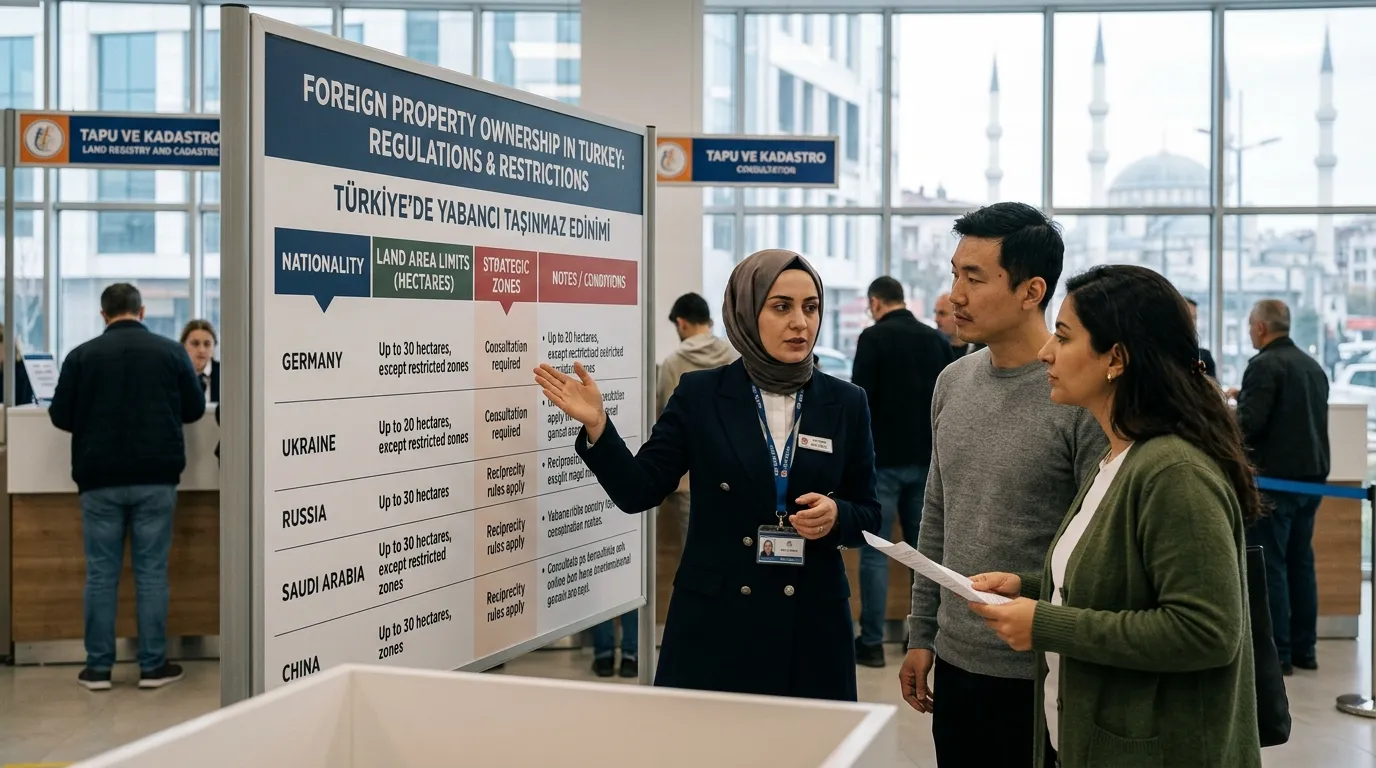
Foreign Property Ownership Restrictions in Turkey by Nationality: A Practical 2026 Guide
Turkey has spent years attracting overseas property buyers with a combination that is difficult to ignore: Mediterranean and Aegean coastlines, enormous cities such as Istanbul, relatively accessible real estate markets, and a legal system that allows many foreign nationals to acquire property directly in their own names. Yet the phrase “foreigners can buy property in Turkey” hides an important layer of complexity. Eligibility can depend on the buyer's nationality, the type and location of the land, statutory ownership limits, security restrictions, and the legal status of the individual transaction. A foreign purchaser who can freely acquire an apartment in Istanbul, for example, should not automatically assume that the same rules allow that person to acquire a large agricultural parcel close to a sensitive border or military installation.
That is why anyone researching foreign property ownership restrictions in Turkey by nationality needs to look beyond simplistic country lists circulating on property websites. Turkish law establishes a broad framework for foreign natural persons, but administrative restrictions and nationality-specific considerations can make the practical answer more nuanced. Some older online material is particularly misleading because Turkey significantly changed its foreign-ownership regime in 2012, when the traditional reciprocity principle was removed from the general framework. In practical terms, a Turkish citizen no longer necessarily needs to have equivalent purchasing rights in a foreign buyer's home country before that foreign national can acquire Turkish real estate.
This guide explains the major rules foreign buyers need to understand in 2026, including nationality considerations, land-size limits, restricted locations, title-deed procedures, costs, and the relationship between property ownership and Turkish citizenship by investment. Because nationality eligibility and security designations can be affected by administrative decisions, sanctions, international developments, and the precise location of a property, this article should be treated as an educational guide rather than a substitute for transaction-specific Turkish legal advice. Before paying a reservation deposit or signing an irrevocable contract, a buyer should have current eligibility and the specific parcel checked through the appropriate Turkish authorities and an independent Turkish lawyer.
Understanding Foreign Property Ownership in Turkey
Foreign ownership of Turkish real estate sits at the intersection of private-property law and national-interest controls. That distinction matters because buying an ordinary apartment is not simply a question of whether the seller agrees to the price. The Turkish land-registration system records ownership through the Tapu, or title deed, and a legally effective transfer normally requires completion through the competent land-registry system. Foreign purchasers therefore enter a regulated process in which identity, nationality, property characteristics, legal encumbrances, and—in cases where relevant—location restrictions can all affect whether the transfer is possible.
The encouraging part for international investors is that Turkey's system is broadly open compared with jurisdictions that prohibit foreigners from owning land altogether or force them into long leases. A qualifying foreign natural person can generally hold eligible real estate directly rather than needing to establish a Turkish company merely to own an apartment or villa. This makes property acquisition comparatively straightforward in principle. Yet “straightforward” should never be confused with automatic. The rules distinguish between foreign natural persons, foreign-controlled Turkish companies, and legal entities established abroad, while special legislation can apply to particular types of entities and property.
Location is another piece of the puzzle. Imagine Turkey's property rules as a map with several transparent overlays. One overlay represents nationality eligibility, another represents maximum landholding rules, another marks military or security-sensitive areas, and still another concerns the legal status and zoning of the parcel. A transaction needs to pass through all the relevant layers. Being an eligible national does not erase a location restriction, just as purchasing an unrestricted apartment does not excuse a buyer from title, identity, tax, or registration requirements.
For that reason, foreign purchasers should conduct legal due diligence before transferring substantial funds. Estate-agent assurances can be useful commercially, but they do not replace official title records or independent legal review. A buyer should verify who actually owns the property, whether mortgages or attachments exist, whether the property description corresponds with what is being sold, and whether any foreign-ownership restriction applies. The safest question is not merely “Can someone of my nationality buy in Turkey?” but “Can someone with my nationality and legal status acquire this particular title at this particular location?”
The Legal Framework Governing Foreign Buyers
The central statutory framework for foreign natural persons acquiring real estate in Turkey is found in Land Registry Law No. 2644, particularly Article 35, as amended over time. One of the most consequential changes came through Law No. 6302 in 2012. Before that reform, reciprocity played a major role: broadly speaking, the ability of citizens of one country to buy Turkish property was linked to the property rights Turkish citizens enjoyed in that foreign state. The reform abolished that general reciprocity requirement and substantially widened the international market for Turkish real estate.
The modern framework instead gives Turkey authority to determine which foreign nationals may acquire real estate and limited real rights, subject to statutory restrictions and considerations involving international relations and national interests. That wording explains why a neat, permanent internet chart dividing every country into “yes” and “no” categories can be dangerous. The legal framework establishes the architecture, while administrative decisions and the circumstances of the transaction can determine how the rules operate for a particular purchaser. Current verification is especially important when a buyer comes from a jurisdiction affected by diplomatic complications, sanctions, border sensitivities, or other exceptional conditions.
Foreign buyers also encounter other areas of Turkish law. Condominium and construction rules matter when purchasing apartments or off-plan projects. Municipal zoning affects what can lawfully be built or used on a parcel. Tax legislation determines acquisition and recurring liabilities. Foreign-exchange and banking requirements may affect how funds and supporting documents are handled. Buyers pursuing citizenship face an additional regulatory layer because an ordinary legal property purchase and a qualifying citizenship investment are related but not identical legal objectives.
Another distinction frequently overlooked is the difference between a natural person and a company. Rules that allow an individual French, British, Russian, American, or Gulf national to purchase an eligible home do not automatically mean a company incorporated in that person's home jurisdiction receives identical treatment. Foreign legal entities generally operate under a more specialized framework, while companies incorporated in Turkey but containing foreign capital are governed by rules applicable to foreign-capital companies and may face additional procedures in sensitive circumstances.
This is why good due diligence starts with the buyer as well as the building. Lawyers should know the purchaser's nationality or nationalities, whether the buyer is acting personally or through a legal entity, the property's official parcel information, intended use, and whether citizenship is part of the objective. Only then can the broad law be translated into a reliable answer for an individual transaction.
Why Nationality Matters When Buying Turkish Real Estate
Nationality still matters even though Turkey abolished the old general reciprocity system. This point often causes confusion. Abolishing reciprocity did not create an unconditional right for every person holding every passport to purchase every category of Turkish property. Instead, the revised framework opened ownership much more widely while preserving Turkey's ability to impose nationality-related limits in accordance with statutory authority, international relations, and national interests.
Consider two buyers viewing apartments in the same development. They may agree to the same purchase price and have identical financial resources, yet their documentation or eligibility checks can differ because they hold different passports. Add dual nationality and the analysis can become even more interesting. A purchaser should disclose citizenship information accurately rather than assuming that presenting whichever passport appears most convenient will resolve an underlying restriction. The land-registry process is a legal registration procedure, not merely an identity check at a hotel desk.
Nationality can also interact with geography. Turkey shares borders with several countries and contains military, security, agricultural, environmental, and strategically important areas. A foreign buyer's ability to acquire a specific parcel can therefore involve more than a general national eligibility question. This is one reason broad statements such as “all Europeans can buy anywhere” or “citizens of country X are completely banned” should be approached cautiously unless they are supported by current official information and applied to the precise property concerned.
Nationality also matters indirectly through practical issues such as obtaining and legalizing documents, banking compliance, sanctions screening, international money transfers, inheritance planning, and powers of attorney. A person may be legally eligible to own the property while still encountering banking or compliance hurdles. Those are not necessarily the same as a Turkish land-ownership prohibition. Confusing the two can cause unnecessary panic—or, in the opposite direction, create dangerous overconfidence.
The sensible approach is therefore individualized verification. Buyers should have their nationality checked against the rules applicable at the time of transfer and have the property's official location and title examined separately. This is particularly important because the purchase contract, deposit, currency transfer, valuation, and citizenship strategy may all be affected if eligibility is discovered too late. In real estate, discovering a legal obstacle after sending the money is rather like checking whether you packed a parachute after jumping from the aircraft.
Which Nationalities Can Buy Property in Turkey?
Turkey permits citizens of a large number of foreign countries to acquire eligible real estate, which is one reason Istanbul, Antalya, Mersin, Ankara, İzmir, Bodrum, Alanya, and other markets have developed substantial international buyer communities. The 2012 reforms made the market significantly more accessible by removing the traditional general reciprocity requirement. Consequently, foreign ownership is no longer best understood through the simplistic question of whether Turkish citizens can buy equivalent property in the purchaser's home country.
For many prospective buyers, this means ordinary residential acquisitions are legally possible in principle. European citizens, British buyers, North Americans, citizens from numerous Gulf and Middle Eastern states, Russians, Ukrainians, and buyers from various Asian jurisdictions participate in the Turkish property market. But the phrase “in principle” is doing important work here. Eligibility to acquire Turkish real estate does not mean unlimited acreage, unrestricted geographical access, or exemption from title and security controls.
Another problem is that commercial property websites sometimes publish country lists without a date, legal source, or explanation of what “allowed” actually means. One website may describe a nationality as permitted because its citizens can acquire apartments, while another describes it as restricted because particular land categories or locations are unavailable. Both statements might be attempting to describe different parts of the same legal picture. Readers should therefore distinguish a complete prohibition, a nationality-specific condition, a property-type restriction, a location restriction, and an ordinary administrative requirement.
The same caution applies when regulations evolve. A property article that was accurate several years ago can continue ranking on Google long after procedures have changed. Search visibility is not a legal authority. Current confirmation should come from the competent Turkish land-registry authorities and, for a significant transaction, an independent lawyer who can assess the buyer and exact parcel.
A useful rule is to treat nationality as the first gate rather than the entire journey. Once eligibility is confirmed, the buyer still needs to examine statutory area limits, restricted zones, title quality, zoning, building status, taxes, valuation requirements where applicable, payment arrangements, and registration. Citizenship investors need an additional review because their purchase must satisfy the requirements of the investment-based nationality route rather than merely qualify as a valid real-estate acquisition.
Nationalities Generally Permitted to Purchase Turkish Property
For most international buyers researching mainstream Turkish residential property, the legal environment is relatively welcoming. Citizens of many countries can acquire apartments, houses, commercial premises, and eligible land directly in their personal names, subject to the restrictions imposed by Turkish law. This broad accessibility helps explain the international character of markets such as Istanbul and Antalya, where buyers from Europe, the Middle East, Russia and other CIS countries, North America, and Asia can often be found purchasing alongside Turkish residents.
Still, it is more accurate to describe these nationalities as generally eligible subject to applicable restrictions than to promise universal purchasing rights. A British citizen who can acquire an apartment in an ordinary residential district, for instance, remains subject to the statutory rules governing foreign ownership. The same principle applies to an American, German, Saudi, Emirati, Russian, Ukrainian, or other generally eligible buyer. The passport may open the first door, but the parcel itself must still pass legal scrutiny.
This distinction becomes especially important with land. Buyers sometimes assume that because they are eligible to purchase a completed apartment, they can purchase any vacant, agricultural, or development parcel on identical terms. Turkish law imposes additional controls on undeveloped property and overall foreign landholdings, and projects associated with unbuilt land may carry implementation requirements. Agricultural classification, zoning, environmental rules, municipal plans, and strategic-location restrictions can all transform what initially looks like a simple purchase into a more specialized legal exercise.
Foreign buyers should also resist the temptation to use nationality eligibility as a substitute for title due diligence. Eligibility tells you whether you are capable of owning qualifying Turkish property; it does not tell you whether the seller has good title. A property can still carry a mortgage, attachment, usufruct, annotation, disputed boundary, building problem, or other burden. Equally, an attractive marketing brochure is not proof that an off-plan unit has the exact legal status a purchaser expects.
For practical purposes, buyers from commonly participating nationalities should begin with official confirmation rather than relying on nationality charts copied from one estate website to another. Give the lawyer or land-registry professional the passport details and exact title information. That simple pairing—buyer verification plus parcel verification—is much more useful than a generic online “approved countries” list.
Nationalities Facing Restrictions or Special Conditions
This is the area where careful language matters most. Turkish legislation preserves governmental authority over foreign real-estate acquisition, and nationality-specific limitations or conditions may apply. Yet those restrictions should not be converted into a permanent, unsourced blacklist because rules and administrative practices can change, while the nature of a restriction may differ according to property location or category. A buyer needs to know not only whether a restriction exists but precisely what that restriction prevents.
Some foreign nationals may encounter limitations arising from Turkey's national-security considerations, international relationships, border geography, or specific governmental decisions. In practice, a person's nationality can therefore require additional scrutiny even where foreigners generally participate freely in the Turkish real-estate market. The exact answer should be obtained using current official information at the time of the proposed transfer. This is especially important for buyers whose nationality is frequently described inconsistently across real-estate websites.
Sanctions create another source of confusion. A bank refusing or delaying an international transfer because of compliance screening does not necessarily mean the purchaser's nationality is prohibited from owning Turkish property. Conversely, successful movement of money into Turkey does not prove that the buyer is legally eligible to register a particular parcel. Banking compliance and land-registration eligibility are separate questions, even though both can affect whether a transaction closes successfully.
Buyers should also be wary of attempted workarounds. If an individual faces a legal restriction, putting the property nominally in the name of a friend, relative, or informal nominee can create severe ownership and enforcement risks. The person supplying the purchase money may discover that Turkish title records recognize somebody else as the owner. Creating a company is likewise not a magic switch; corporate acquisitions involving foreign interests have their own legal framework and should be structured only after specialist advice.
The practical lesson is simple: investigate restrictions before signing binding documents. Ask whether the purchaser's nationality can acquire the exact property, whether special approvals are required, and whether the intended ownership structure changes the analysis. Put any necessary protection into the preliminary agreement and deposit arrangements. When nationality eligibility is uncertain, handing over a non-refundable deposit on the strength of an agent's verbal assurance is an avoidable gamble.
Why the Exact Nationality List Requires Case-by-Case Verification
People understandably want a table with every country in the world and a green tick or red cross beside it. It feels decisive, searchable, and convenient. Unfortunately, foreign property ownership restrictions in Turkey by nationality are not always well represented by a frozen binary list. Turkish law gives the state regulatory powers that can interact with nationality, property type, geographic location, and national-security considerations, while procedures and administrative interpretations can evolve.
There is also a difference between legislation available publicly and information needed to complete an actual title transfer. A generic list cannot tell a prospective purchaser whether a particular cadastral parcel intersects a restricted area, whether a piece of land has a special legal classification, or whether the purchaser's individual documentation raises a separate issue. Nor can it reliably account for every future change. This becomes particularly important in 2026 because buyers often encounter articles written before recent procedural changes but updated cosmetically by changing only the year in the headline.
For the most reliable answer, the purchaser should provide the exact nationality, passport information, province, district, neighbourhood, block and parcel details—where available—to the professionals handling the transaction. The relevant land-registry authorities can then process the acquisition under current rules, while an independent lawyer can review contractual and title risks. If the buyer is pursuing citizenship, the lawyer should also determine whether the asset and transaction structure satisfy citizenship requirements.
This approach may sound less convenient than a universal chart, but it protects the buyer from two opposite errors. The first is walking away from a perfectly lawful investment because an outdated website claims the buyer's nationality is banned. The second—and more expensive—is paying for a property after being told that “everyone can buy in Turkey,” only to discover a nationality, parcel, security, or land-use obstacle during registration.
Think of the nationality list as a weather forecast rather than a boarding pass. It can help you understand the general environment, but it does not authorize the transaction. Official, property-specific verification at the time of purchase is what matters when real money and legal title are on the line.
Property Ownership Rules That Apply to Foreigners Regardless of Nationality
Nationality receives most of the attention in searches, but several of Turkey's most important restrictions are broader rules applying to foreign natural persons who are otherwise eligible to purchase. These limits are easy to overlook because a buyer may hear that his or her passport is “approved” and assume the legal analysis has finished. In reality, nationality eligibility is only one component of the acquisition framework.
One of the central statutory controls concerns the total amount of land a foreign natural person can own. Another concerns the aggregate amount of privately owned land within a district that can fall into foreign hands. Turkey also protects military, security, and strategically significant locations from unrestricted foreign acquisition. Together, these measures allow substantial international investment while maintaining territorial and security safeguards.
These restrictions matter differently depending on what you are buying. Someone purchasing a 90-square-metre apartment in an established Istanbul development is unlikely to approach a nationwide hectare ceiling personally. A foreign investor assembling agricultural or development land, however, needs to pay much closer attention. Likewise, a normal residential unit in a central urban neighbourhood and a parcel close to a sensitive installation can produce completely different legal outcomes even when the same purchaser is involved.
Land intended for development deserves additional scrutiny. The law can impose requirements connected with projects on property acquired without structures, and zoning rules determine what can actually be built. A cheap field advertised as tomorrow's luxury-villa site can therefore be a very different asset from a legally zoned building plot. Buyers should obtain professional confirmation rather than treating the estate agent's description—“agricultural,” “development,” “villa land,” or “investment plot”—as an official legal classification.
The broader lesson is that Turkish foreign-ownership law operates through overlapping limits. A transaction needs to satisfy the nationality rule and the total-land rule and district-level controls and location restrictions, alongside ordinary property law. Passing one test does not cancel the others.
The 30-Hectare Ownership Limit
A key rule for foreign natural persons is the general nationwide ceiling of 30 hectares of real estate ownership, subject to the statutory framework and the possibility provided by law for the applicable limit to be increased by presidential authority. Thirty hectares equals 300,000 square metres, so an ordinary buyer purchasing one apartment will be nowhere near this threshold. For land investors, developers, agricultural purchasers, and wealthy buyers building portfolios, however, the rule can become highly significant.
The important point is that the limit concerns aggregate ownership rather than merely the size of one transaction. Splitting acquisitions among different provinces does not necessarily make the overall statutory ceiling disappear. Anyone accumulating substantial Turkish landholdings should therefore maintain accurate records and obtain advice before each acquisition. Portfolio planning becomes especially important when different title deeds contain different land interests or when acquisitions are being made over several years.
The rule also illustrates why headlines claiming “foreigners can buy unlimited Turkish property” are misleading. A foreigner may be able to purchase multiple qualifying properties, but landownership remains subject to statutory boundaries. Owning ten apartments is conceptually different from acquiring hundreds of thousands of square metres of land, and Turkish law is designed to distinguish ordinary investment from territorial concentration.
Buyers should also avoid assuming that using multiple companies or nominees automatically sidesteps the policy behind ownership controls. Corporate structures have separate rules, beneficial ownership and compliance issues can matter, and sham arrangements can create legal and tax problems. If a genuine commercial project requires substantial land, it should be structured transparently with Turkish legal and tax advice rather than improvised after an individual limit becomes inconvenient.
For most residential buyers, the 30-hectare rule is therefore something to understand rather than fear. It demonstrates that Turkey is open to foreign ownership without abandoning quantitative safeguards. For serious land investors, by contrast, it should be part of acquisition planning from day one. Before agreeing to a large parcel or a portfolio of parcels, calculate existing holdings, verify how the proposed interest is treated, and confirm the current statutory and administrative position.
The 10% District-Level Limitation
Turkish foreign-ownership law also contains an aggregate geographical safeguard commonly described as a 10% limitation relating to privately owned land within a district. This is fundamentally different from the 30-hectare individual ceiling. The hectare rule focuses on how much a particular foreign natural person owns across Turkey, whereas the district rule addresses the concentration of foreign ownership in a particular administrative area.
Why have such a rule? Imagine a coastal or strategically valuable district where international demand becomes exceptionally intense. Without an aggregate mechanism, foreign acquisition could theoretically concentrate a very large share of privately held land in one locality even though each individual purchaser remained comfortably below the personal ownership ceiling. A district-level cap gives the state a way to prevent that outcome.
For a typical apartment purchaser, this restriction may remain invisible because the relevant district has ample capacity and the transaction proceeds normally. But investors buying in areas with unusually high foreign demand should understand that their personal eligibility does not guarantee indefinite availability for foreign acquisitions. The rule concerns the wider ownership picture, something an individual buyer cannot determine simply by looking at a title deed or counting foreign neighbours in a development.
This is another reason to verify eligibility before making a non-refundable payment. If an aggregate statutory restriction affects a location, a perfectly clean title and a willing seller cannot necessarily override it. Buyers should therefore avoid contracts that assume registration is guaranteed without dealing sensibly with circumstances in which governmental or land-registry restrictions prevent transfer.
It is also useful to separate this legal limitation from informal market observations. A neighbourhood having thousands of international residents does not itself prove that a statutory ceiling has been reached, and rumours that “foreigners can no longer buy here” may sometimes relate to a different immigration or residence-permit policy rather than property title. Residence eligibility and real-estate ownership are distinct legal subjects. Before changing investment plans because of social-media claims, identify which rule is actually being discussed and confirm the current position through the appropriate authority.
Military, Security, and Strategic Zone Restrictions
Location-based security restrictions are among the most important exceptions to the idea that an eligible foreign national can buy anywhere in Turkey. Properties situated in designated military forbidden zones, military security zones, or other strategically restricted areas can be subject to prohibitions or special controls. The underlying principle is familiar internationally: states commonly limit foreign access to land whose location creates national-security concerns.
For buyers, the practical challenge is that a property does not wear a sign saying “foreign ownership restricted.” A villa can look entirely ordinary during a viewing while its cadastral location creates a legal issue that photographs and marketing descriptions cannot reveal. This is why parcel-specific checking matters. The relevant question is not whether the home is beautiful or whether Turkish citizens can own it; the question is whether that title can legally be transferred to this foreign purchaser.
Procedures surrounding security-zone verification have changed over the years, and buyers should be cautious about guides describing obsolete approval processes as though every transaction still follows them. Modern land-registry systems and mapped information have streamlined many transactions, but a buyer should rely on current official procedure rather than assuming an old blog post describes today's requirements. When uncertainty exists, the land-registry authority and a competent Turkish property lawyer should establish whether additional clearance is needed.
Border areas can deserve particular attention because security and international considerations may overlap with nationality. Yet buyers should not generalize from one border district to an entire province or from one restricted parcel to every property available to a particular nationality. Real-estate restrictions can be geographically precise.
The safest workflow is pleasantly boring: identify the property by official title information, verify the seller, check encumbrances, determine whether the parcel is subject to foreign-acquisition restrictions, and only then allow major funds to become irrevocable. In property law, boring is often profitable. The dramatic stories usually begin when someone skips those checks because the sea view was irresistible.
Special Issues Affecting Buyers from Different Countries
Foreign buyers often enter the Turkish property market with a deceptively simple question: “Can people from my country buy property in Turkey?” As the earlier sections show, nationality is certainly relevant, but it is rarely the only variable that determines whether a transaction can proceed. Two purchasers buying identical apartments may experience different banking checks, documentation requirements, transfer procedures, or nationality-related reviews even when both are legally eligible to own Turkish real estate. For that reason, understanding the practical issues commonly encountered by major groups of international buyers can be just as valuable as understanding the statutory rules themselves.
The first distinction to keep firmly in mind is between property-ownership law and financial compliance. A foreign national might be legally entitled to acquire a Turkish apartment but have difficulty sending purchase funds because a bank needs additional evidence concerning the source of money, beneficial ownership, sanctions exposure, or the parties to the transfer. The reverse can also occur: money can arrive successfully while the proposed property itself remains unsuitable for foreign acquisition. Neither a successful bank transfer nor an estate agent accepting a deposit proves that the Tapu can ultimately be registered in the buyer's name.
Documentation presents another practical variable. Depending on the transaction, buyers may need passports and translated or notarized documents, a Turkish tax identification number, photographs or identity information required by the applicable procedure, powers of attorney if somebody acts on their behalf, and supporting documents for banking or investment purposes. Requirements can also differ when a buyer is married, purchasing jointly, using a company, or pursuing Turkish citizenship. Documents executed abroad may require notarization, legalization, an apostille under the Hague Convention where applicable, or another authentication process depending on the country involved and the document.
Currency movements deserve particular attention. Turkey's financial and foreign-exchange procedures have changed over time, and a foreign buyer should confirm the current requirements applicable on the date of the transaction rather than following a checklist downloaded several years earlier. Citizenship applicants have even more reason to coordinate banking, valuation, payment evidence, title annotations, and transfer timing carefully because a valid property purchase does not automatically become a qualifying citizenship investment.
So, nationality is best viewed as the beginning of the buyer profile rather than its entire definition. Where do the funds originate? Does the buyer have multiple nationalities? Is the property being purchased personally or through a company? Is the goal a holiday home, rental investment, permanent relocation, development project, or citizenship? Once those questions are answered, the transaction becomes much easier to structure correctly.
Gulf and Middle Eastern Buyers
Turkey has long attracted property purchasers from the Gulf and wider Middle East because it offers a combination of geographic proximity, extensive air connections, established tourism infrastructure, major metropolitan markets, and a lifestyle that can feel culturally accessible without being identical to home. Istanbul remains an obvious magnet, while destinations such as Bursa, Trabzon, Antalya, Yalova, Sapanca, Bodrum, and other coastal or scenic areas have attracted varying levels of regional interest. Buyers may be searching for a summer residence, rental property, family base, long-term investment, or an asset that forms part of a Turkish citizenship by investment strategy.
For citizens of Gulf states and many other Middle Eastern countries, purchasing eligible Turkish real estate may be possible under the general foreign-ownership framework, but buyers should resist treating “Arab buyer” or “Gulf buyer” as a legal nationality category. Turkey deals with the purchaser's actual citizenship and legal status. A Saudi national, Qatari national, Emirati national, Kuwaiti national, Jordanian national, Lebanese national, Iraqi national, Iranian national, or citizen of another state cannot safely assume that the precise rules applicable to a neighbouring country's citizens are identical. Current nationality eligibility should be checked individually.
This matters particularly when online property marketing uses sweeping phrases such as “all Middle Eastern citizens can buy in Turkey.” Such statements are too broad to substitute for legal verification. Certain nationalities can face specific limitations, property-type issues, location-related constraints, or changing administrative conditions. A restriction may also be misunderstood because an immigration rule is being confused with a property-ownership rule. Being able to own a home does not automatically grant an unrestricted right to reside in Turkey, just as a residence permit does not necessarily remove limitations applying to real-estate acquisition.
Buyers from the region should also plan the payment trail carefully, especially where substantial funds pass through multiple banks, companies, family members, or jurisdictions. Turkish banks and other financial institutions may require source-of-funds information or additional compliance documentation. Citizenship applicants should be even more disciplined because proving a qualifying investment can depend heavily on documentary consistency.
The safest strategy is therefore remarkably universal: verify nationality, verify the parcel, verify the title, and verify the money trail. A luxurious Bosphorus apartment may be emotionally compelling, but the legal paperwork should remain wonderfully unexciting.
Russian, Ukrainian, and Other CIS Buyers
Russian and Ukrainian purchasers have been prominent participants in parts of Turkey's international property market, particularly in destinations such as Antalya, Alanya, Mersin, Istanbul, and other areas popular for tourism, relocation, and investment. Citizens from other post-Soviet and CIS-region states also buy Turkish property for a mixture of lifestyle and financial reasons. In broad terms, many buyers from these countries can acquire eligible Turkish real estate subject to the ordinary statutory restrictions and any nationality-specific rules applicable at the time of acquisition.
Yet this buyer group illustrates perfectly why legal eligibility and banking practicality should not be confused. International sanctions and enhanced financial-compliance measures can affect particular people, banks, companies, payment channels, or transactions without necessarily creating a blanket Turkish prohibition on property ownership by everyone holding the same nationality. A Russian citizen, for example, should not interpret difficulty with a particular international transfer as conclusive proof that Russian citizens cannot own Turkish property. At the same time, the fact that another Russian purchaser completed a transaction does not guarantee that every buyer, bank, source of funds, or property will be accepted.
The right approach is individualized compliance screening. Buyers should establish which banks are involved, whether any person or entity in the payment chain is subject to applicable restrictions, what source-of-funds evidence will be required, and how the seller will receive payment. Attempting to bypass legitimate compliance controls through opaque intermediaries can turn an ordinary purchase into a serious legal problem. If a transfer route looks suspiciously complicated, that is a signal to obtain regulated legal and banking advice rather than become more creative.
Ukrainian and other CIS buyers should likewise confirm the current property rules applicable to their actual citizenship. Dual nationals should disclose their status accurately to their advisers. Documentation issued abroad may need translation and authentication, while a power of attorney should be drafted specifically enough to accomplish the intended Turkish transaction without granting unnecessarily broad authority.
Location restrictions still apply independently of these financial issues. A buyer who is otherwise eligible can encounter a problem with a particular parcel because of military, strategic, or statutory geographic controls. The sensible sequence remains the same: nationality screening first, parcel screening second, financial planning third, and binding payment only after the major risks have been understood.
European, British, and North American Buyers
European, British, Canadian, and American purchasers often approach Turkish property with expectations shaped by the land-registration systems in their own countries. Some are surprised by how direct the Turkish Tapu system can be, while others underestimate the importance of checking the official title because the sales process feels familiar. Citizens of many European countries, the United Kingdom, the United States, and Canada can generally participate in Turkey's foreign property market, subject to the applicable foreign-ownership restrictions and current nationality eligibility.
British buyers provide a useful historical example because Turkey's abolition of the general reciprocity requirement in 2012 fundamentally changed the framework through which foreign ownership is understood. Today, the correct question is not simply whether Turkish citizens enjoy equivalent rights in Britain. The buyer must instead satisfy Turkey's current statutory and administrative requirements. The same logic broadly informs purchases by citizens of EU states and North America: eligibility is governed by Turkish law, not by an assumption that a passport from a Western country automatically receives unrestricted treatment.
One practical issue for these buyers is the difference between the Tapu and a purchase contract. In many property systems, consumers are accustomed to long periods between exchange and completion. In Turkey, the exact structure can differ, but buyers must understand that signing a private sales agreement or paying the entire purchase price is not the same thing as having registered ownership. The land-registry transfer is crucial. Off-plan purchases require even greater care because the asset being marketed may not yet exist as a completed, separately registered unit in the form the buyer expects.
Independent representation is valuable here. Buyers sometimes accept a lawyer recommended and effectively controlled by the seller or developer because the transaction appears routine. Yet the purchaser's lawyer should be able to investigate title, encumbrances, zoning, permits, contractual protections, taxes, and foreign-ownership restrictions without a conflicting commercial interest. An interpreter should likewise allow the purchaser to understand what is being signed rather than simply reassure the buyer that everything is “standard.”
European and North American buyers should also plan for inheritance and estate issues. Owning Turkish real estate can create cross-border succession, tax, and probate questions even when the original purchase is simple. A €200,000 holiday apartment may eventually touch two legal systems, two sets of heirs, and multiple tax considerations. Thinking about that at purchase is far cheaper than leaving the family to untangle it later.
How Foreigners Buy Property in Turkey
The actual process of buying property in Turkey can move surprisingly quickly when the title is clean, the buyer is eligible, the funds are ready, and all documents are properly prepared. Speed, however, should never become the objective in itself. The goal is a legally secure acquisition, not a record-breaking transfer. A fast transaction with poor due diligence can create years of expensive litigation, whereas a few extra days spent checking title records can prevent the problem entirely.
The process normally begins with identifying the property and negotiating commercial terms. Before a meaningful deposit becomes non-refundable, the buyer should obtain the property's official title information and have it reviewed. The legal owner named in the records must match the person or entity entitled to sell. The title should also be examined for mortgages, liens, attachments, usufruct rights, annotations, restrictions, or other interests that could affect ownership or use.
Next comes buyer-side preparation. Foreign purchasers generally need appropriate identification and Turkish administrative information required for the transaction, while additional documentation may be necessary where a representative acts under a power of attorney. Foreign documents often need proper translation and authentication. The buyer should simultaneously establish a workable payment route and understand any current foreign-exchange or banking requirements.
Where a valuation is required by the applicable rules or the transaction structure—particularly in contexts connected with citizenship—the report should be obtained through the appropriate authorized process. Buyers should never assume that the seller's asking price, municipal value, valuation figure, and legally relevant investment amount are interchangeable concepts. They may serve very different purposes.
Finally comes registration. The Tapu transfer is the moment at which legal title is registered through Turkey's land-registry system. Before signing, the buyer should understand the exact property being transferred, the declared consideration, annotations, restrictions, and any citizenship-related commitment. If the purchaser does not speak Turkish sufficiently to understand the procedure, proper interpretation should be arranged. Signing a title transaction you cannot understand because someone says “don't worry, this is normal” is not efficiency; it is unnecessary risk.
Title-Deed Checks, Valuation, and the Tapu Transfer
The Tapu is the beating heart of a Turkish real-estate purchase. Marketing brochures, reservation forms, WhatsApp messages, and even sophisticated sale contracts may establish obligations between parties, but the official title record tells you who owns the registered real-estate interest and what legal characteristics attach to it. That makes title-deed due diligence one of the most important stages for any foreign purchaser.
A competent review should confirm the registered owner, cadastral information, nature of the property, and relevant encumbrances or annotations. Mortgages deserve obvious attention, but buyers should not stop there. Attachments, court-related annotations, rights in favour of third parties, usufruct interests, management or construction issues, and restrictions on transfer or use may also matter. With apartments, the building's legal status and the relationship between the advertised unit and registered title deserve careful examination.
Valuation is another area where foreign buyers can become confused. A developer may say an apartment is “worth $600,000,” a municipal tax value may show something else, and an authorized valuation prepared for a regulatory purpose may produce yet another figure. These numbers are not automatically interchangeable. Citizenship investors in particular should ensure that the valuation and payment evidence meet the current citizenship program rules rather than relying on a marketing valuation created to justify a sale price.
The title transfer itself is conducted through the competent Turkish land-registry system. The buyer and seller, or properly authorized representatives, complete the required formalities and execute the transfer. A foreign buyer who cannot understand Turkish may need an authorized interpreter according to the applicable procedure. Where citizenship is intended, the necessary restriction or annotation preventing disposal for the required period must also be correctly incorporated under the current program rules.
Before completion, the buyer should compare every important detail one final time: owner, property identifier, price, payment evidence, required approvals, annotations, and identity information. Real estate is unforgiving of assumptions. One wrong parcel number can matter more than a hundred glossy photographs.
Taxes, Fees, and Ongoing Ownership Costs
The purchase price is only one part of the cost of owning Turkish property. Foreign buyers should budget for title-deed charges, valuation costs where applicable, legal fees, translation and notarization expenses, compulsory insurance requirements where relevant, agency costs where contractually payable, municipal property taxes, maintenance charges, utilities, and potential taxes arising from rental income or disposal. The exact amount depends on the property, transaction structure, municipality, services, and current legislation.
The title-deed fee is particularly important because buyers sometimes negotiate a headline property price without clarifying who will economically bear transactional charges. Turkish law and market practice should be distinguished from whatever a salesperson casually promises. The purchase agreement should clearly allocate costs between buyer and seller, and the declared transaction value should comply with applicable legal and tax requirements. Artificially understating the value to reduce fees can create tax exposure and may be especially problematic when the acquisition is being used to support a citizenship application.
Apartment buyers should investigate monthly aidat, or site-management charges. In a simple residential building, these may be modest. In a resort-style complex with swimming pools, private security, gyms, landscaped gardens, elevators, generators, concierge services, and extensive communal facilities, the recurring charge can become substantial. A beautiful €150,000 apartment with disproportionately high annual management costs may be a less attractive investment than a €165,000 unit with simpler facilities.
Rental investors must also calculate net rather than imaginary returns. Gross rent is not profit. Vacancy, management, maintenance, tax, furnishing, insurance, repairs, currency movements, and building charges can eat into the headline yield. Short-term rentals may also be subject to specific licensing, consent, or regulatory requirements, so buyers should not assume that purchasing an apartment automatically gives them an unrestricted right to operate it like a hotel room.
Foreign owners should obtain current tax advice where meaningful sums are involved, especially if they remain tax resident in another country. Turkey may tax income or gains in circumstances governed by domestic law, while the owner's home jurisdiction may impose additional reporting or taxation. Double-taxation agreements can become relevant. Cross-border property is an asset, but it is also a small international tax ecosystem.
Turkish Citizenship Through Real Estate Investment
Property ownership and Turkish citizenship are often marketed as though they were the same product. They are not. A foreigner can legally buy Turkish real estate without becoming a citizen, and a property that can legally be purchased by a foreigner does not automatically satisfy the requirements for Turkish citizenship by investment. Buyers who want citizenship must structure the acquisition with both sets of rules in mind from the beginning.
Under the real-estate investment route widely applicable in recent years, the qualifying minimum has been US$400,000, subject to the detailed valuation, payment, eligibility, and holding requirements in force when the application is made. Because citizenship regulations and administrative procedures can change, applicants in 2026 should verify the current threshold and qualifying criteria before committing funds. A developer's advertisement promising a “citizenship guaranteed” apartment should never substitute for independent confirmation.
The citizenship process is document-heavy for good reason. Authorities need to establish that a genuine qualifying investment occurred, that the required value has been met through acceptable evidence, and that the property is subject to the required restriction on disposal for the prescribed period. The applicant also needs to satisfy the broader citizenship and security procedures. Simply transferring $400,000 to a seller does not by itself prove every regulatory element.
Buyers should be especially cautious about inflated valuations, circular payment arrangements, related-party structures, promises to return part of the purchase price privately, or schemes designed primarily to manufacture an apparent qualifying investment. A property worth substantially less than its marketed “citizenship price” may create both legal and financial risk. Even if an application proceeds, overpaying by $100,000 for an asset to obtain a passport is still overpaying by $100,000.
The best citizenship acquisition is therefore one that makes sense twice: first as a legitimate real-estate investment, and second as a qualifying immigration investment. If the deal only makes sense because a salesperson has attached the word “citizenship” to it, the buyer should examine it much more closely.
How Nationality Restrictions Interact With Citizenship by Investment
Nationality eligibility does not disappear simply because the purchaser intends to apply for citizenship. This is a critical point. The citizenship-by-investment route does not generally operate as a magic exemption allowing a person to acquire real estate that he or she is otherwise prohibited from purchasing under Turkish property law. The underlying acquisition must itself be legally valid.
That creates a sequence buyers should understand. First, determine whether a person of the applicant's nationality and legal status can acquire the proposed property. Second, verify that the parcel is open to foreign acquisition and satisfies ordinary property-law requirements. Third, determine whether the property and transaction structure qualify under the current citizenship-by-investment regulations. Only then should the buyer treat the asset as part of a citizenship strategy.
Dual nationality can require special attention. Applicants should disclose all relevant citizenship information and obtain advice about which nationality and documents are being used throughout the transaction and application. Trying to conceal a nationality because somebody believes it will simplify eligibility can create far greater problems during security checks or citizenship review. Consistency and accurate disclosure are safer than improvisation.
The property itself must also satisfy citizenship rules that go beyond ordinary ownership. The qualifying value, permitted transaction structure, seller relationship where relevant, payment evidence, valuation, title registration, and mandatory no-sale commitment must comply with current requirements. Rules in this field have evolved specifically to prevent artificial or abusive transactions, so an approach that appeared acceptable in an old YouTube video may no longer work.
Applicants should therefore coordinate the property lawyer, citizenship adviser, valuation process, bank transfers, and title registration rather than allowing each participant to work independently. A mistake made at the purchase stage may not be fixable later simply by submitting more documents. Citizenship is not a sticker added to an ordinary sale after completion; when it is the goal, the transaction should be engineered correctly from the start.
Common Legal Risks Foreign Property Buyers Should Avoid
The greatest risks in Turkish property purchases are often not dramatic legal mysteries. They are ordinary mistakes repeated at high financial stakes: paying too early, trusting the wrong representative, failing to inspect the title, misunderstanding the property being purchased, relying on outdated nationality information, or assuming that a developer's citizenship promise has governmental authority. Foreign purchasers can eliminate a large portion of these risks by refusing to let urgency replace due diligence.
One recurring problem is the non-refundable reservation deposit. A buyer sees an apartment, fears another purchaser will take it, and transfers money within hours. Only afterward does a lawyer discover a title issue, nationality restriction, mortgage, planning problem, or citizenship defect. Reservation agreements should therefore contain sensible protections where eligibility or legal due diligence remains outstanding. If a seller refuses to allow basic checks before demanding a substantial irrevocable payment, that resistance is itself useful information.
Another risk is conflict of interest. The seller's estate agent works to complete the sale. A developer's internal lawyer may primarily protect the developer. Neither role is inherently improper, but neither automatically replaces independent representation for the purchaser. A foreign buyer committing six figures to a property should be comfortable paying for advice from somebody whose professional duty is genuinely aligned with the buyer's interests.
Powers of attorney also require care. They are useful when the buyer cannot remain in Turkey for every step, but authority should be tailored to the intended tasks. Giving a near-stranger sweeping power to buy, sell, mortgage, receive money, and operate bank accounts simply because it is convenient is like handing over the master key to your financial house. Use properly drafted powers, appropriate authentication, and trustworthy professionals.
Off-plan projects create another category of risk. Buyers should investigate the developer, land title, planning and construction status, contractual completion obligations, specifications, delay provisions, and what happens if the project does not proceed as promised. Renderings are sales material, not completed buildings.
Finally, never confuse ownership with residency, rental permission, or citizenship. These are separate legal outcomes. A foreigner may own property without obtaining the immigration status expected, while a property suitable for residence may not necessarily qualify for citizenship. Verify each objective separately before buying.
Conclusion
Turkey remains one of the more accessible major property markets for international buyers, but accessibility should not be mistaken for the absence of restrictions. The modern legal framework allows citizens of many foreign countries to acquire eligible Turkish real estate directly, particularly after the 2012 removal of the traditional general reciprocity requirement. Yet foreign property ownership restrictions in Turkey by nationality still matter because the state retains authority to regulate acquisitions according to nationality, national interests, international relations, property characteristics, and location.
The most important insight is that there is no single question called “Can foreigners buy property in Turkey?” There are several questions hiding inside it. Can a person holding this nationality acquire Turkish real estate under the current rules? Can that person acquire this exact cadastral parcel? Does the acquisition remain within individual and district-level landholding restrictions? Is the property outside prohibited or restricted security areas? Is the title clean? If citizenship is intended, does the transaction independently satisfy the citizenship program?
For ordinary residential purchasers from many commonly participating countries, those questions can produce a straightforward yes. The foreign buyer can select an eligible apartment, conduct due diligence, organize payment and documentation, and register the Tapu. Large land acquisitions, unusual ownership structures, sensitive locations, nationality-specific circumstances, and citizenship transactions require more careful planning.
Buyers should remember the general 30-hectare individual ownership ceiling, the district-level restriction commonly described by reference to 10% of privately owned land, and restrictions involving military or strategically sensitive areas. They should also distinguish ownership rules from sanctions compliance, residence permits, short-term rental regulations, and citizenship. Each operates within its own legal framework.
Above all, use current information. Nationality charts copied from old property websites can become outdated, and changing the publication date at the top of an article does not magically update the law underneath it. Before paying a substantial deposit, have an independent Turkish lawyer verify both the purchaser and the parcel using current official information. In a transaction worth hundreds of thousands of dollars, that small layer of friction is not bureaucracy for bureaucracy's sake. It is the seat belt.









Have Question Or Suggestion ?
Please Share Your Thought, To Make It Real