Countries Where You Can Buy Property with Crypto in 2026
Discover the best countries where you can buy property with crypto in 2026, including legal considerations, payment options, taxes, and foreign ownership rules.
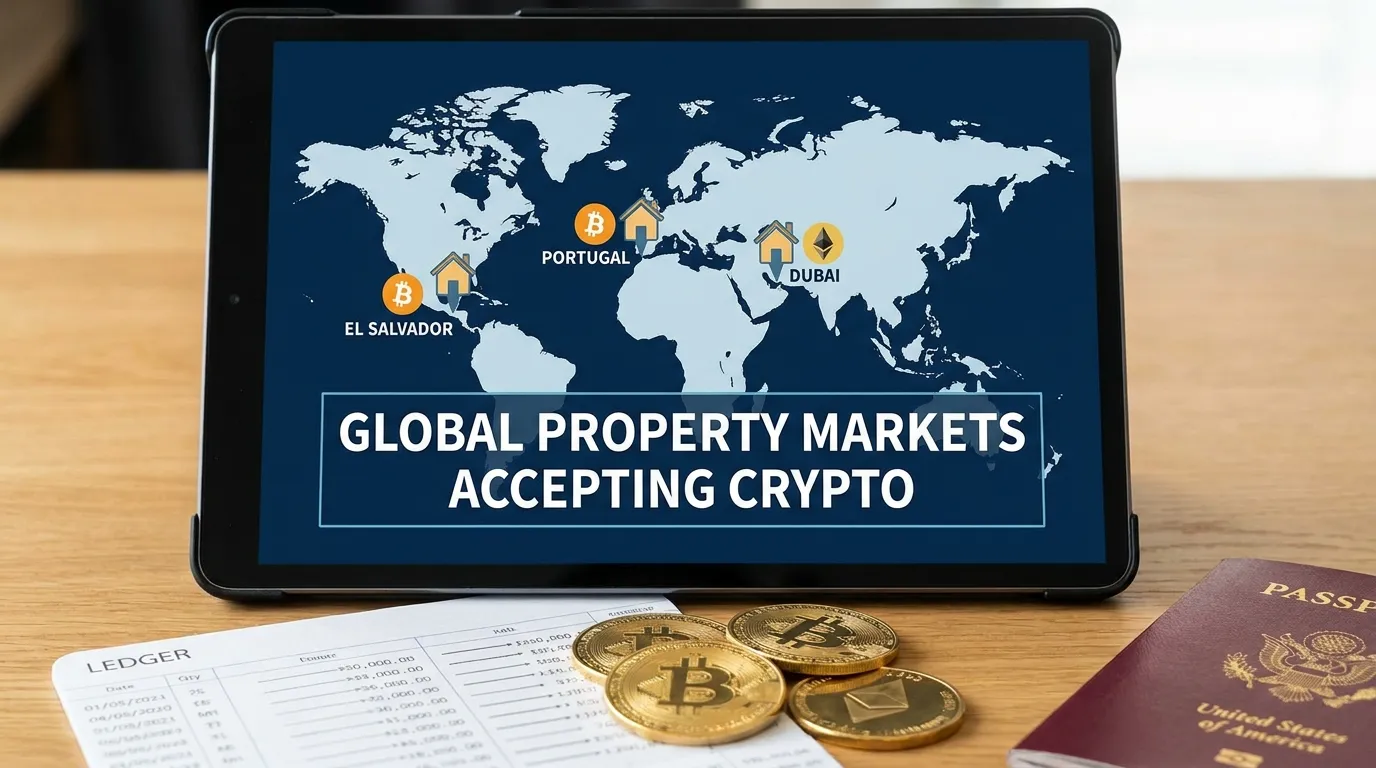
Countries Where You Can Buy Property with Crypto
Bitcoin began as an experiment in peer-to-peer electronic money. Today, someone holding Bitcoin, Ether, stablecoins, or another digital asset may be looking at a very different question: Can I turn my crypto portfolio into an apartment in Dubai, a villa on the Mediterranean, or an investment property in Europe? The answer is increasingly yes, but the process is rarely as simple as sending coins from one wallet to another and receiving a set of keys. Real estate sits inside a dense web of property law, banking rules, anti-money-laundering requirements, taxes, foreign-ownership restrictions, title registration, and source-of-funds checks. Cryptocurrency may be the economic source of the purchase price without necessarily becoming the currency recorded on the final property deed.
That distinction matters when researching countries where you can buy property with crypto. A country does not need to recognize Bitcoin as legal tender for a crypto-funded real estate transaction to happen. A willing seller may accept cryptocurrency directly where local rules permit, a developer may work with a regulated payment processor, or the buyer may convert digital assets into fiat currency immediately before completion. In all three situations, people casually describe the deal as "buying property with crypto," even though the legal mechanics can be dramatically different. That is why lists claiming that certain countries simply "accept Bitcoin for houses" can be misleading.
The destinations attracting crypto-funded property buyers tend to share a few characteristics: international real estate markets, substantial foreign investment, sophisticated payment or banking infrastructure, and professionals accustomed to verifying digital-asset wealth. The UAE, Portugal, Spain, Turkey, Thailand, Montenegro, Georgia, Switzerland, and the United States are among the markets worth investigating, although their ownership and payment rules differ significantly. Regulations also change quickly. This guide therefore focuses not only on where deals are possible, but on how they typically work and what a buyer should verify with licensed legal and tax professionals before moving digital assets.
Can You Really Buy Property with Cryptocurrency?
Yes, it is possible to buy real estate using wealth held in cryptocurrency, but "possible" and "universally accepted" are two very different things. Property transactions require both a legal transfer of ownership and a legally acceptable method for documenting the purchase consideration. Bitcoin can move across the world in minutes, while a land registry still needs names, contracts, valuations, identification documents, tax calculations, and evidence showing where the purchase money originated. Think of cryptocurrency as the engine powering the transaction rather than automatically being the road on which the entire transaction travels. The engine may be modern and decentralized, but the road remains firmly governed by national property law.
There are several ways a transaction can qualify in practical terms as a crypto real estate purchase. The cleanest example is a seller who explicitly agrees to receive Bitcoin, Ether, USDT, USDC, or another cryptocurrency. Buyer and seller establish a crypto-denominated or fiat-referenced price, complete the necessary legal checks, and transfer the agreed digital assets. More commonly, however, an intermediary converts the buyer's cryptocurrency into dollars, euros, dirhams, or another local currency. The seller receives ordinary fiat money while the buyer effectively funds the purchase from crypto. Some developers and brokers advertise "crypto accepted" precisely because they have integrated this conversion process.
The crucial point is that cryptocurrency acceptance is often transaction-specific rather than country-wide. A Dubai developer might accept crypto through a payment partner while another developer does not. A Spanish homeowner could agree to a Bitcoin-funded sale while the notary and tax authorities still require values to be stated in euros. A US seller might accept Bitcoin, yet the title company or mortgage lender could impose additional conditions. Foreign buyers also face separate rules governing whether they can own land, condominiums, houses, agricultural property, or property in restricted zones.
For that reason, buyers should treat statements such as "Bitcoin is accepted in Country X" as the beginning of their research rather than the end. Confirm the exact property, seller, payment mechanism, land-registration procedure, tax consequences, and source-of-funds requirements. Owning enough crypto to pay for a property does not automatically make the transaction legally executable.
How Crypto Real Estate Transactions Actually Work
A crypto-funded property deal usually begins much like a conventional international purchase. The buyer chooses a property, negotiates the price, conducts due diligence, signs the required agreement, and completes the transfer according to local property law. The unusual part is the payment rail. Instead of money arriving exclusively from a conventional bank account containing long-held fiat funds, some or all of the buyer's wealth originates on a blockchain. That creates opportunities for faster settlement, but it also introduces questions that traditional real estate professionals must resolve before completion.
One of the biggest issues is price volatility. Imagine agreeing on Monday to purchase an apartment for the equivalent of $500,000 in Bitcoin and completing several weeks later. If Bitcoin moves sharply during that period, one party can unexpectedly gain or lose substantial purchasing power. Many sophisticated deals therefore establish the property's price in fiat currency and calculate the amount of cryptocurrency payable at a specified exchange rate shortly before settlement. Stablecoins can reduce some price volatility, although they introduce their own issuer, reserve, regulatory, blockchain, and counterparty risks.
Documentation is another major consideration. A regulated broker, lawyer, notary, developer, exchange, payment provider, or financial institution may ask the buyer to prove source of funds and source of wealth. Simply showing a wallet balance may not be enough. A buyer could need exchange statements, wallet transaction histories, tax records, proof of the original acquisition of digital assets, evidence of trading activity, employment or business records, and identification connecting wallets to the buyer. Long blockchain histories involving mixers, sanctioned addresses, unidentified counterparties, or high-risk platforms can complicate compliance.
Finally, there is settlement itself. Cryptocurrency transactions can be irreversible, so sending funds to the wrong address can be catastrophic. Real estate buyers should verify wallet addresses through secure channels, understand network selection, perform any agreed test transfer, and avoid improvising at closing. The convenience of blockchain settlement does not eliminate the need for legal due diligence, title verification, escrow arrangements, and professional transaction controls.
Direct Crypto Payments vs. Crypto-to-Fiat Settlements
The difference between direct payment and conversion is one of the most important concepts in crypto property investing. In a direct cryptocurrency transaction, the seller actually receives digital assets. If a villa costs the equivalent of $1 million and the seller accepts Bitcoin, the parties establish how much BTC must be delivered and when the exchange rate is measured. This arrangement can reduce reliance on traditional cross-border payment rails, but it requires a seller comfortable holding cryptocurrency and professionals capable of documenting the transaction in accordance with local law.
A crypto-to-fiat settlement works differently. The buyer transfers cryptocurrency to an exchange or regulated payment processor, the asset is sold or converted, and the resulting fiat currency is used to complete the property transaction. To the seller, land registry, escrow provider, or notary, the payment can look much more like an ordinary cash purchase. For many buyers this is the practical sweet spot: they can liquidate digital wealth for real estate without needing every participant in the transaction to handle cryptocurrency.
The conversion route can also make accounting easier, but it may create a taxable event. In jurisdictions where cryptocurrency is treated as property or an investment asset for tax purposes, disposing of Bitcoin to acquire a house—or selling it for fiat immediately beforehand—can crystallize a capital gain or loss. A buyer who originally acquired BTC for $50,000 and later disposes of it when it is worth $500,000 cannot assume the only tax bill connected with the transaction is property transfer tax. The crypto disposal and the real estate acquisition can be separate taxable events.
Neither method is automatically superior. Direct settlement can be elegant when both sides understand crypto, while conversion can fit more comfortably into established real estate infrastructure. The right choice depends on local law, the seller, tax residence, asset history, banking access, and the professionals handling completion.
Investors interested in combining digital assets with tangible investments can also explore how to buy property in Turkey with crypto, including the practical steps involved in converting cryptocurrency wealth into Turkish real estate.
United Arab Emirates: A Major Hub for Crypto Property Buyers
The United Arab Emirates, and Dubai in particular, has become one of the most visible destinations for internationally mobile digital-asset investors. Dubai combines a large expatriate population, extensive new-build inventory, designated areas where foreign nationals can acquire freehold property, and a business environment that has actively developed virtual-asset regulation. Those ingredients have encouraged property developers, agencies, and payment providers to explore cryptocurrency-funded purchases. Search for luxury property marketed to crypto investors and Dubai appears again and again for a reason.
That does not mean Bitcoin has replaced the UAE dirham in ordinary conveyancing. Property registration, contractual documentation, regulatory compliance, and official fees still operate inside the UAE's established legal and financial system. A developer advertising crypto payments may use a specialist processor that receives the digital asset and settles the transaction in fiat. Buyers should therefore ask exactly what "crypto accepted" means. Is the developer receiving the token? Is a regulated third party converting it? Which cryptocurrencies are supported? At what moment is the exchange rate locked?
Dubai's appeal extends beyond payment convenience. The emirate offers an internationally oriented property market spanning relatively affordable apartments through ultra-prime villas and branded residences. Certain property investments may also support eligibility for UAE residence pathways when applicable investment thresholds and other requirements are satisfied. Buying with cryptocurrency itself does not create immigration rights; the property and investor must independently satisfy the relevant residence rules.
Compliance remains central. The UAE has developed formal regulation around virtual assets rather than treating the sector as an unregulated free-for-all. Buyers can expect identification, wallet, transaction, and source-of-funds checks, particularly for high-value purchases. Anyone planning a large conversion should organize their digital-asset records before negotiating a completion date. Dubai may be crypto-friendly, but "friendly" should not be confused with anonymous.
Buying Dubai Real Estate with Bitcoin and Other Cryptocurrencies
A typical Dubai crypto property purchase starts with finding a developer, seller, or intermediary prepared to accommodate digital-asset wealth. Bitcoin and Ether are obvious candidates, while stablecoins can sometimes be attractive because their price is designed to track a fiat asset. Actual supported tokens depend on the payment provider involved, so buyers should never transfer a token simply because an advertisement says "cryptocurrency accepted." The payment instructions contained in the verified transaction documents are what matter.
Suppose an apartment is priced at AED 2 million. The contract may continue to state the price in dirhams even if the buyer supplies the economic value in cryptocurrency. A payment processor can calculate the required crypto amount at an agreed exchange rate, perform compliance screening, convert the funds, and deliver fiat settlement to the developer or other authorized recipient. This arrangement protects the seller from holding a volatile asset while allowing the buyer to unlock crypto wealth without first manually arranging every stage of conversion.
Buyers should budget for more than the advertised property price. Dubai transactions can involve registration charges, agency commissions, trustee or administrative fees, conveyancing costs, mortgage-related charges where relevant, and ongoing service charges. The exact cost structure depends on whether the property is completed or off-plan, financed or cash-funded, and on the specific development and transaction. Crypto conversion may add spreads or processing fees as well. A low headline processing fee can become meaningful when applied to a seven-figure purchase.
Security deserves special attention. Fake brokers, altered payment instructions, impersonated representatives, and wallet-address substitution can turn an irreversible transfer into a permanent loss. Confirm that the broker and property participants are appropriately authorized, independently verify payment details, and have a qualified UAE property professional review the paperwork before funds move.
Portugal: Crypto-Friendly Living and European Property
Portugal became famous among crypto holders during an earlier period when its treatment of certain cryptocurrency gains was widely perceived as especially favorable. That reputation still echoes across blogs and social media, but buyers need current advice rather than relying on screenshots from several years ago. Portugal's cryptocurrency tax framework has evolved, and the treatment of a particular disposal can depend on factors including the nature of the activity, holding period, and taxpayer circumstances. A property buyer should therefore separate Portugal's broader crypto reputation from the tax analysis of their own transaction.
From a real estate perspective, foreigners can generally participate in Portugal's property market, making destinations such as Lisbon, Porto, the Algarve, Madeira, and other regions attractive to international buyers. A crypto holder can potentially finance a Portuguese property purchase by converting digital assets into euros, and individual sellers or intermediaries may sometimes accommodate crypto-linked arrangements. However, the formal conveyancing process still requires proper documentation, tax compliance, registration, and identification. The practical question is not merely whether someone will "take Bitcoin," but whether the complete settlement structure will satisfy the professionals responsible for transferring title.
Portugal illustrates why crypto-funded is often a better phrase than crypto-denominated. You might sell USDC or Bitcoin through a compliant provider, move euros into an acceptable account or settlement arrangement, and complete the acquisition much like any other international cash buyer. The economic source of the money remains cryptocurrency even though the seller ultimately receives euros. This structure is usually easier to integrate with conventional property procedures.
Residency deserves a separate warning. Property-purchase rules and immigration programs change, and purchasing Portuguese real estate should not be assumed to provide the same residence benefits that older articles may describe. Anyone combining property acquisition with relocation should verify the current immigration route independently. Portugal can still be compelling for lifestyle and investment reasons, but the decision should rest on today's law—not yesterday's crypto mythology.
Spain: Growing Opportunities for Crypto-Funded Real Estate
Spain has many characteristics that attract crypto-rich international buyers: globally recognized cities, Mediterranean coastal markets, islands, strong tourism, and a substantial second-home sector. Barcelona, Madrid, Valencia, Málaga, Marbella, Alicante, and island markets regularly attract international capital. Cryptocurrency can be used as the financial source behind a purchase, and private parties may structure transactions involving digital assets when legally workable. Yet the property's legal transfer remains subject to Spain's conventional framework of contracts, taxation, notarial involvement, and land registration.
A major practical issue is valuation. Even if buyer and seller discuss the deal in Bitcoin, taxes and official documentation generally need a defensible euro value. Cryptocurrency's volatility makes the timing and source of the exchange rate important. The parties should establish how the crypto amount is calculated and what happens if the market moves before completion. Without that clarity, a seemingly straightforward deal can become a dispute before anyone reaches the notary.
Foreign buyers also need the identification and administrative arrangements required for Spanish transactions. Lawyers commonly assist international purchasers with due diligence, checking title, debts, planning matters, community obligations, contracts, and tax implications. That work becomes even more important when cryptocurrency is involved because the buyer may additionally need to demonstrate how the digital assets were accumulated. A bank receiving proceeds from a crypto liquidation may ask questions independently of the property lawyer or notary.
Spain is therefore better viewed as a market where properly structured crypto-funded purchases can occur, not as a country where every property can simply be bought by scanning a Bitcoin QR code. Sellers, agents, banks, payment providers, and legal professionals can have different risk tolerances. Buyers who prepare a clean source-of-wealth package and discuss the payment structure before signing a binding deposit agreement are in a much stronger position than those who reveal at the last minute that all their funds sit on-chain.
Turkey: An Active Market for International Crypto Buyers
Turkey has long attracted international real estate buyers looking at Istanbul, Antalya, Alanya, Bodrum, and other major residential or resort markets. The country's active property sector and strong public interest in digital assets make it a natural place for crypto investors to explore. Some real estate businesses have marketed properties to cryptocurrency holders, but marketing language should never be mistaken for the legal settlement procedure. Foreign purchasers must still follow Turkey's property ownership, registration, valuation, foreign-exchange, and compliance requirements applicable to their transaction.
For a crypto holder, the workable route may involve conversion. Bitcoin, Ether, or stablecoins can potentially be liquidated through an appropriate channel, after which the required fiat payment and documentation are used for the property acquisition. Direct arrangements may exist in individual transactions, but the buyer should have Turkish legal counsel establish exactly how the purchase consideration must be evidenced. A seller's willingness to accept crypto cannot override mandatory rules governing title transfer.
Turkey also attracts attention because qualifying real estate investment can play a role in its citizenship-by-investment framework. That makes precision especially important. If citizenship is part of the plan, the property value, valuation process, payment trail, holding requirement, title annotation, and other program conditions must satisfy the rules in force at the time. Paying from crypto wealth does not exempt an applicant from any of those requirements. A creatively structured payment that works commercially but fails an immigration requirement could defeat the buyer's larger objective.
Currency movements and crypto volatility add another layer. Someone whose wealth is denominated in BTC may simultaneously be exposed to changes in Bitcoin, the Turkish lira, and any reference currency used to price the property. Buyers should model the transaction in advance rather than focusing solely on the property's sticker price. When multiple volatile assets and currencies meet in one closing, exchange-rate mechanics can matter almost as much as negotiation.
Thailand: Crypto Wealth Can Fund Property, but Ownership Rules Matter
Thailand is a good example of why payment technology and property ownership law must never be mixed together. The country has a substantial digital-asset community and an internationally popular real estate market, particularly in Bangkok, Phuket, Pattaya, Chiang Mai, and resort destinations. A cryptocurrency holder may be able to convert digital assets and use the resulting funds toward a property acquisition. Yet foreign ownership restrictions determine what the buyer can legally own, regardless of whether the money originated in Bitcoin, dollars, euros, or baht.
Foreign nationals generally face restrictions on direct land ownership in Thailand, while condominium ownership can be available subject to legal conditions and foreign ownership quotas. Leasehold arrangements and other structures are also encountered, but each has different rights and risks. Anyone promising a simple corporate workaround for prohibited foreign land ownership deserves careful scrutiny. Crypto does not create a loophole in land law. A blockchain transaction cannot give a foreign buyer property rights that national law does not permit.
Funding documentation can also matter for condominium acquisitions. Foreign-currency remittance and banking evidence may be important depending on the transaction and applicable requirements. That means converting crypto at the wrong stage or moving money through an unsuitable route could create unnecessary complications even if the buyer has more than enough wealth. A Thai property lawyer should map the money flow before the buyer liquidates a large crypto position.
There is still a compelling opportunity here for buyers who structure things correctly. A crypto investor could liquidate assets through compliant channels, document the source and movement of funds, satisfy the rules applying to foreign condominium ownership, and acquire a legally registered unit. The lesson is broader than Thailand: first determine what you are legally allowed to own, then design the crypto payment route around that answer.
Montenegro: A Small Market with International Appeal
Montenegro occupies an interesting position for globally mobile investors. Its Adriatic coastline, luxury developments, tourism economy, and relatively small property market have attracted foreign purchasers, including entrepreneurs and digital-asset investors. Crypto communities have also shown interest in the country, which can make Montenegro appear on lists of crypto-friendly destinations. Still, buyers should distinguish between a welcoming technology culture and an official system in which cryptocurrency itself functions as the standard settlement currency for registered real estate.
In practical terms, a buyer whose wealth is held in Bitcoin or another digital asset may need to convert part of that portfolio into the fiat currency required by the transaction structure. Montenegro uses the euro, despite not being a member of the European Union, and property contracts, taxes, notarial processes, and registration need to fit the local legal framework. An individual seller may be open to a crypto-linked deal, but both sides need professional advice before assuming that a wallet-to-wallet payment alone constitutes valid completion.
Due diligence is particularly important in any unfamiliar overseas market. Buyers should investigate title, cadastral records, planning status, building permissions, encumbrances, access rights, taxes, and the seller's authority to dispose of the property. Coastal property can be visually irresistible, but a sea view is not a substitute for clean title. Crypto buyers should add blockchain source-of-funds documentation to that conventional checklist.
Montenegro may suit investors seeking lifestyle property, tourism exposure, or geographic diversification, but residency and investment-program assumptions need current verification. Past immigration initiatives or proposals should never be treated as automatically available today. The sensible approach is to evaluate the property on its own merits, confirm present immigration rules separately, and use cryptocurrency as a funding source only through a legally documented route.
Georgia: Accessible Property and a Crypto-Friendly Reputation
Georgia has earned attention among remote workers, entrepreneurs, and digital-asset users thanks to relatively accessible business conditions, a historically active crypto-mining scene, and comparatively approachable living costs. Tbilisi and Batumi are the best-known property markets for international buyers, with Batumi in particular attracting investors interested in apartments linked to tourism. Foreign property ownership can be relatively accessible in certain categories, although agricultural land and other restricted property require special attention.
For a cryptocurrency investor, Georgia can offer a relatively natural environment in which to convert digital wealth and invest in real estate. Yet, once again, there is a difference between a crypto-friendly economy and universal on-chain property settlement. The parties need a valid purchase contract and compliant registration, and the buyer should determine whether crypto will be accepted directly or converted before settlement. Local professionals can clarify what is required for the exact asset being purchased.
Georgia's appeal also comes from transaction simplicity relative to some heavily bureaucratic markets. That simplicity should not encourage buyers to skip due diligence. New-build and investment apartment projects can carry construction, developer, management, rental-return, and completion risks. An advertised guaranteed yield deserves the same skepticism whether the deposit is paid in Bitcoin or banknotes. Buyers should verify the developer, project permissions, ownership records, completion obligations, and contractual remedies.
Tax residence is another separate issue. Purchasing an apartment does not magically determine the tax treatment of the crypto used to acquire it. A buyer may have obligations in Georgia, their existing country of tax residence, or both, depending on the facts and applicable treaties. The borderless appearance of cryptocurrency can make taxes feel geographically vague; real estate does the opposite. Once digital wealth is transformed into a registered physical asset, jurisdiction becomes impossible to ignore.
Switzerland: Mature Crypto Infrastructure Meets Premium Real Estate
Switzerland's reputation in the digital-asset world is built on more than enthusiastic marketing. Zug's "Crypto Valley," established blockchain companies, sophisticated financial services, and a developed regulatory environment have made the country an important European center for digital assets. This infrastructure can make Switzerland attractive to high-net-worth crypto investors who value professional custody, banking, compliance, and wealth-management services alongside real estate. It does not, however, mean every Swiss homeowner wants to receive Bitcoin.
Property ownership rules are the first major consideration. Switzerland imposes restrictions on certain acquisitions of real estate by people abroad, and eligibility can depend on residency status, nationality, property type, location, and intended use. Cantonal differences can matter as well. Before worrying about which wallet to use, a foreign buyer needs to establish whether they are permitted to purchase the desired property. A million-dollar crypto balance does not outrank Swiss property law.
When a purchase is legally available, Switzerland's mature financial ecosystem can be helpful in documenting and converting digital assets. Buyers with properly documented crypto wealth may find professional institutions capable of handling the interface between blockchain assets and traditional finance. That can be particularly valuable for large transactions where AML checks, beneficial ownership, tax history, and source of wealth will receive serious attention.
The trade-off is cost and complexity. Swiss property can be expensive, and transaction costs vary by canton and deal structure. Tax consequences also depend heavily on the buyer's circumstances. Switzerland therefore tends to make the most sense for investors who value institutional quality and can tolerate rigorous documentation. It is not the place to expect anonymous property acquisition with a hardware wallet and a handshake—and that institutional discipline is precisely part of its appeal.
United States: Crypto Property Deals Depend on the Transaction
The United States has already seen numerous real estate transactions involving Bitcoin and other digital assets, ranging from ordinary residential sales to luxury properties. Because US real estate is governed through a combination of federal requirements and state-specific property law, there is no single nationwide "Bitcoin property purchase" procedure. A seller can potentially agree to a crypto-related arrangement, but title companies, escrow agents, attorneys, lenders, exchanges, and local recording systems all influence how the transaction actually closes.
The most straightforward arrangement for many buyers is to liquidate cryptocurrency and make a conventional cash offer. That can broaden the pool of sellers because the seller never needs to touch digital assets. Direct crypto deals are possible when the participants and settlement professionals can accommodate them, but financing becomes more complicated. A traditional mortgage lender generally cares about verified funds, underwriting, and compliant closing procedures rather than the philosophical elegance of peer-to-peer money.
Taxes are especially important. The US generally treats cryptocurrency as property for federal tax purposes, meaning disposing of cryptocurrency can produce a taxable gain or loss. If Bitcoin bought years ago for $20,000 is used when it is worth $400,000, the property purchase does not erase the appreciation that occurred before disposal. Spending appreciated crypto can itself have tax consequences. State taxes may add another layer depending on where the taxpayer lives and where relevant events occur.
US buyers also need to think about timing. Moving a large amount of crypto into a bank account shortly before a closing can trigger requests for extensive documentation. Mortgage borrowers may face seasoning or verification issues depending on lender policies. Cash buyers have more flexibility but still encounter AML and title-company requirements. The safest strategy is to involve the closing professionals early and explain that the purchase funds originate from digital assets before signing a contract with a tight deadline.
What to Check Before Buying Property with Crypto
The most expensive mistake a crypto property buyer can make is assuming that successful payment equals successful ownership. It does not. You could theoretically transfer $500,000 worth of Bitcoin perfectly and still have a disastrous transaction if the seller lacks clean title, the property cannot legally be owned by a foreigner, the contract is defective, or the payment route fails regulatory requirements. Blockchain finality cannot repair bad conveyancing. Treat the property investigation and the crypto settlement as two connected but independent due-diligence projects.
Start with ownership eligibility and title. Confirm that you can legally acquire the specific class of property and that the seller has the right to sell it. Then establish exactly how the consideration will move. Will cryptocurrency go directly to the seller, through escrow, through a regulated virtual-asset provider, or through an exchange before fiat settlement? Who bears exchange-rate risk? What timestamp or exchange determines the conversion rate? What happens if a network is congested or a compliance provider freezes the transfer for review?
Next comes taxation. Depending on the jurisdictions involved, a buyer may encounter capital-gains tax on the crypto disposal, property transfer taxes, stamp duties, registration fees, VAT on certain new properties, annual property taxes, wealth-related taxes, rental-income tax, and future capital-gains tax when the property is sold. Cross-border buyers may have reporting duties in more than one country. A transaction that looks cheap because a developer offers "zero crypto processing fees" can still carry a substantial tax burden.
Finally, build a compliance file before anyone asks for it. Preserve exchange statements, purchase records, wallet histories, transaction hashes, tax returns, business records, and evidence explaining how the crypto wealth was accumulated. Use independently verified lawyers and licensed professionals, confirm wallet addresses outside potentially compromised email threads, and never send irreversible funds based solely on a messaging-app conversation. In crypto real estate, documentation is not bureaucracy for bureaucracy's sake; it is the bridge that allows decentralized wealth to enter a legally registered asset.
Conclusion
The list of countries where you can buy property with crypto is longer than it was a decade ago, but the phrase needs careful interpretation. The United Arab Emirates stands out for its combination of international property development and an increasingly sophisticated virtual-asset ecosystem. Portugal and Spain provide attractive European markets where crypto wealth can potentially be converted or structured into real estate purchases. Turkey offers an active international property sector, while Thailand can appeal to buyers who understand its restrictions on foreign land ownership. Montenegro and Georgia provide smaller markets with international appeal, Switzerland combines premium property with mature digital-asset infrastructure, and the United States offers transaction-specific possibilities across a huge and diverse market.
What connects these destinations is not a magical law declaring that every house can be purchased with Bitcoin. The connection is infrastructure. Sellers, developers, brokers, payment processors, exchanges, lawyers, notaries, title professionals, and banks can sometimes build a compliant bridge between cryptocurrency and registered real estate. In some transactions, the coins travel directly from buyer to seller. In many others, crypto is converted into fiat somewhere along the path. Both can legitimately be described as crypto-funded purchases, but their legal and tax consequences may differ.
The best country therefore depends on more than crypto acceptance. Ask what you actually want from the property: rental yield, a home, geographic diversification, lifestyle, long-term appreciation, residency eligibility, or simply a way to diversify concentrated digital wealth. Then examine foreign-ownership rules, taxes, market fundamentals, currency exposure, transaction costs, and immigration requirements before considering the payment mechanism.
Crypto can make capital extraordinarily portable; property is extraordinarily local. Bringing the two together successfully means respecting both realities. Verify current law and tax treatment immediately before committing funds, because cryptocurrency regulation, immigration programs, and property rules can change. A qualified lawyer and tax adviser in the relevant jurisdictions can turn an exciting idea into a transaction that actually survives closing day.









Have Question Or Suggestion ?
Please Share Your Thought, To Make It Real