Istanbul Tenant Demand & Rental Yield Index 2026
Discover Istanbul’s 2026 rental yields, tenant demand hotspots, vacancy risks, and the best districts for profitable property investment.
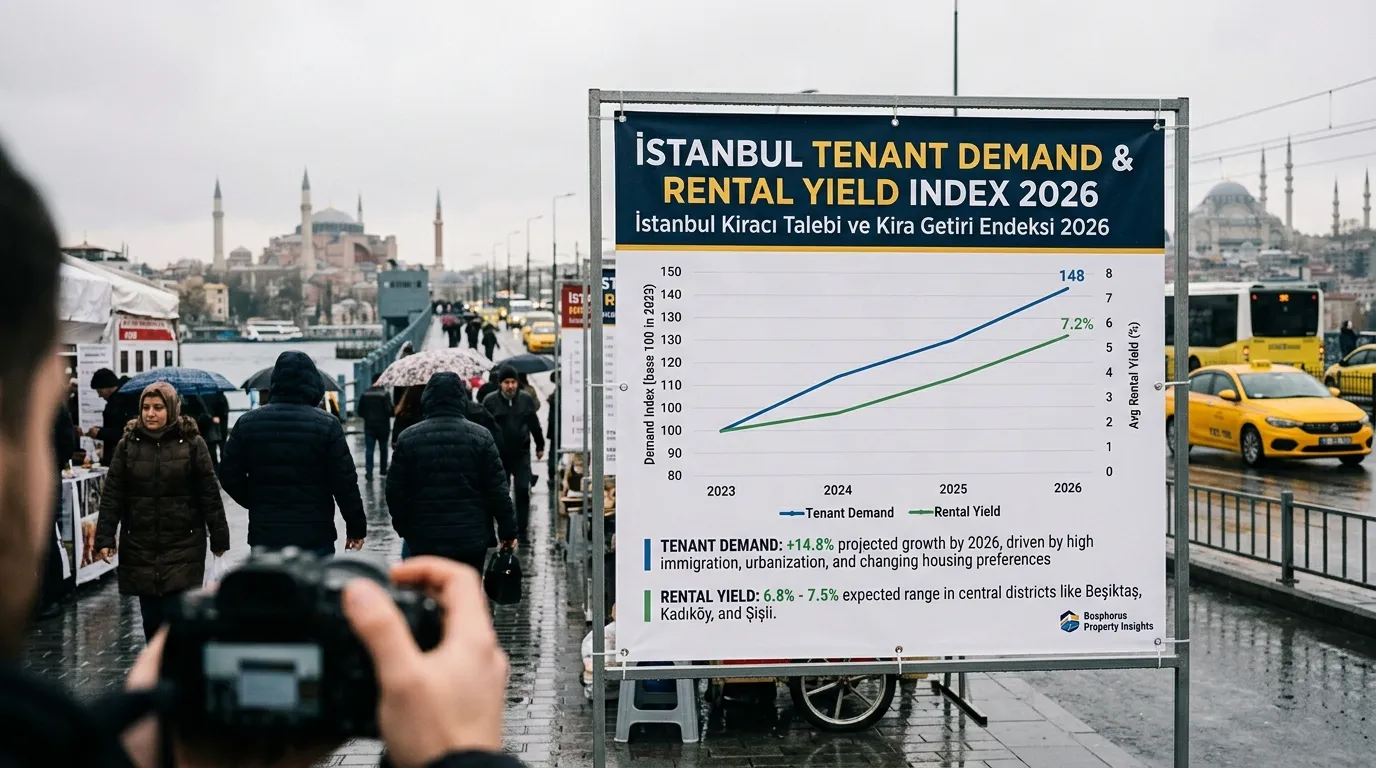
Istanbul Tenant Demand & Rental Yield Index 2026: The Ultimate Investor's Guide
Istanbul's property market in 2026 is becoming a very different animal from the one international investors became accustomed to during the previous decade. For years, the standard investment pitch was relatively straightforward: buy an apartment, wait for property prices and the Turkish lira value of rents to rise, and concentrate primarily on capital appreciation. That strategy has not disappeared, but the investment equation has changed. Rental income, tenant quality, occupancy, building safety, operating costs, and genuine net yield now matter much more. An apartment that looks spectacular in a sales brochure but sits empty for six weeks between tenants can be a worse investment than an ordinary-looking property beside a metro station that rarely spends a day without an occupant. Istanbul investors are consequently beginning to think less like property collectors and more like operators of small income-producing businesses.
That distinction is particularly important because Istanbul is not one homogeneous rental market. It is an enormous metropolitan economy containing premium Asian-side neighborhoods, European business districts, family-oriented residential communities, rapidly developing suburban corridors, student markets, industrial employment zones, and tourism-driven micro-markets. A gross rental yield advertised for Esenyurt cannot sensibly be compared with a Kadıköy yield without considering vacancy, tenant turnover, building quality, liquidity, management expenses, and the likely tenant profile. The same principle applies when comparing conventional leases with furnished short-term accommodation. The highest advertised yield is rarely automatically the best risk-adjusted yield. Investors therefore need to examine the entire rental engine rather than staring at one percentage.
This 2026 guide approaches Istanbul through that income-investor lens. The yield ranges discussed below should be treated as market-oriented investment estimates rather than guaranteed returns, because achievable rents and sale prices can vary substantially even between neighboring streets and buildings. Turkey's inflationary environment also makes nominal year-on-year percentages unusually volatile, while exchange-rate movements can produce a very different return for an investor measuring wealth in euros, pounds, dollars, or another foreign currency. Before completing a purchase, investors should verify the property's current asking price against completed or comparable transactions, obtain several independent rental assessments, check title and legal documentation, investigate building and earthquake-related records, and model expenses rather than relying on a developer's headline yield. With those safeguards in place, Istanbul can be analyzed for what increasingly matters in 2026: how reliably each lira invested in property can produce sustainable rental cash flow.
The 2026 Real Estate Shift: A Yield-Driven Market
The most important change in Istanbul's 2026 property story is the growing importance of income. High financing costs have made affordability difficult for many would-be Turkish homeowners, particularly households that would normally use mortgages to move from renting into ownership. When mortgage financing becomes expensive relative to household income, some potential buyers postpone purchasing and remain tenants for longer. That does not automatically make every Istanbul apartment a profitable investment, but it can deepen the pool of renters competing for appropriately priced homes. For cash-rich investors, this creates an interesting asymmetry. The financing conditions that make property ownership difficult for leveraged domestic purchasers can simultaneously strengthen rental demand for investors who do not need expensive local debt to acquire their properties.
The result is a market in which rental fundamentals deserve at least as much attention as projected resale appreciation. Investors once willing to tolerate a mediocre tenant proposition because they expected rapid appreciation increasingly need to ask practical questions before purchasing. Who will rent this unit? What does that household earn? How long is it likely to remain? How many competing apartments exist in the same complex? Can the tenant reach work without driving? Is the building new enough to overcome earthquake-related concerns? What happens to the return if the property is vacant for 30 days? Those questions sound mundane compared with predictions of dramatic property-price growth, yet they determine whether a theoretical return becomes money in the bank.
This shift also exposes an important difference between nominal growth and real investment performance. Turkish property values and rents can record large increases in lira terms during periods of elevated inflation. A 25% increase sounds extraordinary in a low-inflation economy; in Turkey, however, that figure needs to be interpreted alongside consumer-price inflation, construction costs, wage growth, exchange-rate movements, and the investor's base currency. The same caution applies to rents. Rapid rental growth can improve the income stream, but maintenance, management, insurance, taxes, furnishing, and turnover expenses may also rise. The successful 2026 investor therefore does not simply chase the district reporting the fastest percentage growth. The better objective is to find durable tenant demand at a purchase price that leaves sufficient margin after realistic operating friction.
Rent Growth vs. Property Price Appreciation
One of the strongest arguments for viewing Istanbul as an increasingly yield-oriented market comes from the relationship between rents and residential property values. Mid-2026 market discussions have placed nominal residential price growth in roughly the mid-20% range, while measures tracking newly agreed rents have in some periods indicated considerably faster annual increases, broadly around the low-to-high 30% range depending on the dataset, location, and measurement period. These figures should not be treated as a universal Istanbul-wide promise: official indices, listing datasets, appraisal data, and new-tenant rent measurements use different methodologies. Yet the direction matters. When new rents rise faster than acquisition prices for a sustained period, the rent-to-price relationship can improve, potentially expanding gross yields for newly purchased investment properties.
Imagine two apartments. Property A costs TRY 8 million and generates TRY 35,000 per month, while Property B costs TRY 5 million and generates TRY 32,000. The first may be located in a more prestigious neighborhood and may ultimately prove the stronger capital-preservation asset, but its initial gross yield is only about 5.25%. The second produces roughly 7.68% gross, despite charging a slightly lower monthly rent. That simple example illustrates why the absolute rent is almost meaningless without the acquisition price. Yield measures the relationship between the two, and in a city with enormous differences in land values, prestige premiums, building ages, and tenant demographics, that relationship can change dramatically from district to district.
Investors should also distinguish new-tenant rental growth from the income generated by an existing lease. A market index showing rents rising by 35% does not mean every landlord can immediately increase an occupied apartment's rent by the same percentage. Turkish residential leases operate within a legal framework governing rent adjustments and tenant protections, and the applicable rules should be checked at the time an increase is proposed. New leases, meanwhile, can reveal current market conditions more quickly because they reset when a property returns to the market. This creates a trade-off. Tenant turnover may allow rent to reconnect with current market pricing, but turnover also creates vacancy, marketing, cleaning, repair, and brokerage costs. Maximum rent growth and maximum investment profitability are not necessarily the same thing.
Set your budget and goal to get a personalized purchase plan and matching projects.Deal AI Investment Advisor
Your Investment Purchase Plan
📍 AI Recommended Areas
🏆 Top :count Projects for You
The Reality Check: Gross vs. Net Rental Yields
Gross yield is seductive because it is wonderfully simple. Take the property's annual rent, divide it by the acquisition price, and multiply the result by 100. If an apartment costs TRY 6 million and produces TRY 40,000 a month, its annual rent is TRY 480,000 and its headline gross yield is 8%. A sales agent can put that number in bold letters, and at first glance the investment looks easy to understand. The trouble begins after the tenant moves in. Real property has expenses, and those expenses are precisely where an apparently exceptional investment can become merely average.
A more useful model begins with effective rental income rather than perfect occupancy. Assume that same TRY 40,000-a-month apartment experiences one month of economic vacancy during a year. Collected rent falls from TRY 480,000 to TRY 440,000 before considering any other expense. Now subtract management costs if the owner lives abroad, routine maintenance, landlord-paid building charges where applicable, insurance, periodic repainting, appliance replacement, legal or accounting expenses, and the cost of sourcing a new tenant. Furnished properties introduce another layer because furniture has a finite life. Short-term accommodation takes the principle even further: cleaning, utilities, linen, guest communication, platform commissions, dynamic pricing, and licensing compliance can consume a surprisingly large share of revenue. An advertised 10% gross yield can therefore produce a materially smaller net operating yield.
This is why comparing Istanbul districts requires more than putting headline percentages in a league table. The ranges below illustrate how different strategies can behave; they are underwriting ranges rather than promises and should be validated against the exact property before purchase.
| Istanbul market type | Indicative gross-yield range | Possible stabilized net range* | Vacancy/turnover profile | Typical investor appeal |
|---|---|---|---|---|
| Kadıköy / prime Şişli | 5.5%–6.5% | 4.3%–5.5% | Generally low in well-priced units | Capital preservation, liquidity |
| Başakşehir / Ataşehir | 6.0%–8.0% | 4.8%–6.7% | Low-to-moderate | Balanced income, family demand |
| Esenyurt / Beylikdüzü | 8.5%–10.5% | 6.0%–8.5% | Moderate; highly project-dependent | Higher cash yield |
| Beyoğlu tourism micro-markets | 10%–14% gross revenue potential | Highly variable | Seasonal/operational | Active short-term strategy |
*Illustrative only. Net results depend on acquisition price, occupancy, taxes, management, maintenance, building dues, furnishing, regulation, financing, and individual property performance.
The investor's real target should therefore be risk-adjusted net yield. A consistently occupied 6% gross property with inexpensive management can outperform a supposedly 9% property that requires frequent repairs and repeatedly loses several weeks of rent. Think of gross yield as the speedometer in a car: useful, but it tells you nothing about fuel consumption, maintenance, or whether the road ahead is full of potholes. Net yield tells you much more about the journey.
2026 Istanbul District Yield & Demand Breakdown
District-level analysis is essential in Istanbul, but even district averages can conceal enormous differences. Kadıköy alone contains expensive waterfront and heritage neighborhoods, dense urban streets, newer residential projects, student-friendly areas, and properties with dramatically different access to rail and ferry connections. Şişli includes both prestigious central addresses and buildings whose age or physical condition substantially affects tenant demand. Başakşehir's modern residential compounds behave differently from older standalone buildings, while Esenyurt contains thousands of units spread across projects of sharply varying construction quality, management standards, occupancy, and reputation. An Istanbul district is a screening tool, not an investment thesis by itself.
Investors should consequently analyze Istanbul at three levels: district, neighborhood, and building. The district tells you about broad employment, transportation, schools, hospitals, retail infrastructure, and tenant demographics. The neighborhood tells you whether residents can walk to everyday services and transit, whether the immediate streets are desirable, and how much competing inventory exists. The building determines the final rental product. Age, structural documentation, elevators, parking, security, insulation, heating, communal facilities, monthly dues, floor level, sunlight, view, and unit layout can all influence the rent and speed of occupancy. In 2026, earthquake awareness makes this building-level filter even more important than it was during earlier investment cycles.
A useful Istanbul tenant demand index should therefore avoid treating yield as the only score. An investor might conceptually rate each candidate from one to five for tenant depth, transport access, building resilience, achievable rent, vacancy risk, operating costs, resale liquidity, and supply competition. A property earning slightly less rent but scoring strongly across every other category can be the superior asset. Foreign investors should pay particular attention to management complexity because distance magnifies small problems. A broken boiler that a local owner can resolve in an afternoon may become an expensive management issue for somebody living 3,000 kilometers away. Istanbul's highest-performing rental investment is consequently not always the property with the largest percentage printed on a spreadsheet. It is the one where location, tenant profile, acquisition price, building quality, and operational burden fit the investor's actual strategy.
The Central Premium: Kadıköy & Şişli — Low Yield, Low Vacancy
Kadıköy and Şişli demonstrate why sophisticated investors sometimes deliberately accept lower headline yields. Both offer deep tenant pools because they sit inside Istanbul's established urban fabric, although their tenant profiles and neighborhood character vary considerably. Kadıköy combines Asian-side lifestyle appeal with ferry, metro, Marmaray, bus, retail, restaurant, education, and cultural infrastructure. Şişli, meanwhile, sits close to major employment and commercial areas and provides access to central Istanbul's extensive transport network. Well-positioned apartments can appeal to professionals, managers, couples, students with stronger budgets, corporate tenants, and some international residents. When a good property is correctly priced, demand can be resilient enough to keep economic vacancy comparatively low, although describing any district literally as having zero vacancy would overstate what a landlord can safely assume.
That stability comes at a price. Investors buy not only the apartment but also the scarcity and prestige of the location, so acquisition values can run high relative to rent. Gross yields in an illustrative 5.5%–6.5% band may therefore look unexciting beside suburban opportunities approaching high single digits. Yet yield comparisons change once friction enters the calculation. Suppose a prime apartment achieves 6.2% gross, remains occupied for almost the entire year, attracts a financially stable tenant, and needs little intervention. Compare it with a 9% suburban unit that loses a month between tenants, requires repeated brokerage or marketing expenditure, carries high complex dues, and experiences heavier wear. The spread in actual owner income can narrow quickly.
The primary risk in central Istanbul is overpaying for prestige or buying obsolete stock. A famous neighborhood name cannot compensate for structural uncertainty, an impractical layout, poor natural light, excessive renovation needs, or a building that tenants increasingly avoid because of earthquake concerns. Investors should also resist treating every expatriate or corporate tenant as automatically superior; tenant screening and properly drafted contracts remain necessary. For investors prioritizing capital preservation, strong resale liquidity, convenient management, and durable urban demand over maximum current income, however, carefully selected Kadıköy and Şişli properties can occupy an attractive place in a diversified Istanbul portfolio. Their investment case is less about winning the gross-yield contest and more about reducing the number of things that can interrupt the rent cheque.
The Family Demand Hubs: Başakşehir & Ataşehir — Balanced Returns
Başakşehir and Ataşehir occupy an interesting middle ground between expensive central districts and aggressively priced outer-suburban yield plays. Their attraction comes from a simple feature that property investors sometimes underestimate: families organize housing decisions around daily life rather than investment narratives. Schools, hospitals, employment access, parks, shopping, parking, security, transportation, apartment size, and predictable building management can matter more to a long-term household than fashionable nightlife or postcard views. Properties that solve these everyday needs can create sticky tenant demand, and sticky tenants are valuable because every avoided turnover event protects the landlord from vacancy and reletting costs.
Başakşehir benefits from substantial modern residential development and major infrastructure, including the Başakşehir Çam and Sakura City Hospital, one of the area's most important employment and service anchors. Modern compounds can attract families seeking larger layouts, parking, security, green space, and newer construction. Ataşehir has a different but equally powerful demand engine: its position on Istanbul's Asian side and relationship with the Istanbul Financial Center strengthen its relevance to white-collar and professional employment. Transport connectivity also matters enormously. A family may happily live farther from Istanbul's historic center when the commute is manageable and essential services sit close to home. This is why an apartment's walking route to a metro entrance can sometimes matter more than its straight-line distance on Google Maps.
For underwriting purposes, carefully selected properties in these broad family-demand markets may be examined around an indicative 6%–8% gross-yield spectrum, although actual performance varies substantially by project, unit, purchase price, and lease. The sweet spot is often a practical one- to three-bedroom property in a well-run building where the service charge does not swallow too much rent. Investors should be particularly cautious about luxurious developments with enormous pools, landscaping programs, reception services, and recreational facilities if those amenities create monthly dues that tenants resist paying or that ultimately reduce owner profitability. The ideal family rental is not necessarily the flashiest apartment. It is the home where a household can imagine staying for several years. For investors who want a balance between respectable income, lower turnover, modern housing stock, and a broad domestic tenant base, Başakşehir and Ataşehir deserve serious attention.
The High-Yield Outer Suburbs: Esenyurt & Beylikdüzü — High Yield, High Friction
Esenyurt and Beylikdüzü are where Istanbul's yield conversation becomes more aggressive. Lower acquisition prices relative to achievable rents can push selected properties toward an illustrative 8.5%–10.5% gross-yield range, making these districts immediately attractive on a spreadsheet. The arithmetic can look compelling: why accept 6% in a central location when another apartment appears to offer nine or ten? Yet this is precisely where investors need to stop treating gross yield as a trophy. Outer-suburban markets can contain substantial competing supply, very different project standards, varying tenant affordability, longer commutes, and higher turnover. A strong building can perform well while another development a short distance away struggles. Project selection is therefore often more important than the district label.
Esenyurt in particular is a huge and diverse market. Investors should investigate actual building occupancy, management quality, title status, service charges, elevator and common-area maintenance, surrounding retail, transportation, tenant demographics, and the volume of comparable apartments simultaneously advertised for rent. A development containing dozens of nearly identical investor-owned units creates a miniature commodity market: when several owners need tenants at once, renters can negotiate aggressively. Beylikdüzü can offer a somewhat different family-oriented proposition in selected neighborhoods, especially where buildings, transportation, retail, and lifestyle infrastructure work together. Yet the same rule applies. A high advertised rent means little if competing landlords repeatedly discount to secure occupancy.
The mathematics of vacancy explains the danger. A property generating TRY 30,000 monthly produces TRY 360,000 annually at perfect occupancy. Lose one month and revenue immediately falls to TRY 330,000—a reduction of 8.3% in annual rent before any other turnover expense. Add repainting, cleaning, repairs, brokerage, and management, and the supposed yield advantage over a stable central property can shrink substantially. High-yield suburban investing therefore works best when investors behave like disciplined operators: buy below comparable value, select buildings with genuine tenant utility, maintain the property properly, price rent realistically, screen tenants, and maintain a cash reserve for vacancies and repairs. For an investor willing to accept greater management intensity, the outer suburbs can produce compelling income. For someone seeking a completely passive asset from overseas, the same headline yield can become a mirage.
Short-Term Rental Anomalies: Beyoğlu & Tourist Zones
Beyoğlu is the part of Istanbul where conventional rental-yield mathematics can suddenly stop behaving conventionally. In micro-markets around Galata, Karaköy, Cihangir, Taksim, and other heavily visited central neighborhoods, a furnished apartment sold by the night can generate substantially more gross revenue than the same unit leased to a conventional long-term tenant. Under favorable assumptions, investors may encounter projections equivalent to roughly 10%–14% gross annual revenue yields. That number is understandably tempting. A well-designed apartment within walking distance of tourist attractions, restaurants, nightlife, ferries, tram connections, and the historic peninsula can attract visitors who pay a significant nightly premium over the property's long-term rental equivalent. Yet short-term accommodation is not simply a higher-paying version of being a landlord. It is closer to running a small hospitality business, and that distinction changes almost everything about the investment.
Turkey's regulatory framework is the first hurdle. The country's short-term tourism-rental regime requires authorization for qualifying rentals of 100 days or less, subject to the applicable legislation and implementing rules. Investors need to establish whether a specific apartment can legally obtain and maintain the required tourism-rental permission before incorporating nightly rental income into an acquisition model. Building-level approval requirements and other restrictions can make an apparently perfect Airbnb-style property unsuitable for the strategy. Rules can also evolve, so foreign buyers should obtain current legal advice rather than relying on an old listing, an agent's verbal assurance, or the fact that another apartment in the neighborhood appears online. Buying first and investigating licensing afterward is the property equivalent of purchasing an airplane before checking whether you are allowed to fly it.
Operational expenses create the second reality check. Short-term rentals may involve platform commissions, professional management, guest communication, cleaning, laundry, utilities, internet, consumables, furniture replacement, maintenance, photography, dynamic pricing, insurance, licensing costs, and periods of weaker occupancy. Even a strong gross revenue figure can compress significantly after these expenses. Seasonality also matters. Investors should model a conservative annual occupancy rate and average daily rate, not multiply the best summer night's price by 365. A long-term tenant paying less but covering utilities and staying for years can sometimes generate a surprisingly competitive net return.
Beyoğlu therefore belongs in a separate category within an Istanbul rental yield index for 2026. It can offer extraordinary revenue density, but it demands regulatory due diligence and active management. Investors who already understand hospitality operations, have a reliable local management team, and purchase a legally suitable property may find the model compelling. Passive overseas investors should be much more cautious. In short-term rentals, gross revenue is the beginning of the calculation, not the answer.
Top Factors Driving Istanbul Tenant Demand in 2026
Tenant demand in Istanbul is not random. Renters repeatedly pay premiums for properties that remove friction from their lives, and understanding those preferences can help investors identify demand before it becomes obvious in historical yield statistics. Transportation is one of the strongest variables, but it operates alongside employment access, building age, perceived earthquake resilience, schools, hospitals, shopping, neighborhood safety, apartment efficiency, and monthly building dues. A beautifully finished apartment in the wrong place can remain vacant while an ordinary unit beside reliable public transportation attracts multiple inquiries. The reason is simple: tenants experience a home every day. A marble kitchen countertop is pleasant; saving forty minutes on a daily commute can be life-changing.
The second major shift is toward quality differentiation within the same neighborhood. Istanbul contains a vast amount of older housing alongside newer developments and buildings produced through urban transformation. Following devastating earthquakes elsewhere in Turkey and continuing awareness of Istanbul's seismic exposure, many households scrutinize building condition more seriously. This does not mean every new building is automatically safe or every old building unsafe; structural performance cannot responsibly be determined from age alone. It does mean that documentation, engineering confidence, construction standards, and the perception of resilience increasingly influence tenant decisions. Investors who ignore that preference may discover that a superficially cheap older apartment comes with a hidden discount in rentability and resale liquidity.
Employment anchors create another layer of demand. Hospitals, universities, financial centers, offices, industrial zones, technology employers, airports, and major commercial districts continuously generate households that need accommodation. The strongest rental locations often sit where employment and transportation overlap. A landlord does not need every Istanbul resident to want the property; they need a sufficiently deep pool of people whose daily routines make that location convenient. This is why investors should map a prospective property's realistic 30- to 45-minute commuting catchment rather than merely measuring kilometers from Sultanahmet or the Bosphorus.
Finally, affordability remains the invisible ceiling. Landlords can advertise any rent they wish, but sustainable tenant demand depends on household income. An investor should therefore ask whether the target tenant can comfortably support the proposed rent and building dues. When a property's projected yield depends on rents substantially above comparable household budgets, the spreadsheet is doing fantasy rather than finance. The best Istanbul rental markets combine willingness to pay with ability to pay, and the next two factors—transport and building quality—often determine exactly where those households concentrate.
Accessibility and Metro Expansions
Transportation in Istanbul is not merely an amenity; it is part of the property's economic infrastructure. Anyone who has experienced the city's scale understands why. A distance that looks manageable on a map can become a punishing commute when road congestion intervenes. Rail access changes the equation because predictable journey times allow residents to consider neighborhoods farther from their workplace without surrendering large parts of the day to traffic. Consequently, apartments within comfortable walking distance of metro, Marmaray, tram, or other high-capacity transit connections can command stronger tenant attention than otherwise comparable properties dependent on cars or multiple bus transfers.
Investors should nevertheless be precise when discussing new lines. Infrastructure projects have phases, extensions, opening dates, interchange arrangements, and sometimes delays. The M11 Gayrettepe–Istanbul Airport–Arnavutköy corridor, for example, affects accessibility in northern and northwestern parts of the city, while Asian-side rail connectivity around the M4 corridor and its connections shapes commuting choices across neighborhoods serving employment centers such as Ataşehir. But investors should never buy solely because a salesperson points at a future colored line on a map. Verify which station is operational, which section is under construction, how long the actual walk takes, and whether the route genuinely connects the target tenant with major employment destinations.
Walking distance deserves special attention. Saying that an apartment is "near the metro" can mean 300 meters on a pleasant pavement or two kilometers across an unpleasant highway interchange. Those are completely different rental products. Investors should physically walk the route where possible. Observe lighting, gradient, crossings, weather exposure, pedestrian safety, retail activity, and how the journey feels after dark. A genuine seven-minute walk to reliable rail can create a powerful advantage because it affects the tenant twice every working day.
Transport investment can also influence property values before a line opens, meaning the market may already have priced part of the expected benefit into the acquisition cost. That is why yield investors should compare the transport premium in purchase price with the transport premium in achievable rent. Paying 20% more for a metro-adjacent property that rents for only 5% more may reduce current yield, although stronger occupancy and resale liquidity could still justify the premium. The ideal scenario is not simply "buy near a metro." It is to acquire a property where connectivity produces measurable tenant demand without paying away the entire advantage at purchase.
The Earthquake Compliance Premium
No serious Istanbul property analysis in 2026 can treat seismic risk as a footnote. The city sits in a region with significant earthquake exposure, and both residents and investors have become increasingly attentive to the condition of the housing stock. For tenants, this concern is deeply practical. Two apartments may have similar floor plans and be separated by only a few streets, yet a newer property with credible engineering documentation, modern systems, and a well-maintained structure may receive much stronger interest than an older building whose condition is uncertain. That preference creates what investors increasingly describe as an earthquake-compliance or resilience premium—although the phrase needs careful handling because legal compliance and actual structural safety are not interchangeable concepts.
Building age is a useful initial filter, not a structural diagnosis. Investors should investigate the construction date, permits, occupancy documentation, renovations, ground conditions where relevant, structural modifications, and available engineering assessments. Properties produced through kentsel dönüşüm, or urban transformation, can attract tenants specifically because older structures have been replaced or substantially redeveloped. Yet investors should still perform building-specific due diligence. A newly completed façade does not replace engineering evidence, and an attractive lobby says virtually nothing about structural performance. When the stakes involve human safety as well as investment capital, professional assessment is one expense that should not be economized away.
The rental implications can be substantial. Imagine an older apartment offered at TRY 30,000 monthly and a newer alternative at TRY 35,000. A tenant may willingly pay the extra TRY 5,000 for perceived security, better insulation, parking, modern elevators, more efficient heating, and lower likelihood of disruptive repairs. From the investor's perspective, paying a higher purchase price for the newer unit can still make sense if it reduces vacancy, broadens the tenant pool, supports rent, and protects resale liquidity. The calculation must be performed rather than assumed, but quality can generate income indirectly through occupancy and tenant retention.
There is also a future-liquidity dimension. An investment property must eventually be sold, refinanced, inherited, or transferred. As buyers become more sophisticated about seismic exposure, buildings with uncertain structural characteristics may face deeper discounts or a smaller buyer pool. The cheapest square meter in a desirable district can therefore carry a hidden liability. Investors should resist the instinct to maximize apartment size at any cost. In 2026 Istanbul, a smaller unit in a well-documented, professionally assessed building can be a far more defensible rental asset than a larger apartment whose structural history leaves tenants—and eventually buyers—uncomfortable.
Risk Management & Operational Friction for Investors
Rental property looks passive from a distance because the income arrives monthly. Up close, it is an operating asset exposed to people, buildings, law, inflation, maintenance, and time. Istanbul magnifies that reality because rents and costs can change rapidly in nominal terms, neighborhoods differ dramatically, and foreign owners may be managing from another country. A sensible investor therefore constructs the downside case before admiring the upside case. What happens if the apartment sits vacant for six weeks? What if an appliance fails? What if the tenant leaves immediately before a planned rent review? What if building dues rise sharply? What if the owner needs legal representation? If one ordinary problem destroys the projected return, the property was never truly yielding what the spreadsheet claimed.
A practical underwriting model should contain explicit allowances for vacancy, recurring maintenance, major replacement reserves, management, taxes and insurance applicable to the owner, and tenant-acquisition costs. Investors should also examine the building's monthly aidat, or common-area charge. Luxury compounds can look attractive because they provide security, gyms, pools, landscaped grounds, and extensive communal services, but someone has to pay for those facilities. If dues become too high, tenants may discount what they are willing to pay in base rent, while owners can remain exposed to certain charges depending on the lease and applicable rules. The building's operating budget therefore deserves nearly as much attention as the apartment itself.
Currency adds another risk for international investors. A landlord may experience substantial nominal rent growth in Turkish lira while receiving a much smaller increase—or even a decline—when income is translated into euros, pounds, or dollars. Investors whose future expenses or financial goals are denominated outside Turkey should model returns in both TRY and their home currency. Capital appreciation should receive the same treatment. A spectacular lira gain does not automatically produce an equally spectacular hard-currency return.
Risk management does not mean avoiding Istanbul. It means pricing uncertainty rather than pretending it does not exist. Keep a liquidity reserve, use realistic occupancy assumptions, obtain independent legal advice, inspect the building, verify title and permits, understand the tenant segment, and establish who will handle emergencies before the first lease begins. A property that survives conservative assumptions is much more interesting than one that works only under perfect conditions.
Managing Tenant Turnover & Vacancy Rates
Vacancy is one of the most underestimated expenses in rental investing because it rarely appears as an invoice. No one sends the landlord a bill marked "empty apartment." The money simply fails to arrive. That makes vacancy psychologically easy to ignore when comparing properties, yet even a short empty period can materially reduce annual yield. A property rented for eleven months rather than twelve loses 8.33% of its potential annual rental revenue before the landlord spends anything on cleaning, repairs, advertising, brokerage, or management. Two vacant months remove 16.67%. Suddenly the difference between a theoretical 9% yield and a stable 6.5% property looks much less dramatic.
There is no responsible single "average vacancy time" that applies to every property in Kadıköy, Başakşehir, Beylikdüzü, or Esenyurt. Vacancy is intensely property-specific and changes with season, asking rent, unit size, furnishing, building quality, and local supply. For underwriting, however, investors can use conservative scenarios. A highly liquid central apartment might be stress-tested at two to four weeks of economic vacancy during turnover; a family-oriented unit might be modeled around a month depending on timing; and a higher-turnover or supply-heavy suburban property could be tested at one to two months. These are scenario assumptions, not measured district averages, and that distinction matters.
Tenant retention is often the cheapest vacancy strategy. Responding quickly to maintenance, keeping the apartment functional, communicating professionally, and avoiding unrealistic pricing can preserve a good tenant relationship. Landlords sometimes chase every last lira of theoretical market rent and accidentally trigger a departure that costs more than the attempted increase would have earned. If a reliable tenant pays slightly below the maximum possible market level but stays another year, the avoided vacancy and reletting expense may make the arrangement economically superior.
Foreign investors should also establish a turnover process before buying. Who photographs the property after departure? Who checks utilities and inventories? Who organizes repairs? Who markets it? Who screens applicants? Who holds keys? A competent local manager can be expensive when measured as a percentage of rent, but poor management is more expensive when measured through lost occupancy. The objective is not to eliminate vacancy—that is impossible—but to shorten avoidable gaps and incorporate unavoidable ones into the acquisition model from day one.
Legal Considerations for Foreign Landlords
Foreign ownership does not remove a landlord from Turkey's residential tenancy framework. Investors need to understand that residential tenants have legal protections and that lease relationships cannot be managed solely according to whatever produces the highest theoretical yield. Rent increases, lease renewals, deposits, eviction, notices, disputes, and tax obligations all operate within Turkish law. Rules can change, court interpretation matters, and individual facts can alter the legal position. For that reason, an investor should use a qualified Turkish lawyer and accountant for current advice rather than treating an online investor guide—including this one—as a substitute for professional counsel.
One particularly important issue is rent adjustment. Turkey previously applied an extraordinary temporary 25% cap on residential rent increases, but that temporary regime ended in 2024. The ordinary framework subsequently returned to calculations linked to the twelve-month average consumer price index, subject to the applicable provisions of the Turkish Code of Obligations and the circumstances of the tenancy. By 2026, landlords should check the current legally permitted adjustment when the relevant renewal date arrives rather than assuming they can simply apply whatever percentage appears in a new-rent market index. Existing-tenancy rules and asking rents for newly available properties are not the same thing.
Short-term rentals require an additional layer of caution because Turkey introduced a dedicated legal regime for tourism rentals of residences for periods of 100 days or less. Permit requirements, building-related approvals, identification rules, administrative obligations, and potential penalties can make compliance central to the investment case. Investors considering Beyoğlu, Galata, Karaköy, Cihangir, or another tourism market should make legal feasibility a pre-purchase condition, not a post-purchase administrative task.
Overseas ownership also makes professional property management more valuable. A good manager should do more than collect rent. The role may include tenant screening, contract administration, property inspections, maintenance coordination, payment tracking, compliance support, and documented communication. Investors should still supervise the manager, demand transparent statements, and understand exactly which expenses require approval. Legal protection begins with good documentation: title due diligence, properly drafted agreements, recorded payments, inventories where appropriate, and clear records of property condition. Istanbul can be an effective rental market for foreign owners, but distance makes improvisation expensive.
Conclusion & Strategic Takeaways
The Istanbul rental market in 2026 rewards investors who stop asking only, "Which district has the highest yield?" and start asking, "Which property produces the best sustainable return after risk and friction?" That change in perspective is the central thesis of this guide. Elevated financing costs can help sustain rental demand among households postponing ownership, while the relationship between rents and acquisition values can create interesting opportunities for cash purchasers. Yet headline market growth does not guarantee an attractive investment. Inflation, currency movements, vacancy, maintenance, management, tenant protections, building dues, and property-specific quality all sit between a gross yield and the money an investor actually keeps.
The district comparison reveals three broad strategies. Kadıköy and prime Şişli suit investors willing to sacrifice some headline yield for centrality, tenant depth, and liquidity. Başakşehir and Ataşehir can provide a middle path, with family and professional demand supported by modern housing, hospitals, employment centers, and transportation. Esenyurt and Beylikdüzü can produce stronger gross-income mathematics, but investors must earn that premium by accepting greater project-selection risk and operational complexity. Beyoğlu and other tourist areas belong in another category entirely because a short-term property is effectively a regulated hospitality operation rather than a conventional passive rental.
Across all four strategies, two filters stand above the noise: transport accessibility and credible building quality. Tenants pay for time, convenience, and confidence. A property that shortens the commute and provides a reassuring residential environment has structural advantages that decorative upgrades cannot easily reproduce. Investors should therefore examine the actual walking route to transit, the building's documentation and condition, surrounding employment, competing rental supply, realistic household affordability, and expected lease duration before negotiating a purchase.
The final lesson is deceptively simple. Buy the income stream, not the brochure. Stress-test that income, deduct the expenses, investigate the building, understand the tenant, and decide whether the resulting net return adequately compensates you for the risk. Istanbul still offers opportunities across very different budgets and investor profiles, but disciplined selection—not a district name—is what turns tenant demand into durable yield.
Where Should You Invest Your Capital in 2026?
There is no universally best Istanbul district because investors are buying different combinations of income, stability, liquidity, and operational responsibility. A conservative investor with substantial capital who values easy reletting and long-term desirability may prefer Kadıköy or carefully selected parts of Şişli. A 5.5%–6.5% indicative gross yield can be entirely rational when the underlying property attracts a deep tenant pool, experiences limited vacancy, and maintains strong resale appeal. The investor is effectively paying a premium for location quality and reduced operational uncertainty. That can be particularly attractive for overseas owners who do not want their property investment to become a second job.
Investors seeking balance should examine Başakşehir and Ataşehir. Here the thesis is less dependent on tourism or prestige and more connected to how Istanbul households actually live. Hospitals, financial employment, modern residential stock, family infrastructure, transportation, parking, and larger layouts can support longer tenancies. An indicative 6%–8% gross range can provide respectable cash flow without automatically taking on the tenant turnover associated with more aggressive yield markets. Individual projects still require careful analysis, especially because high common charges can erode the apparent advantage.
For investors prioritizing maximum conventional rental yield, Beylikdüzü and selected Esenyurt projects may offer more attractive entry-price-to-rent ratios. The key word is selected. Buying an arbitrary apartment simply because the district appears near the top of a yield table is dangerous. Investors need to examine competing supply, actual occupancy, project management, transportation, tenant affordability, dues, and resale liquidity. The extra yield should compensate for additional friction rather than conceal it.
Beyoğlu's tourist areas may appeal to experienced operators capable of legally running short-term accommodation, but projected Airbnb revenue should never be treated as guaranteed rental yield. For most investors, the strategic shorthand is straightforward: choose Kadıköy for defensive central exposure, Başakşehir or Ataşehir for balanced long-term demand, and carefully selected Beylikdüzü or Esenyurt properties when current income is the priority. Then ignore the shorthand and conduct building-level due diligence anyway. In Istanbul, the building you buy ultimately matters more than the district name you tell your friends.
If you are evaluating rental income opportunities in Istanbul, these related guides can help you build a more complete investment strategy. They cover commercial property with guaranteed rent, average rental prices by district, ROI potential, and rental income taxation in Turkey.
- The Secret to Passive Income: Istanbul Commercial Properties with Guaranteed Rent — Learn how guaranteed-rent commercial properties can support a more predictable passive-income strategy in Istanbul.
- Average Rent in Istanbul 2026: Prices by District, ROI & Investment Opportunities — Compare rental prices across Istanbul districts and explore potential ROI and property investment opportunities.
- Complete Guide to Rental Income Tax Rates in Turkey: 2026 Edition — Understand the key rental income tax considerations that property investors and landlords should factor into their net-yield calculations.












Have Question Or Suggestion ?
Please Share Your Thought, To Make It Real