The Ultimate Hedge: How Istanbul Real Estate Outpaced Inflation and Protected Capital in USD
Discover how Istanbul real estate preserved and grew wealth in USD despite inflation and currency volatility, making it a compelling long-term investment.
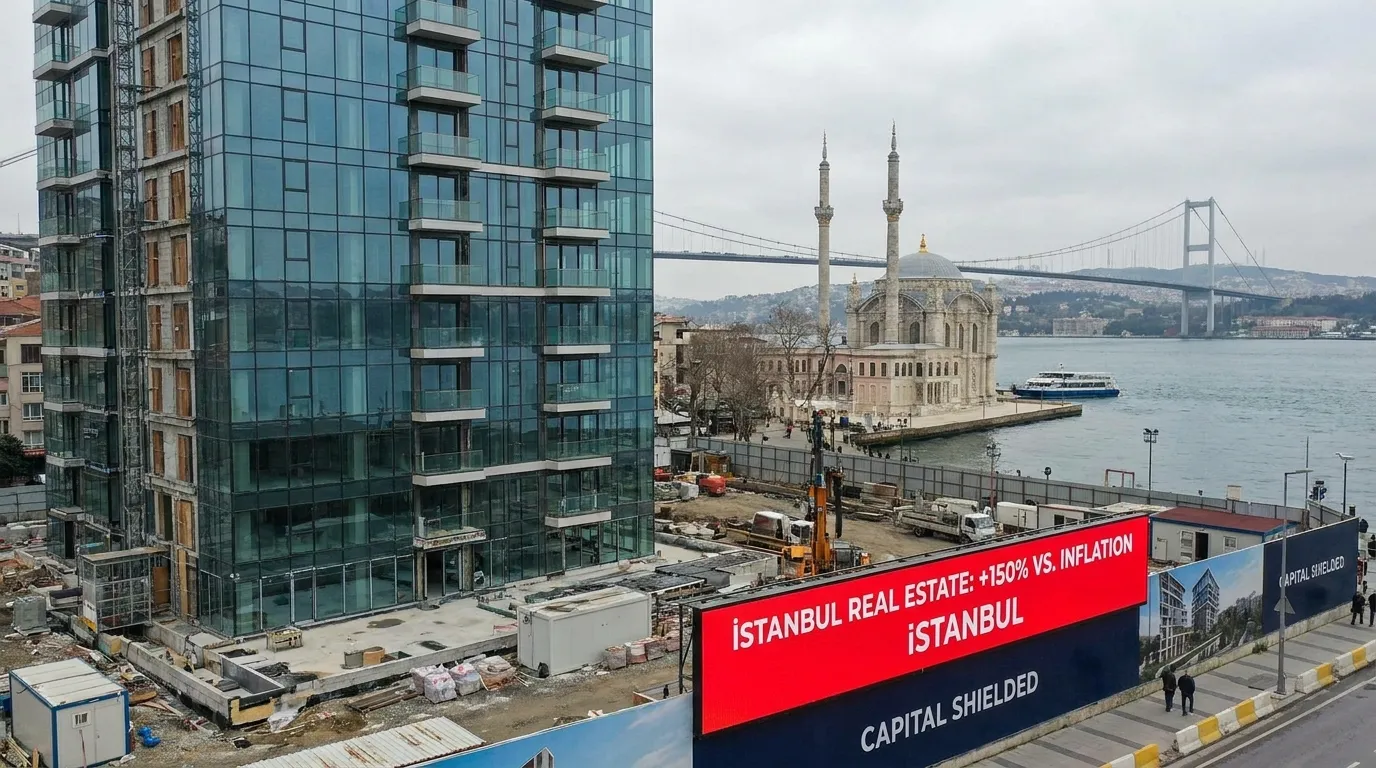
The Ultimate Hedge: How Istanbul Real Estate Outpaced Inflation and Protected Capital in Hard Currency
Why Currency Risk Is the First Question Investors Ask
Ask any serious international buyer about Turkey, and the first question usually arrives before the coffee does: “What about the Turkish Lira?” It is a fair question. Nobody wants to move hard-earned dollars, euros, or pounds into a market where the local currency can swing like a small boat in rough water. For domestic buyers, the fear is even more personal. Savings held in cash can feel like ice left in the sun, slowly melting as prices rise.
That is exactly why Istanbul real estate USD returns have become such an important topic. The smartest investors are not only asking whether prices rose in Turkish Lira. They are asking whether the asset preserved value in hard currency. That is the real test. A property can look impressive in local currency terms, but if it collapses when converted back into dollars or euros, the investor has not really protected capital.
Istanbul property is interesting because it sits at the crossroads of local inflation, foreign-currency demand, urban scarcity, rental growth, tourism, migration, and long-term demographic pressure. In other words, it is not just a local asset. A good Istanbul apartment in the right district can behave more like an internationally priced asset than a simple domestic purchase.
The Turkish Lira Problem in Plain English
Currency weakness is not some abstract financial concept. It affects everyday decisions. A buyer who keeps savings in Turkish Lira may see the number in the bank stay the same while groceries, rent, school fees, construction materials, and imported goods climb higher. For international investors, the fear is slightly different. They worry that they will buy an apartment, watch the Lira fall, and later discover that their property is worth less in dollars.
But here is the key distinction: cash and property do not react the same way to inflation. Cash is fixed. Property is repriced. When construction costs rise, land becomes more expensive, labor costs increase, and replacement value climbs. Developers cannot build tomorrow’s apartments at yesterday’s prices. That pushes the market upward over time, especially in a city where demand is deep and land is limited.
This does not mean every property wins. A badly located unit, overpriced project, weak developer, poor title structure, or low-demand district can still disappoint. But strong real estate has one major advantage over cash: it is tied to something physical, useful, and scarce. People need homes. Businesses need locations. Tenants need access to transport, schools, hospitals, universities, and lifestyle districts. That demand gives real estate a backbone.
Why Real Estate Behaves Differently From Cash
Think of cash as a measuring tape made of rubber. During inflation, the tape stretches, so everything appears more expensive. Real estate, on the other hand, is one of the things being measured. Its price often rises because the cost of land, cement, steel, permits, labor, and financing rises too. That is why property can become a natural inflation hedge.
Istanbul adds another layer. The city attracts domestic migration, foreign buyers, students, medical tourists, business travelers, and lifestyle investors. When a market has multiple sources of demand, prices are not dependent on one buyer group alone. This is one reason Istanbul has often remained attractive even during volatile periods.
For foreign investors, the magic happens when property values rise enough in local terms to offset currency weakness and still show appreciation in USD or EUR. That is the real “currency hedge” story. The goal is not to avoid volatility completely. The goal is to own an asset that can move through volatility without losing its purchasing power.
The 5-Year Istanbul Property Test
Let’s use an illustrative 5-year scenario. Imagine an investor purchased a well-located Istanbul apartment in 2019 for 1,500,000 TRY. At the time, assume the exchange rate was around 5.75 TRY per USD, making the entry price roughly $260,870. In euro terms, assuming about 6.45 TRY per EUR, the purchase price would have been around €232,558.
Now fast-forward five years. Due to inflation, construction cost increases, land scarcity, and stronger demand in selected districts, suppose the same apartment is now valued at 12,000,000 TRY. If the exchange rate is around 32 TRY per USD, the property is now worth about $375,000. In euros, assuming 35 TRY per EUR, it is worth roughly €342,857.
That means the property rose dramatically in Turkish Lira, but more importantly, it also appreciated in hard currency. The USD value increased from about $260,870 to $375,000, representing roughly 43.7% appreciation in USD. In EUR terms, it increased from about €232,558 to €342,857, or around 47.4% appreciation.
Entry Price: Buying in TRY, Thinking in USD
Smart foreign investors in Istanbul rarely think only in Turkish Lira. They may pay in TRY because the legal transaction happens locally, but mentally they calculate everything in dollars or euros. That mindset changes the entire investment process. Instead of asking, “Will this apartment rise in Lira?” they ask, “Will this apartment protect and grow my capital when I convert back to hard currency?”
That is the right question. The answer depends heavily on the entry price. A buyer who overpays during hype may wait years just to break even. A buyer who negotiates well, chooses a liquid district, checks comparable sales, and avoids weak projects has a much better chance of seeing real returns. In currency-volatile markets, buying correctly is half the profit.
The strongest Istanbul investments usually share a few traits: central or improving location, limited new supply nearby, strong rental demand, clean title deed, quality construction, good transport links, and realistic pricing. When those pieces line up, the property has a better chance of behaving like a hard-currency asset rather than a purely local-currency bet.
Current Value: What Happened After Inflation
Inflation can feel destructive, but for owners of scarce assets, it can also reprice wealth upward. In Istanbul, the cost to replace a quality apartment has increased significantly over recent years. Developers face higher material costs, land acquisition costs, labor expenses, financing pressure, and regulatory costs. Those pressures do not disappear. They become embedded in new-build pricing.
Existing apartments in strong locations often benefit from this. When new units become expensive, buyers compare them with resale properties and lift the entire price floor. This is why a well-bought apartment can rise even when the broader economy feels unstable. It is not magic. It is replacement cost economics.
For domestic buyers, this is especially powerful. A family holding savings in cash may lose purchasing power year after year. But a family that bought a quality Istanbul property may find that the asset adjusted with the economy. Instead of watching savings shrink, they now own something that became harder and more expensive to recreate.
USD and EUR Performance Snapshot
| Metric | 2019 Purchase | 2024/2025 Value | Approx. Gain |
|---|---|---|---|
| Value in TRY | 1,500,000 TRY | 12,000,000 TRY | 700% |
| Value in USD | $260,870 | $375,000 | 43.7% |
| Value in EUR | €232,558 | €342,857 | 47.4% |
This table tells the real story. The Turkish Lira price looks dramatic, but the hard-currency result is what matters most for international investors. The property did not merely “survive” inflation. In this illustrative case, it protected capital and produced a meaningful gain in dollars and euros.
That is why the phrase “Istanbul real estate USD returns” matters. It cuts through the noise. Local inflation headlines can be scary, but the true investor question is whether the right property, bought at the right price, can outperform currency depreciation. In many strong Istanbul districts, the answer has often been yes.
Inflation vs. Istanbul Property Value
A dual-axis chart would show two lines moving upward: one for cumulative inflation and one for the property’s USD value. The inflation line would likely rise sharply in local terms, while the USD property value line would show whether the investment truly protected international purchasing power.
| Year | Indexed Inflation | Property Value in USD |
|---|---|---|
| Year 0 | 100 | $260,870 |
| Year 1 | 115 | $275,000 |
| Year 2 | 145 | $295,000 |
| Year 3 | 210 | $320,000 |
| Year 4 | 310 | $350,000 |
| Year 5 | 430 | $375,000 |
The point is not that every apartment follows this exact path. It does not. The point is that real estate can reprice while cash cannot. When inflation pushes construction costs and replacement values higher, good property may become more valuable in both local and hard currency.
What the Numbers Really Mean
The biggest mistake investors make is treating Turkey as one single market. It is not. Istanbul is not the same as a small inland town. A Bosphorus-view apartment is not the same as a distant, oversupplied suburb. A walkable district near metro access is not the same as a project with weak transport links. Real estate is local down to the street level.
So, when someone asks, “Is it safe to invest in Turkey right now?”, the honest answer is: it depends on the asset, the price, the holding period, and the legal structure. Turkey carries currency risk, policy risk, and liquidity risk. But it also offers demographic strength, international appeal, attractive entry prices compared with many global cities, and real asset protection against inflation.
For cautious investors, the safest approach is not speculation. It is capital preservation first, upside second. That means buying property with real demand, real rental potential, and realistic resale appeal. In Istanbul, the best hedge is rarely the flashiest brochure. It is usually the property that ordinary people and international buyers will still want five or ten years from now.
Why Istanbul Real Estate Can Work as a Currency Hedge
Istanbul works as a potential currency hedge because it is not just a city; it is an economic engine. More than a historic destination, it is Turkey’s financial, cultural, educational, medical, and commercial center. That gives its real estate market a depth many smaller markets cannot match.
The city also benefits from emotional demand. People do not buy in Istanbul only for spreadsheets. They buy because they want access, prestige, lifestyle, safety, education, business networks, healthcare, and mobility. That emotional layer supports pricing in prime areas, especially when supply is limited.
Hard assets tend to become more attractive when trust in currency weakens. Gold, land, and property often become safe harbors. Istanbul real estate sits in that category for many Turkish families and foreign investors. It is visible, rentable, usable, inheritable, and sellable. That combination makes it powerful during inflationary cycles.
Hard-Currency Demand From Foreign Buyers
Foreign buyers bring another layer of support. When buyers enter with dollars, euros, pounds, or Gulf currencies, they often compare Istanbul prices with London, Dubai, Berlin, Paris, or Athens. From that angle, Istanbul can look undervalued, especially in central locations or high-quality lifestyle districts.
This hard-currency demand can help stabilize premium segments. If local purchasing power weakens, foreign buyers may still find value. That does not remove risk, but it can create a stronger buyer base than a market dependent only on local salaries.
For sellers, this matters. A property that appeals only to local buyers is exposed to local affordability. A property that appeals to both Turkish and international buyers has a wider exit market. Wider exit markets usually mean better liquidity, and liquidity is one of the most underrated forms of safety in real estate.
Risks Investors Should Not Ignore
No serious article about Turkish property should pretend there are no risks. Currency volatility is real. Regulations can change. Taxes, title rules, residence requirements, and citizenship investment rules may shift. Some developers overpromise. Some districts are oversupplied. Some rental assumptions are too optimistic.
There is also timing risk. A buyer who needs to sell quickly during a weak market may not capture the full benefit of long-term appreciation. Real estate is not a savings account. It works best with patience, due diligence, and a realistic holding period.
The safest investors treat Istanbul property like a business decision, not a vacation purchase. They verify title deeds, check earthquake compliance, compare real transaction prices, understand maintenance fees, calculate rental yields conservatively, and use independent legal advice. That discipline is what turns a risky market into a manageable opportunity.
How to Reduce Currency and Market Risk
The strongest strategy is simple: buy quality, avoid hype, and think in hard currency from day one. Set your budget in USD or EUR. Compare the purchase price with similar properties. Stress-test the investment using weaker exchange-rate assumptions. Ask what happens if rent is lower than expected or resale takes longer than planned.
A practical investor should also focus on liquidity. Can this property be sold easily? Does it appeal to families, professionals, students, expats, or foreign investors? Is it close to transport? Is the building well managed? Are monthly fees reasonable? These details may sound boring, but boring details often protect money.
For domestic buyers, the same principle applies. Instead of chasing the cheapest unit, look for the asset most likely to preserve purchasing power. In inflationary environments, cheap can become expensive if nobody wants to rent or buy it later.
Best Istanbul Areas for Inflation-Beating Real Estate
Prime central districts tend to offer stronger capital preservation. Areas such as Beşiktaş, Şişli, Kadıköy, Üsküdar, Bakırköy, and parts of Beyoğlu often benefit from established demand, lifestyle appeal, transport access, and limited land. These locations may not always deliver the highest percentage growth, but they often provide better liquidity and resilience.
Growth corridors can also perform well when infrastructure improves. Districts connected to new metro lines, business hubs, universities, hospitals, or urban renewal zones may offer stronger upside. However, they require more careful research because future growth is never guaranteed.
The best choice depends on the investor. A conservative buyer may prefer a central resale apartment with proven rental demand. A growth-focused buyer may accept more risk in a regeneration area. A lifestyle investor may choose a sea-view or branded residence. The key is matching the asset to the goal.
Conclusion
Istanbul real estate can be a powerful currency hedge when the property is selected carefully, bought at a fair price, and held through a realistic time horizon. The real story is not just that prices rise in Turkish Lira. The stronger story is that quality assets can protect and even grow capital in USD and EUR, despite inflation and currency volatility.
For buyers asking, “Is it safe to invest in Turkey right now?”, the answer is not a blind yes. It is a strategic yes for investors who do due diligence, think in hard currency, avoid weak locations, and focus on real demand. Istanbul rewards smart buyers, not careless ones.
FAQs
Is Istanbul real estate a good hedge against inflation?
Yes, quality Istanbul real estate can act as an inflation hedge because property values often adjust with construction costs, land scarcity, and rental demand.
Can Istanbul property protect capital in USD?
It can, especially in prime or high-demand districts. The key is buying at the right price and measuring performance in USD from the beginning.
Is it safe to invest in Turkey right now?
It can be safe with proper legal checks, conservative pricing, strong location selection, and a long-term holding strategy.
Should foreign investors worry about the Turkish Lira?
They should account for Lira volatility, but they should not assume it automatically destroys returns. Strong assets may appreciate enough to protect hard-currency value.
What is the best strategy for USD returns?
Focus on liquid Istanbul locations, negotiate the entry price, avoid oversupplied projects, calculate returns in USD, and hold long enough for inflation-linked appreciation to work.







Have Question Or Suggestion ?
Please Share Your Thought, To Make It Real