Turkey Property Cost Calculator 2026: Taxes, Fees & Total Buying Costs
Calculate the real cost of buying property in Turkey, including Tapu fees, taxes, legal costs, agent commissions, insurance, and hidden expenses.
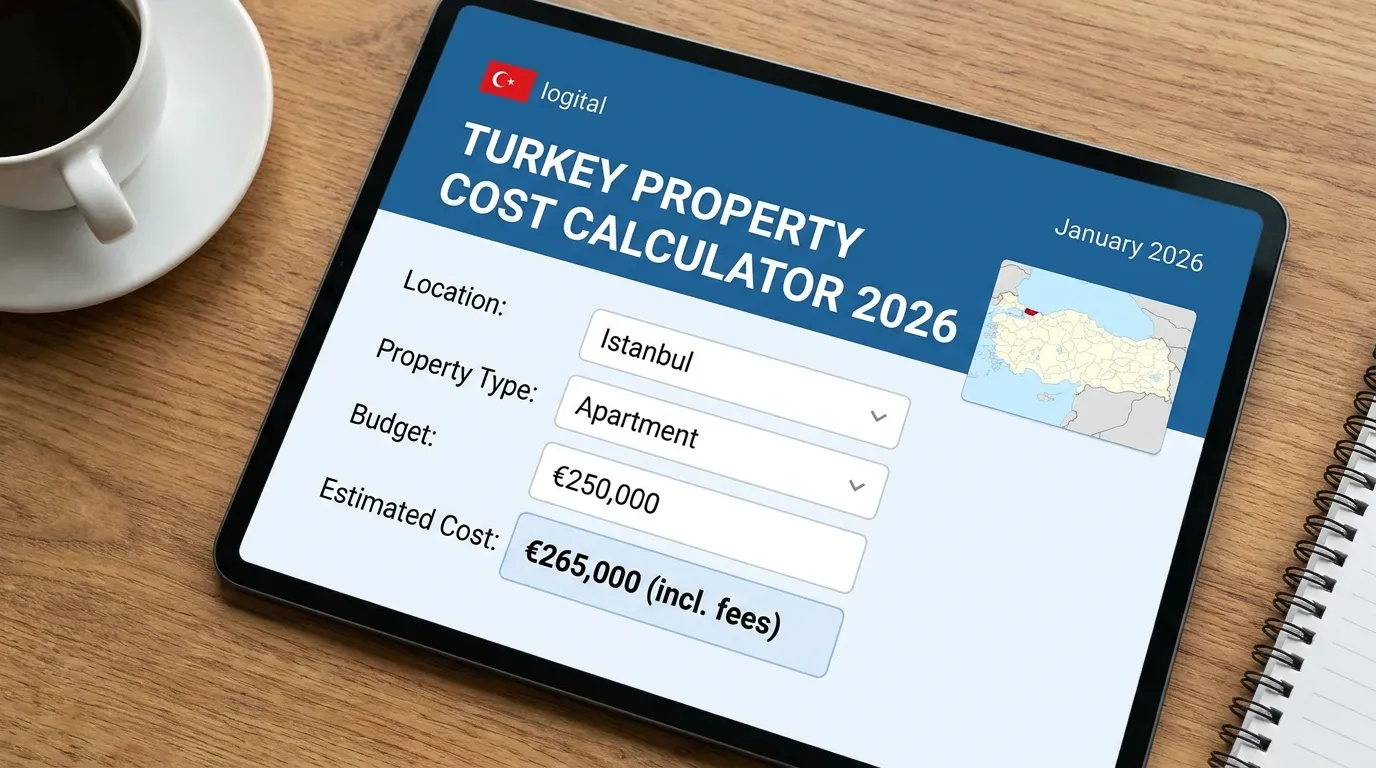
Turkey Property Cost Calculator: Complete Guide to Buying Costs, Taxes, Fees, and Total Budget
Buying a home in Turkey can look surprisingly straightforward when you first browse property listings. You see an apartment advertised for €150,000, $200,000, or perhaps a price denominated in Turkish lira, and it is tempting to treat that figure as the amount you need in the bank. Yet the advertised price is only the starting line. Taxes, registration charges, valuation expenses, legal work, agency fees, insurance, utility setup, currency conversion, furnishings, and property-specific charges can all increase the amount you eventually spend.
That is exactly why a Turkey property cost calculator is useful. Instead of looking at a listing price in isolation, a calculator helps you estimate the real amount required to complete the transaction and take possession of the property. Think of it like booking a flight: the headline fare catches your eye, but baggage, seat selection, airport transport, insurance, and exchange-rate fees determine what the trip actually costs. Property purchases work in much the same way, only the financial stakes are considerably higher.
A good calculator should therefore answer a simple question: “If this property costs X, how much money should I realistically prepare from beginning to end?” The answer depends on the property, location, buyer profile, payment structure, and current Turkish regulations. Certain taxes are calculated as percentages, while other expenses may be fixed, negotiated, or based on the service provider you choose. Foreign buyers can also encounter expenses that local buyers may not notice as much, such as sworn translation, document legalization, power-of-attorney preparation, and foreign-currency conversion.
This guide breaks those costs into practical categories so you can build a realistic buying budget rather than relying on a rough guess. Because taxes, official tariffs, exchange rates, insurance premiums, and administrative charges can change, any calculator should be treated as a planning tool rather than a final legal quotation. Before transferring money, confirm the current figures with the relevant land registry office, municipality, licensed lawyer, bank, insurer, and other professionals involved in your transaction.
What Is a Turkey Property Cost Calculator?
A Turkey property cost calculator is a budgeting tool designed to estimate the total financial commitment involved in purchasing real estate in Turkey. At its simplest, you enter the purchase price and add expected taxes and transaction expenses. A more useful calculator goes further by accounting for title deed charges, agency commission, valuation expenses, legal fees, insurance, utilities, translation services, currency conversion, and any initial furnishing or renovation budget. Instead of asking whether you can afford the asking price, it helps you decide whether you can afford the entire purchase process.
That distinction matters because buyers often think in round numbers. Imagine you have allocated €200,000 to purchase a Turkish apartment. You find a property listed at exactly €200,000 and assume it fits your budget perfectly. In reality, committing every euro to the property price leaves nothing for closing expenses. A calculator forces you to reserve room for the transaction itself. Depending on the circumstances, even a modest percentage added to the price can represent thousands of euros, pounds, dollars, or hundreds of thousands of Turkish lira.
The calculator is particularly useful when comparing properties. A resale apartment in Istanbul may carry a different cost structure from a new-build property in Antalya, a villa in Bodrum, or a unit bought directly from a developer. Some sellers may include particular expenses in the negotiated package, while others may expect the buyer to cover nearly everything. Agency arrangements also differ. Rather than comparing two homes solely on their sale prices, you can compare their estimated all-in acquisition costs.
Foreign buyers gain another benefit: predictability. Purchasing in another country involves unfamiliar terminology, institutions, documents, and payment procedures. A clear cost model transforms that uncertainty into categories you can investigate one by one. You may not know the precise amount of every item on day one, but once you know what to ask about, you are far less likely to be surprised later. That is the real purpose of a property calculator—not mathematical perfection, but better financial visibility before you commit.
Why the Property Price Is Only Part of Your Real Budget
The asking price of a Turkish property tells you what the seller wants for the real estate, but it does not automatically tell you what you will spend to acquire, register, insure, and prepare that property for use. This gap between purchase price and total acquisition cost is where many inexperienced buyers underestimate their budget. A property may technically cost 5 million Turkish lira while your overall cash requirement is significantly higher after transaction expenses are included.
One reason is that property ownership must be formally transferred. That process creates registration and tax obligations. Turkey uses the title deed, commonly known as the Tapu, as the core ownership document, and a transfer through the official land registry involves charges that should be factored into your calculation. You may also need a valuation report, particularly in transactions involving foreign nationals or circumstances where an official assessment is required. These are not glamorous expenses, but they are part of turning a signed agreement into legally registered ownership.
Professional support is another layer. A buyer may choose to hire an independent lawyer to review the title, investigate debts or restrictions, check the contract, and represent the buyer through a power of attorney when necessary. An estate agent may also charge commission depending on the transaction. Foreign documents can require notarization, translation, or legalization. Banks may charge transfer or currency-conversion fees. Even when each individual cost seems manageable, the combined amount can meaningfully change your budget.
Then there is the property itself. Does it need furniture? Are appliances included? Will you pay a site-management contribution immediately? Does the building have outstanding communal costs? Will electricity, water, gas, or internet services need to be opened or transferred? A beautifully presented purchase price can hide a long tail of smaller payments.
For that reason, experienced buyers often work backward. Instead of saying, “I have €200,000, so I can buy a €200,000 property,” they ask, “I have €200,000 in total; what purchase price leaves enough room for every other expense?” That simple change in thinking is one of the smartest ways to use a Turkey property cost calculator.
How to Calculate the Total Cost of Buying Property in Turkey
Calculating the total cost of a property in Turkey is easier when you treat the transaction as a set of financial layers. Start with the agreed purchase price, then add compulsory taxes and government charges, followed by professional services, financing or banking costs, property setup expenses, and an emergency reserve. The formula does not need to be complicated. In practical terms, your calculation can look like this: purchase price + transfer costs + professional fees + administrative costs + insurance + setup expenses + contingency allowance = estimated total cash requirement.
The most important rule is to separate percentage-based expenses from fixed or variable expenses. For example, a tax linked to the declared property value may rise as the value rises. A lawyer, translator, notary, valuation expert, insurer, or utility provider may instead quote a specific amount. Estate-agent commission can also be percentage-based, but the actual responsibility for paying it depends on the transaction agreement and applicable rules. Creating separate calculator fields for each cost makes the estimate easier to update.
Currency deserves its own line as well. International buyers often think in euros, pounds, US dollars, Gulf currencies, or another home currency while the Turkish transaction involves Turkish lira and regulated foreign-currency procedures. A small exchange-rate change on a six-figure property can dwarf several smaller administrative fees. For that reason, calculate both a base-case rate and a slightly less favorable rate. This provides a more realistic range rather than a single optimistic number.
Your calculator should also distinguish between costs due before completion, at title transfer, and after completion. Deposits, legal reviews, translation costs, and valuation work may arise early. Transfer-related expenses are associated with completion. Insurance, utilities, furniture, management fees, maintenance, and renovation can follow afterward. When buyers fail to map the timing of payments, they can be “asset rich but cash poor” at exactly the wrong moment.
The goal is not to predict every lira perfectly months in advance. It is to create a disciplined spending framework so that every significant cost has somewhere to live inside your budget.
Step 1: Enter the Property Purchase Price
The first input in any Turkey property cost calculator is the agreed property price, not simply the figure shown in an online advertisement. That difference is important because advertised prices and final negotiated prices are not always identical. A property may be marketed at one amount and sold for another after negotiations involving furniture, payment schedules, developer incentives, repairs, or closing expenses. Your calculation should always be updated once a written agreement establishes the actual financial terms.
Record the price in the transaction currency and, if you are an overseas buyer, convert it into your home currency using a realistic exchange rate. Avoid using only the most favorable rate you have seen during the past month. Property transactions can take time, and currency markets can move before your largest payment is due. A safer model might include the current working rate, a moderately unfavorable scenario, and an even more cautious stress-test rate. That way, a sudden shift does not turn an affordable home into an uncomfortable financial stretch.
You should also clarify what is included in the agreed price. Does the apartment come with furniture, white goods, air-conditioning units, parking rights, storage, or built-in kitchen appliances? Is VAT relevant to the transaction or already incorporated into the quoted price where applicable? Is the seller offering to cover any specific fees? Does a developer require additional payments for optional packages? Two properties priced at the same amount can produce very different real-world costs once these details are examined.
Another critical point is the officially declared transaction value. Turkish property transactions are subject to legal and tax rules governing declared values, and buyers should never assume that an informal suggestion to understate a price is harmless. Incorrect declarations can create legal, tax, resale, and compliance problems. Have your independent professional explain the current requirements before completion.
Once the genuine purchase price and inclusions are established, you finally have a trustworthy foundation. Every percentage-based charge in the calculator can then be estimated against an appropriate value, while every fixed expense can be added separately.
Step 2: Add Title Deed Transfer Tax
The title deed transfer tax, commonly associated with the Tapu transfer process, is one of the most important costs to include in a Turkey property calculation. Historically, Turkish property transfers have involved a title deed fee calculated as a percentage of the declared transaction value, subject to rules on minimum declared values and official assessments. The statutory allocation and the amount actually borne by each party may not always be the same in commercial negotiations, which is why you should never assume the seller will automatically pay a particular share.
For budgeting purposes, the safest approach is to include a dedicated Tapu transfer tax field and calculate it using the current legally applicable rate confirmed close to completion. If your initial model assumes, for example, that the overall transfer charge is several percentage points of the relevant declared value, you will quickly see why it has such a noticeable impact. On a multi-million-lira purchase, even one percentage point is substantial. This is exactly the sort of cost that can derail a buyer who budgets only for the headline price.
You should also distinguish the main transfer tax from smaller land-registry service charges or administrative fees. Buyers sometimes hear one percentage and mistakenly believe it covers every payment due at the title office. Depending on the transaction, separate revolving-fund fees, service charges, or administrative payments may apply. The exact amount and procedure should be checked directly through official channels or a qualified local professional.
Another common source of confusion involves the value on which fees are calculated. Rules can involve the declared sale amount and officially determined property values, and authorities may impose minimum thresholds or scrutiny where values appear inconsistent. Do not build your budget around an artificially low number simply because somebody says “everyone does it.” Saving money through an incorrect declaration can create a far more expensive problem later.
A good calculator therefore treats title transfer as a major category rather than a footnote. Add a conservative estimate early, confirm the current rate before signing or transferring funds, and update the final figure when your lawyer or land-registry process provides the exact payable amount.
Step 3: Calculate Agency and Legal Fees
Estate agency and legal expenses are among the most variable items in a Turkey property cost calculator, because they depend heavily on how you found the property and how much professional support you choose. Some buyers purchase directly from a developer, others work through a local estate agent, and international purchasers may use companies offering end-to-end relocation or investment services. Each structure can produce different fees, so a calculator should allow you to enter these costs separately rather than assuming a universal percentage.
Agency commission may be calculated as a percentage of the property price and can also be affected by tax treatment, contractual terms, and who is responsible for paying the commission. Before viewing properties through an agent, ask for the commission arrangement in writing. If an agent says the service is “free,” find out who is paying them and whether their compensation is built into the developer price. Free to the buyer does not necessarily mean economically free; it may simply mean the seller or developer pays the intermediary.
Independent legal advice deserves particularly serious consideration. A lawyer can verify ownership, examine title restrictions, check whether mortgages or legal claims exist, review purchase contracts, confirm payment conditions, investigate permits, and help ensure that the party receiving your money has legal authority to do so. For foreign purchasers, a lawyer may also coordinate powers of attorney, translations, tax-number procedures, banking requirements, and title-transfer arrangements.
Legal fees vary according to the scope of work, complexity of the purchase, property value, location, and whether additional services such as citizenship-related documentation are involved. Rather than selecting the cheapest quote automatically, compare what each lawyer actually includes. Paying a modestly higher legal fee can be economical if it uncovers a serious title or contract issue before you transfer a large deposit.
In your calculator, list agency commission, legal due diligence, contract review, and any additional representation separately. This makes the true service cost visible and prevents important professional work from disappearing inside a vague category labeled “miscellaneous.”
Major Property Purchase Costs You Should Include
A reliable Turkish property budget goes beyond the three headline numbers of purchase price, Tapu tax, and agency commission. The transaction usually contains a collection of smaller expenses that can become significant when added together. These may include valuation services, sworn translations, notary charges, document legalization, compulsory insurance, bank transfer fees, foreign-currency conversion, utility deposits, property-management contributions, and sometimes costs connected with powers of attorney or official certificates.
The best way to avoid losing track is to create a calculator category called additional acquisition costs and divide it into individual lines. Even when you do not yet know an exact figure, enter a placeholder amount. A zero entered by default psychologically feels like “no cost,” whereas a placeholder reminds you that the amount still needs to be confirmed. Once the lawyer, agent, land registry, insurer, translator, bank, or utility company provides the correct figure, you can replace the estimate.
Buyers should also ask whether the property carries any seller-side liabilities that could indirectly affect completion. Are site-management fees fully paid? Are there unpaid electricity or water accounts? Is there a mortgage that needs to be discharged? Are there municipal debts associated with the property? The legal responsibility for a particular liability may not always fall on the buyer, but knowing about it before completion is essential. A low purchase price can lose its charm quickly when unresolved administrative problems emerge afterward.
Furniture and renovation also deserve attention. International buyers often purchase holiday homes or rental investments and want the property usable immediately. Beds, sofas, curtains, kitchen equipment, air-conditioning, appliances, locks, internet installation, and minor repairs can add a substantial post-purchase bill. A new-build apartment delivered with an empty shell may require even more.
Treat these costs the way a contractor treats construction materials: individually, not emotionally. When every line is visible, the budget becomes manageable. When everything is pushed into “we’ll sort it out later,” unexpected spending tends to multiply precisely when your cash reserves are already under pressure.
Valuation Report, Translation, Notary, and Administrative Costs
A property valuation report can play an important role in Turkish real-estate transactions, particularly where regulations require an official assessment or where foreign-buyer procedures make valuation relevant. The report is generally prepared by an authorized valuation company and provides an independent assessment of the property. Its fee is small compared with the property price, yet it should still be included in your calculator because it is often required before later steps can be completed.
Translation costs also matter for foreign buyers who do not speak Turkish. Official transactions may require a sworn interpreter, particularly during title-deed procedures when the buyer cannot understand the language sufficiently for the legal act being performed. Foreign passports, certificates, powers of attorney, and other documents may need certified translations depending on the situation. If multiple family members or applicants are involved, these expenses can increase.
Notary fees are another category that frequently catches buyers by surprise. A power of attorney, for example, may be useful when a purchaser cannot attend every stage of the transaction personally. The notarial cost can vary according to the document, length, language, number of copies, and related translation requirements. Documents issued abroad may also need apostille certification or consular legalization before Turkish authorities will recognize them, depending on the issuing country and document type.
Administrative costs can include tax-number procedures, land-registry service charges, document copies, photographs, courier services, banking paperwork, and other transaction-specific items. Individually, many of these expenses seem insignificant beside the purchase price. Collectively, however, they can become noticeable.
Your calculator should therefore have distinct fields for valuation, sworn interpretation, document translation, notary, apostille or legalization, and administrative charges. Keeping them separate makes it easier to compare quotes and identify missing items. It also protects you from a common budgeting mistake: assuming “legal fees” automatically include every piece of paperwork. Always ask what is included, what is excluded, and which costs are paid directly to third-party providers.
DASK Insurance, Utility Connections, and Initial Setup Costs
Owning the property is only half the journey; making it usable is the other half. Once a Turkish property transfer is approaching completion, buyers should prepare for insurance and practical setup costs. DASK, Turkey's compulsory earthquake insurance system, is particularly important. The policy is associated with residential properties and is commonly required in connection with various property and utility procedures. Premiums vary depending on factors such as building characteristics, location, construction type, and insured area, so the figure should be confirmed rather than guessed.
Many owners also choose broader home insurance in addition to compulsory earthquake coverage. DASK has a specific purpose and should not automatically be assumed to replace comprehensive building, contents, liability, water-damage, theft, or landlord insurance. If the property will be rented to tenants, used only seasonally, or left empty for long periods, discuss the appropriate coverage with a licensed insurer. An inexpensive insurance policy can become expensive if it excludes the exact risk you later need to claim for.
Utility setup is another budget line. Electricity, water, natural gas where available, internet, and other services may need to be transferred into the new owner's name or activated. Deposits, connection charges, subscription fees, meter-related payments, and outstanding-account checks may be involved depending on the provider and property. A new-build unit may require more initial work than a resale property with active connections.
Then come the everyday essentials. You might need new locks, furniture, curtains, lighting, appliances, kitchenware, air-conditioning servicing, cleaning, internet hardware, or minor repairs before the home feels ready. For investment properties, professional photography, rental-management onboarding, and furnishing packages can add another layer.
A practical calculator should include an initial setup allowance rather than pretending ownership begins with a perfectly equipped home. When estimating, choose an amount based on your intended use. A fully furnished resale apartment may need very little. An empty new unit intended for short-term rental could require a five-figure furnishing budget in your chosen currency.
Turkey Property Cost Calculator Example
A worked example makes the calculation easier to understand. Suppose you are considering a property priced at the equivalent of €200,000. The first step is to keep that €200,000 separate from every associated cost. You then add a conservative allowance for title transfer expenses based on the legally applicable percentage, followed by estate-agency fees if payable by you, legal advice, valuation, notary and translation costs, insurance, bank charges, and a post-completion setup budget.
The following illustration uses hypothetical numbers only. It is not a statement of current official Turkish fees, and the percentages and fixed costs should be replaced with verified figures before you purchase.
| Cost Category | Example Estimate |
|---|---|
| Property purchase price | €200,000 |
| Title transfer and registry allowance | €8,000 |
| Agency commission allowance | €4,800 |
| Legal services | €2,000 |
| Valuation and administrative costs | €750 |
| Notary and translation | €600 |
| Insurance and utilities | €500 |
| Bank and currency-transfer allowance | €1,500 |
| Furniture or initial setup | €5,000 |
| Contingency reserve | €3,000 |
| Estimated total budget | €226,150 |
In this hypothetical scenario, a €200,000 listing turns into a total planning budget above €226,000. That does not mean every buyer will pay 13% more. Some transactions could cost less because the buyer does not pay agency commission, the home is fully furnished, or particular fees are borne by the seller. Another buyer could spend considerably more if the property needs renovation, currency rates move against them, or additional legal and administrative work is required.
The value of the example is the method, not the precise percentages. Start with the property price. Add compulsory transaction costs. Add professional services. Include the currency-transfer effect. Add practical setup spending. Finally, maintain a contingency reserve.
You can also calculate a useful metric:
Total acquisition premium = (total acquisition cost − property price) ÷ property price × 100
That percentage tells you how far above the listing price your full budget extends. It is a simple figure you can use when comparing several Turkish properties on an apples-to-apples basis.
Costs for Foreign Buyers Purchasing Property in Turkey
Foreign nationals can purchase real estate in Turkey subject to applicable legal restrictions, nationality rules, military or security-zone limitations, property-type requirements, and other regulations. While foreign buyers generally participate in the same property market as Turkish citizens, the practical buying process can create extra costs. These expenses do not necessarily represent a “foreigner tax.” They often arise because international transactions require more documentation, translation, currency handling, identification, and professional coordination.
For example, a foreign buyer may need sworn interpretation during official procedures. Documents issued abroad can require translation, notarization, apostille certification, or consular legalization. A Turkish tax number or other identification steps may be required. International bank transfers can generate fees at the sending bank, intermediary banks, and receiving bank. Converting euros, pounds, dollars, or another currency into Turkish lira may create an exchange-rate spread that is financially more important than the visible bank-transfer fee.
Turkey has also applied specific foreign-currency procedures to certain real-estate transactions involving foreign buyers, so purchasers should obtain current guidance from their bank and professional adviser before moving funds. Banking compliance checks can require evidence of the source of funds, purchase contracts, identification, and supporting documents. Preparing these materials early can reduce delays.
Foreign buyers should also consider travel costs if purchasing in person. Flights, hotels, local transport, interpreter services, and multiple inspection visits may not appear in a typical property calculator, yet they are real acquisition expenses. If you purchase remotely, powers of attorney, international document courier fees, and additional verification costs may replace some of those travel expenses.
For this reason, an overseas buyer should add a dedicated international buyer allowance to the calculator. Even if many of these amounts remain small compared with the home itself, planning for them prevents dozens of small charges from eating into your contingency fund.
Most importantly, choose independent professional representation. When you are unfamiliar with the language, legal system, and local practices, due diligence is not an optional decoration—it is part of the cost of making a well-informed purchase.
New-Build vs Resale Property Costs in Turkey
New-build and resale properties can have very different cost profiles, even when their advertised prices are similar. A new apartment bought directly from a developer may come with promotional incentives, installment schedules, furniture packages, or arrangements where certain transaction expenses are absorbed by the seller. At the same time, new construction can involve tax questions, delivery-stage payments, utility connection costs, snagging inspections, and furnishing expenses that are less prominent when purchasing an established home.
Resale properties have their own considerations. A used apartment may already contain furniture, appliances, curtains, air-conditioning, active utilities, and established site-management arrangements. That can reduce the amount required immediately after completion. Yet older properties may need repairs, modernization, earthquake-related due diligence, plumbing or electrical work, repainting, new appliances, or replacement furniture. What looks cheaper at purchase can therefore require more spending during the first year.
When considering a new development, investigate exactly what the quoted price includes. Is the property delivered with flooring, kitchen cabinetry, built-in appliances, air-conditioning, bathroom fixtures, and lighting? Are utility meters installed and subscriptions ready? Are communal facilities completed? Is there a one-time site or management setup payment? Ask for a written specification. A glossy show apartment can be the real-estate equivalent of a concept car: beautiful, but not necessarily identical to the standard package you are buying.
For a resale property, commission an appropriate technical inspection in addition to legal checks where warranted. Budget for immediate repairs rather than assuming everything you see during a viewing will function perfectly after completion.
A good Turkey property cost calculator should therefore contain a property-type selector. For a new build, increase allowances for furnishing, utility activation, snagging, and delivery-related expenses. For resale, create a maintenance and renovation reserve. Neither category is automatically cheaper overall. The better deal is the one whose total cost, condition, legal status, location, and future suitability align with what you actually want from the property.
Ongoing Costs After Buying Property in Turkey
Closing day does not mark the end of your property expenses. It marks the beginning of ownership. Anyone calculating whether a Turkish property is affordable should therefore add an annual operating budget alongside the one-time purchase calculator. Regular expenses may include municipal property tax, building or complex management fees, insurance, utilities, maintenance, repairs, security, cleaning, gardening, pool servicing, and accounting or property-management charges where relevant.
Apartment owners should pay particular attention to aidat, the regular contribution paid toward shared building or residential-complex expenses. The amount can vary dramatically. A simple local apartment building with minimal common facilities may have modest charges, while a luxury complex with pools, gyms, landscaped gardens, reception, security, lifts, heating systems, and extensive communal areas can require significantly higher monthly payments. Before buying, ask for the current aidat, recent budgets, planned increases, and any major upcoming communal works.
Municipal property taxes and other local charges should also be checked using current information applicable to the property type and municipality. Rates and obligations can depend on classification, value, location, and ownership circumstances. Certain categories of owners or properties may receive exemptions or different treatment, but those rules should never be assumed without verification.
Maintenance costs are easy to underestimate when purchasing a holiday property. A home that sits empty still ages. Air-conditioning systems need servicing, water leaks can occur, batteries die, balconies weather, and appliances fail. Coastal properties can face additional wear from humidity and salt air. Villas may require garden, pool, roof, exterior, and security maintenance.
Investors need an even broader calculation. Property managers may charge a percentage of rental revenue or a fixed fee. Cleaning, guest turnover, booking commissions, repairs, tax compliance, and licensing requirements can affect net yield.
A realistic ownership model therefore has two numbers: total acquisition cost and annual holding cost. The first tells you what it takes to become the owner. The second tells you what it takes to remain one comfortably.
How Exchange Rates Can Change Your Final Property Cost
Currency risk is one of the most overlooked costs in international Turkish property transactions. A buyer may negotiate a home while thinking in euros, British pounds, US dollars, or another currency, yet payments, taxes, banking procedures, and official valuations can involve Turkish lira. When exchange rates move between reservation, deposit, contract, and title transfer, the final amount in your home currency can shift considerably even though the property itself has not changed.
Imagine that you need to convert a large sum several weeks after signing a reservation agreement. If your home currency weakens against the currency needed for the transaction, the purchase becomes more expensive to you. A change of only a few percent on €200,000 can create a difference worth several thousand euros. That is often larger than the combined valuation, notary, insurance, and utility costs that buyers spend so much time negotiating.
Banks and money-transfer services also make money through exchange-rate spreads and fees. A provider advertising a low transfer charge may offer a less competitive exchange rate. Another provider might charge a visible fee but deliver more Turkish lira for the same amount of foreign currency. Compare the final amount received, not merely the headline transfer fee.
Your calculator should ideally include three currency scenarios: expected, unfavorable, and favorable. If the property remains affordable under the unfavorable scenario, you have more breathing room. If a modest exchange-rate movement wipes out your reserve, the budget may be too tight.
Buyers should also ask their bank about transfer limits, processing times, compliance requirements, and documentation well before completion. Large international transfers can trigger source-of-funds reviews, and delays can become costly if a contract contains strict payment deadlines.
Currency planning does not require trying to predict the market. Nobody reliably knows where exchange rates will be on your completion date. The smarter goal is to build resilience. Include a currency buffer in the Turkey property cost calculator, compare providers carefully, and avoid committing every available unit of your home currency to the optimistic rate you see today.
How to Avoid Unexpected Property-Buying Expenses
The best defense against unexpected property costs is not finding a magical transaction with no fees. It is creating a process where every potential fee must be identified, assigned, documented, and verified before money changes hands. Start by requesting a written cost breakdown from the estate agent or developer, then have an independent lawyer review both the contract and the proposed expenses. When somebody says a cost is “standard,” ask what it is called, who charges it, how it is calculated, and who is legally or contractually responsible for paying it.
Never rely solely on verbal promises about what is included. If the seller agrees to pay a transfer expense, include that arrangement in the written contract where appropriate. If furniture is included, create an inventory. If the developer promises appliances, parking, storage, or access to communal facilities, specify them. Memory is a terrible contract, especially after a dispute begins.
Before committing, investigate the property itself. Verify the title, ownership, mortgages, annotations, legal restrictions, permits, occupancy documentation where applicable, and any other issues relevant to the transaction. Ask about unpaid site-management fees, municipal liabilities, or planned building works. Legal due diligence costs money, but discovering a serious problem after completion can cost far more.
Use a contingency allowance as well. A 5% to 10% emergency buffer is a common budgeting concept in many major purchases, although the appropriate amount for your particular Turkish transaction depends on its complexity and your risk tolerance. The reserve is not an invitation to overspend; it is a shock absorber.
Finally, update the calculator continuously. The first version is an estimate. The second incorporates agency and lawyer quotations. The third reflects exact transfer requirements and banking costs. By completion, most estimates should have become documented figures.
Buying property abroad can feel like assembling furniture without instructions: every loose screw creates anxiety. A structured calculator gives every piece a place. Once you can see the complete financial picture, you can negotiate confidently, compare properties intelligently, and walk away from a deal when the total—not merely the listing price—exceeds your comfort zone.
Conclusion
A Turkey property cost calculator is valuable because it changes the way you think about affordability. Instead of focusing exclusively on the asking price, it forces you to calculate the money required to complete the purchase, register ownership, handle professional services, transfer currency, insure the property, connect services, and prepare the home for use. That broader perspective is especially important for international buyers who may be dealing with Turkish property procedures for the first time.
The basic structure is straightforward. Begin with the agreed purchase price. Add the current title deed and registration costs. Include estate-agent commission where applicable, independent legal fees, valuation charges, translations, notary expenses, insurance, banking costs, utility setup, and furnishing or renovation. Then calculate the annual cost of ownership separately, including property tax, aidat, maintenance, utilities, and management. Finally, add a sensible contingency reserve.
Do not treat online percentages as permanent. Turkish property taxes, administrative charges, foreign-buyer procedures, banking requirements, insurance prices, exchange rates, and official tariffs can change. A calculator created today is most useful as a framework into which you place current verified figures before signing contracts or sending money.
The difference between a stressful property purchase and a controlled one often comes down to visibility. If you know that your €200,000 property may require a total cash budget of €215,000, €225,000, or another verified amount, you can plan accordingly. If you discover those additional costs only after paying a large deposit, your options become narrower.
So use the property price as the beginning of the calculation, not the end. Build the budget conservatively, demand written explanations of charges, use qualified independent professionals, and keep a cash buffer. The ideal Turkish property is not merely the one whose listing price fits your budget. It is the one whose true all-in cost still leaves you financially comfortable after the keys are in your hand.










Have Question Or Suggestion ?
Please Share Your Thought, To Make It Real