Best Areas to Invest Near Metro Lines in Istanbul 2026
Discover the top Istanbul districts near metro lines in 2026 offering high ROI, rising property values, and strong rental demand for smart investors.
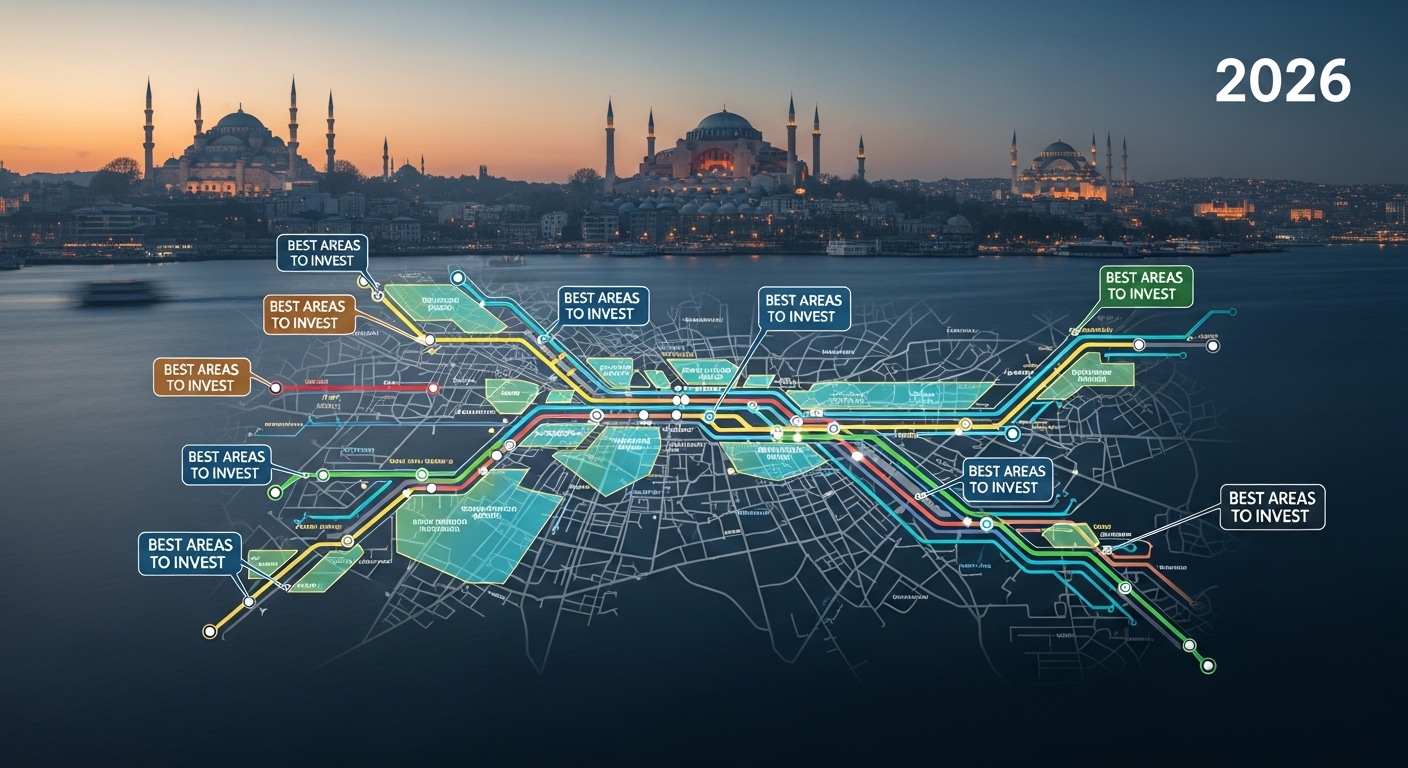
Best Areas to Invest Near Metro Lines in Istanbul 2026
Introduction
What if we told you that a metro line could multiply your property value without lifting a brick? Sounds dramatic—but in Istanbul, it's a reality. As Turkey’s largest city expands its metro network in all directions, real estate values are shifting fast. Investors who position themselves near future metro stations in 2026 are likely to see massive capital appreciation and consistent rental returns.
This article is your full roadmap to identifying the best areas to invest near metro lines in Istanbul in 2026. Whether you're a first-time buyer, seasoned investor, or overseas entrepreneur chasing growth markets, this guide breaks down where to buy, when, and why.
Let’s dive deep into Istanbul’s metro-fueled real estate boom.
Why Istanbul is a Real Estate Investment Magnet
Istanbul is a rare city that sits at the crossroads of continents, cultures, and economies. It’s home to over 16 million residents, making it one of the most populous urban centers in Europe. With massive urban transformation projects, a growing young population, and a demand for housing that far outweighs supply—real estate here isn’t just hot, it’s on fire.
Here’s why investors love Istanbul:
- Ever-growing demand for rentals – From students and white-collar workers to tourists and expats, the city offers rental opportunities across all classes.
- Affordable property (compared to global cities) – Average price per m² is still lower than in cities like Dubai, Paris, or Madrid.
- Incentives for foreigners – Investing $400,000 in real estate can qualify you for Turkish citizenship.
- Major infrastructure projects – Think: Istanbul Airport, Canal Istanbul, and a 600+ km metro system in the making.
- Currency advantage – For investors holding USD or EUR, fluctuations in the Turkish Lira can result in high leverage opportunities.
But there’s a catch: not all areas grow equally. The golden rule in Istanbul real estate is: follow the metro lines.
The Impact of Metro Lines on Property Value
Want to boost the value of your property without doing renovations? Just buy next to a metro station.
That’s not just a slogan—it’s backed by data. Globally, real estate near public transportation hubs typically sees a 15% to 40% increase in value. In Istanbul, where traffic congestion is infamous, this effect is even more pronounced.
Here’s why metro access matters so much:
- Convenience = Higher Demand: Everyone—from students to professionals—wants quick, reliable commutes.
- More demand = Higher prices: As demand surges, property prices increase.
- Faster appreciation: Properties near newly launched metro stations appreciate rapidly, often within 1–2 years.
- Rental yields spike: Renters are willing to pay premium rates for proximity to a metro line.
For example, in Kağıthane, property prices jumped by over 30% after the launch of the M7 metro line. In Başakşehir, properties within 500 meters of the M11 metro station saw a sharp rise in rental inquiries—even before full operation began.
Pro Tip: The earlier you buy (especially before a line is completed), the bigger your long-term return.
How Transportation Access Drives Rental and Resale Returns
- Metro lines don’t just make life easier—they create profit centers.
- A property 200 meters from a metro station:
- Rents 30% faster than one that’s 1 km away
- Commands 15–25% higher rent
- Sells quicker and with less negotiation
- Attracts professional tenants, which means fewer defaults and better maintenance
This is why smart investors use “metro proximity” as one of their top three investment filters. And Istanbul, with 10+ new metro lines in progress, is the perfect playground.
Metro Expansion Projects in Istanbul Until 2026
Istanbul’s current metro length exceeds 240 km, but the goal is to reach over 600 km by 2029. The good news? A significant portion of this growth will happen by 2026.
Key Metro Lines Opening by 2026:
| Line | Route | Length | Status |
|---|---|---|---|
| M7 | Mecidiyeköy – Mahmutbey – Kağıthane | 24.5 km | Operational |
| M9 | Bahçelievler – Ispartakule | 18 km | Opening in 2026 |
| M11 | Istanbul Airport – Kağıthane | 37 km | Partially Open |
| M12 | Ümraniye – Göztepe | 13.3 km | Opening in 2025 |
| M4 Extension | Kadıköy – Sabiha Gökçen Airport | - | Opening by 2026 |
These lines are game changers. Investors should track where these lines intersect residential areas, especially in underdeveloped districts with room for appreciation.
Key Benefits of Investing Near Metro Stations
Here’s why savvy buyers focus on metro-connected properties:
- Higher appreciation – Metro proximity consistently outpaces city-wide average growth.
- Better liquidity – Properties near metro lines sell and rent faster.
- Premium rent – Tenants pay more for shorter commutes.
- Future-proofing – As traffic worsens, car-free convenience becomes more valuable.
- Government-backed value growth – Infrastructure often brings parallel municipal upgrades like parks, roads, and schools.
- Metro = movement = money.
Top Investment Districts Near Metro Lines in Istanbul 2026
Let’s break down the most promising neighborhoods to invest in, based on their proximity to new or recently upgraded metro lines, future growth potential, and current price points. These areas are where the city’s expansion, infrastructure, and market trends meet.
1. Ümraniye – The Rising Star of Asian Istanbul
Located on the Anatolian (Asian) side of the city, Ümraniye has evolved rapidly over the past decade—from a sleepy suburb to a modern, urban residential hub. What makes Ümraniye especially attractive today is the M12 metro line (Ümraniye – Göztepe), which is expected to be fully operational by late 2025.
Investment Highlights:
- Proximity to Istanbul International Finance Center in Ataşehir
- Integration with M5 metro line and direct connections to ferry terminals
- New residential complexes with modern facilities
- Strong appeal for professionals and families alike
Average Price per m² (2026): ₺60,000 – ₺80,000
Rental Yield Estimate: 5.5% – 6.5%
➡️ Learn more about this growing district on Ümraniye Area Guide
2. Beylikdüzü – The Affordable Coastal Investment Zone
Often referred to as the "New West of Istanbul," Beylikdüzü offers a balanced lifestyle: modern complexes, seaside views, and wide roads—all at relatively lower price points. The ongoing extension of metro line M5 into this district is set to revolutionize transportation access, shortening the commute to the city center drastically.
Investment Highlights:
- Ideal for long-term capital appreciation
- Popular among middle-class families
- Proximity to Marmara Park, Marina, and the E-5 Highway
- Strong future demand expected after metro connection is completed
Average Price per m² (2026): ₺45,000 – ₺60,000
Rental Yield Estimate: 6% – 7.5%
➡️ Explore Beylikdüzü Area Overview
3. Bahçeşehir – Family-Friendly and Metro-Connected
Bahçeşehir—translated as “Garden City”—lives up to its name with green spaces, villas, and a master-planned layout. The district is now entering a new phase of investment potential thanks to the upcoming M9 metro line, which connects Bahçeşehir to the city’s main arteries.
Investment Highlights:
- Close to Canal Istanbul project, promising massive long-term returns
- Family-oriented with large apartment layouts
- Increasing popularity among foreign investors
- Many off-plan and under-construction projects available
Average Price per m² (2026): ₺48,000 – ₺62,000
Rental Yield Estimate: 5% – 6.5%
➡️ Discover more in the Bahçeşehir Area Guide
4. Kağıthane – The New Central Business District
Once an industrial zone, Kağıthane has been transformed into one of the fastest-growing real estate hotspots in central Istanbul, especially with the M7 and M11 metro lines now passing through.
Investment Highlights:
- Central location next to Şişli, Levent, and Maslak
- High demand from young professionals
- Modern residential towers with high ROI
- Close to major business hubs and shopping centers
Average Price per m² (2026): ₺70,000 – ₺95,000
Rental Yield Estimate: 6.5% – 8%
➡️ Read more in the Kağıthane Area Guide
5. Sarıyer – Luxury Living Meets Metro Access
If you're aiming for high-end, long-term real estate investment, Sarıyer offers both prestige and practicality. The M11 line, which connects Sarıyer directly to Istanbul Airport, has made even elite neighborhoods like Tarabya and Zekeriyaköy more accessible.
Investment Highlights:
- Elite communities, villas, and sea-view properties
- Direct metro access to business centers via M11
- Popular with diplomats, businesspeople, and celebrities
- Very limited supply = price stability
Average Price per m² (2026): ₺100,000 – ₺160,000
Rental Yield Estimate: 4.5% – 5.5%
➡️ See the full Sarıyer Area Breakdown
6. Zeytinburnu – Classic Location with Modern Upgrades
Zeytinburnu sits just west of the historical peninsula and has been the focus of urban renewal projects for over a decade. Now, with access to multiple metro lines (M1A, Marmaray, and Metrobus), the district is experiencing a property value surge.
Investment Highlights:
- Fast access to Fatih, Taksim, and the airport
- Urban transformation brings high-end developments
- Close to sea, highways, and malls
- Strong rental demand from locals and expats
Average Price per m² (2026): ₺80,000 – ₺120,000
Rental Yield Estimate: 6% – 7.5%
➡️ Learn more on Zeytinburnu Investment Guide
➡️ Learn more on https://www.deal-tr.com/en/blog/best-real-estate-projects-in-zeytinburnu-2025-ultimate-guide
7. Maslak – The Finance Capital of Istanbul
Maslak is not just a neighborhood—it’s Istanbul’s financial engine, located on the European side. With proximity to Levent and Şişli, and connected by the M2 metro line, it continues to be a top-tier destination for commercial and residential real estate.
Investment Highlights:
- Home to international corporations and business centers
- Luxurious residential towers with high ROI
- Metro and highway access to all parts of the city
- Shortage of available land keeps prices rising
Average Price per m² (2026): ₺120,000 – ₺180,000
Rental Yield Estimate: 5% – 6.5%
➡️ Explore Maslak Area Details
➡️ Explore the top projects in maslak https://www.deal-tr.com/en/blog/top-real-estate-projects-in-maslak-compared-2026-guide
8. Kadıköy – Culture, Coastline, and Metro Efficiency
Kadıköy is a cultural hub on the Asian side with high lifestyle quality and now features a fully operational M4 metro line, connecting it to Sabiha Gökçen Airport. Add that to the metrobus, ferry, and Marmaray access, and you’ve got Istanbul’s best-connected district.
Investment Highlights:
- Among the highest real estate values in Istanbul
- Excellent tenant pool: young professionals, students, creatives
- Proximity to universities, shopping centers, and hospitals
- Projects in Fikirtepe offer urban regeneration upside
Average Price per m² (2026): ₺110,000 – ₺170,000
Rental Yield Estimate: 5% – 6.5%
➡️ Visit the Kadıköy Area Overview
💰 Updated 2026 Istanbul Property Prices Near Metro Lines (in USD)
| District | Avg. Price per m² (USD) | Estimated Price for 2+1 (100 m²) | Rental Yield | Notes |
|---|---|---|---|---|
| Ümraniye | $2,000 – $2,500 | $200,000 – $250,000 | 5.5% – 6.5% | Near Finance Center & M12 metro |
| Beylikdüzü | $1,500 – $2,000 | $150,000 – $200,000 | 6.5% – 8% | Metro extension zone, coastal area |
| Bahçeşehir | $1,600 – $2,100 | $160,000 – $210,000 | 5.5% – 6.5% | Near Canal Istanbul & M9 line |
| Kağıthane | $2,300 – $3,000 | $230,000 – $300,000 | 6.5% – 8% | CBD access via M7/M11 |
| Sarıyer | $3,300 – $4,800 | $330,000 – $480,000 | 4.5% – 5.5% | Luxury area near forest, sea, M11 |
| Zeytinburnu | $2,700 – $4,000 | $270,000 – $400,000 | 6% – 7.5% | Sea view, Marmaray access |
| Maslak | $4,000 – $5,600 | $400,000 – $560,000 | 5% – 6% | High-end offices & residences |
| Kadıköy | $3,800 – $5,300 | $380,000 – $530,000 | 5.5% – 6.5% | Most demanded Asian-side zone |
✅ Key Price Factors:
- Floor & View: Sea, forest, or high-floor apartments can add 10–20% more to base prices.
- New vs. Resale: Off-plan properties are generally 10–15% cheaper.
- Proximity to Metro: Less than 300 meters = premium zone.
- Branded Projects: Add 15–30% markup, especially in areas like Maslak and Zeytinburnu.
📉 Why USD Prices Increased Over 50% in 2026:
- TL depreciation: The Turkish Lira has dropped significantly since 2023.
- Construction costs: Materials and labor prices surged due to inflation.
- Foreign demand: High influx from Gulf, Russia, Europe pushing USD prices higher.
- Metro expansion impact: Every new line completion increases nearby property values by 20–40%.
📍 Recommended Strategy:
If your budget is between $150,000–$250,000, focus on:
- Ümraniye
- Bahçeşehir
- Beylikdüzü
If your target is luxury with appreciation and stability, consider:
- Sarıyer
- Kadıköy
- Maslak
Metro vs. Non-Metro Investment Zones: A Clear Winner
To show how metro access impacts your investment, here’s a quick comparison:
| Factor | Near Metro Lines | Non-Metro Zones |
|---|---|---|
| Price Growth (2 yrs) | 25% – 45% | 5% – 15% |
| Rental Demand | High | Moderate |
| Vacancy Risk | Very Low | Medium |
| Liquidity (Resale) | High | Slower, more negotiation |
| Tenant Profile | Professionals, Students | Families, Budget Renters |
Conclusion: If you're buying in 2026, choose properties within 400–600 meters of current or future metro stations. This single factor can double your rental income and ensure capital growth within 24–36 months.
Why 2026 Is the Perfect Time to Buy
We’re in a unique window of opportunity:
✅ Metro construction is nearing completion in multiple districts
✅ Prices haven't peaked yet in most metro-linked areas
✅ The Turkish Lira remains favorable to foreign investors
✅ Urban regeneration is creating new luxury zones
If you wait until metro lines are operational and prices surge, you’ll miss the early-bird profit margin. Buying now in an underpriced area like Bahçeşehir or Beylikdüzü before full metro access is activated is the smart investor move.
Smart Tips for Choosing Property Near a Metro Line
Want to buy the right apartment—not just any apartment?
Here’s your checklist:
- ✅ Walk to Metro: Ensure the building is within 600 meters max.
- ✅ New or Under-Construction: Off-plan projects often offer lower prices and better payment terms.
- ✅ Look for Developer Reputation: Only buy from top-rated construction companies.
- ✅ Avoid Ground Floors: Always aim for floors 3 to 7 for better resale value.
- ✅ Facilities Matter: Gyms, parking, and 24/7 security make a property easier to rent.
- ✅ Check Rental Potential: Ask a local agency for the expected rent.
- ✅ Future Plans?: Make sure there’s no planned highway, factory, or school that could affect living quality nearby.
Conclusion
In the fast-evolving Istanbul real estate market, metro proximity is no longer a luxury—it’s a necessity.
Whether you're looking for short-term capital gains, stable rental yields, or a long-term portfolio asset, buying near a metro line ensures maximum ROI with minimal risk. The areas covered in this guide—Ümraniye, Beylikdüzü, Bahçeşehir, Kağıthane, Sarıyer, Zeytinburnu, Maslak, and Kadıköy—each offer unique value depending on your budget, goals, and timeline.
Want to play it smart in 2026? Then follow this golden rule:
“Buy close to the tracks before the trains arrive.”
FAQs
Yes, but they also appreciate faster and offer better rental returns, making them ideal for investment. Absolutely. Foreigners can freely buy in most districts and even qualify for Turkish citizenship at $400,000+ investment. Between 200 to 600 meters. Anything beyond 1 km loses rental appeal. If you want higher profit, go off-plan. If you want instant rental income, go ready-to-move. Currently, Kağıthane, Basin Express, and Ümraniye show the highest growth potentia




Have Question Or Suggestion ?
Please Share Your Thought, To Make It Real