Istanbul Canal | All details and Information
Explore how the New Istanbul Canal is reshaping Turkey’s economy and real estate landscape.
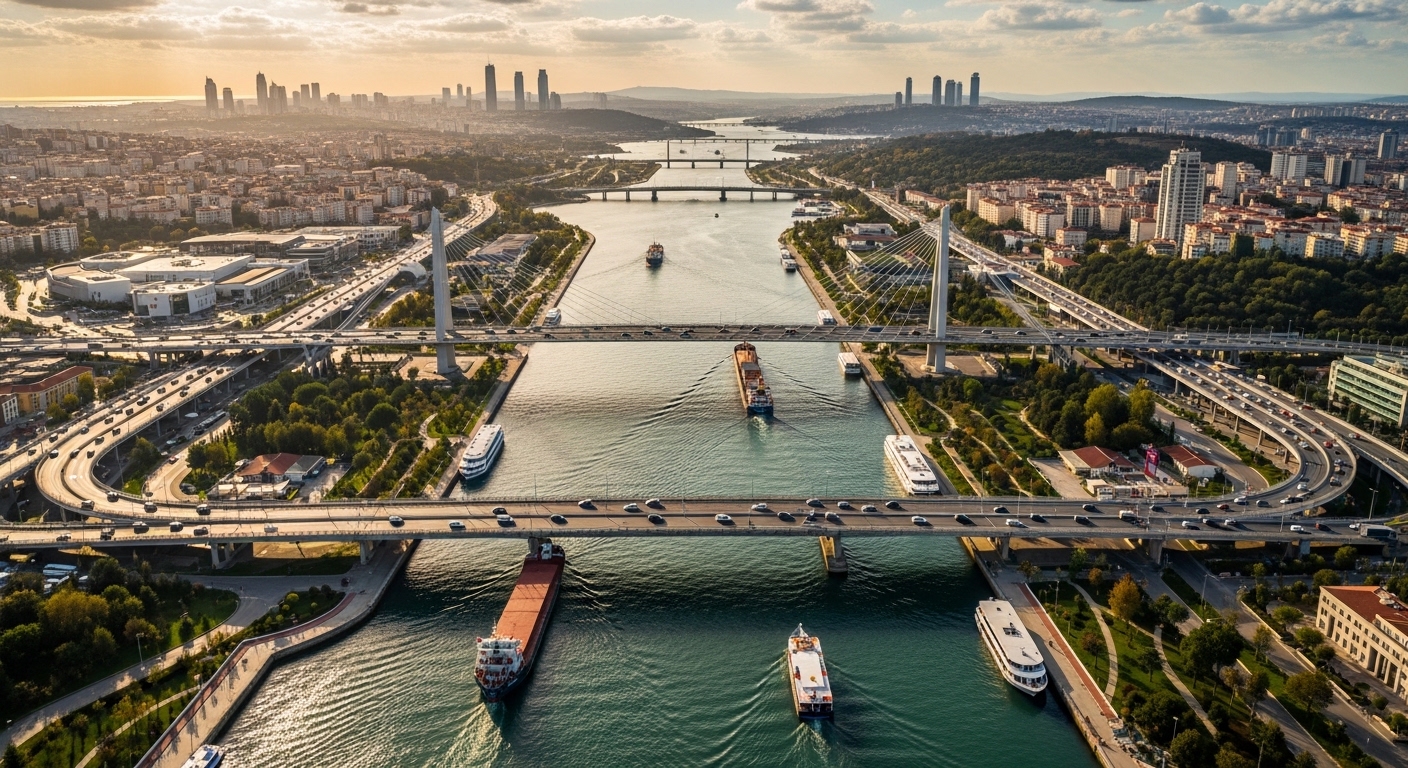
Canal Istanbul: A Bold Vision or a Risky Gamble?
Canal Istanbul isn’t just a waterway. It’s one of the most polarizing infrastructure projects in modern Turkish history. Described by its proponents as a “crazy project” that will elevate Turkey’s global standing, and by critics as an environmental catastrophe in the making, Canal Istanbul straddles the line between ambition and controversy.
Set to be built parallel to the Bosporus Strait, this artificial canal would connect the Black Sea to the Sea of Marmara, providing an alternative route for maritime traffic. But is this visionary megaproject a strategic necessity for a rising regional power—or a costly, irreversible mistake?
Understanding Canal Istanbul: What Is It?
At its core, Canal Istanbul is a man-made canal proposed by the Turkish government as an alternative passage to the Bosporus Strait. The concept is to ease congestion in one of the world’s busiest maritime chokepoints while simultaneously asserting control over international shipping routes.
The canal is projected to be around 45 kilometers (28 miles) long, 275 meters wide, and 20.75 meters deep. With these specs, it could handle some of the world’s largest cargo ships and oil tankers, potentially boosting Turkey’s position in global trade.
Yet this isn’t merely an infrastructure project. It’s a statement. It’s about creating a legacy, redefining Istanbul’s geography, and possibly altering the power dynamics of maritime law in the region.
Historical Context: The Importance of the Bosporus
To understand Canal Istanbul, you need to grasp the historic and geopolitical importance of the Bosporus Strait. This narrow, winding waterway is the only maritime route between the Black Sea and the Mediterranean. For centuries, it’s been a lifeline for trade, culture, and empires.
Under the 1936 Montreux Convention, Turkey controls the Bosporus but must allow free passage for civilian vessels, including warships during peacetime (with restrictions). This agreement limits Turkey's ability to regulate naval traffic, especially from non-Black Sea powers like the U.S.
For Turkey, this lack of full control is both a security concern and a lost economic opportunity. By building a new, artificial canal, Ankara could circumvent Montreux, charge transit fees, and apply its own rules—at least, that’s the idea.
Why Turkey Wants Canal Istanbul
The motivations behind Canal Istanbul are multifaceted:
Economic Strategy: The Bosporus is overcrowded. Over 40,000 vessels pass through annually, compared to 12,000 for the Panama Canal. Turkey claims Canal Istanbul will reduce this burden while creating a new revenue stream from shipping tolls, port services, and logistics.
Political Legacy: For President Erdoğan, Canal Istanbul is a legacy project. He has called it a “dream” and a “crazy project” that reflects the new Turkey—a powerful, independent, and globally connected nation.
Urban Expansion: The canal is more than a waterway. It includes the creation of “New Istanbul”—a massive urban development with residential, commercial, and high-tech infrastructure along both banks. This opens opportunities for investment, real estate, and job creation.

Project Specifications: Size, Route, and Design
The scope of Canal Istanbul is staggering. The canal is planned to run through Istanbul’s European side, starting from Küçükçekmece Lake and stretching north to the Black Sea through Sazlıdere and Terkos basins.
- Length: ~45 km
- Depth: 20.75 m
- Width: 275 m at the surface, narrowing at the bottom
- Bridges: Six new bridges are planned to cross the canal
Smart City Infrastructure: Along the canal, plans include hospitals, ports, logistics centers, parks, and residential zones for over 500,000 people.
The design considers the latest maritime navigation technology, automation, and eco-engineering—on paper. But critics argue that the blueprint underestimates the terrain’s complexity and overpromises sustainability.
Projected Costs and Funding Sources
Turkey’s government estimates Canal Istanbul’s cost at around $15 billion. However, many independent experts argue the real cost could be much higher, possibly exceeding $25 billion when you factor in surrounding infrastructure and long-term maintenance.
So where will the money come from?
- Public-Private Partnerships (PPP): Turkey is exploring PPP models to attract investment while limiting state expenditure.
- Foreign Investors: Qatar, China, and Russia have shown interest at various stages.
- Domestic Developers: The canal's adjacent real estate boom has already attracted Turkish construction giants.
But in a country grappling with inflation, currency devaluation, and high public debt, funding a megaproject of this scale is not without backlash.

Strategic Importance: Shifting Global Trade Routes
Canal Istanbul is also a strategic chess piece. Turkey wants to reposition itself as a central node in east-west trade, much like Egypt’s Suez Canal or Panama’s critical link in the Americas.
By creating a new waterway with its own rules, Turkey could:
- Charge fees and boost state revenue
- Tighten control over military movements
- Redirect global logistics and shipping through Turkish ports
This raises questions about the Montreux Convention’s relevance. While Ankara insists the new canal would be outside Montreux’s jurisdiction, international legal scholars disagree, setting the stage for a geopolitical showdown.
Environmental Concerns and Risks
The environmental backlash is one of the fiercest aspects of the Canal Istanbul debate. Experts warn of irreversible ecological consequences:
Disruption of Freshwater Sources: The canal cuts through key water reservoirs that supply Istanbul. Contamination from saltwater intrusion could endanger the city’s water supply.
Destruction of Ecosystems: Forests, wetlands, and agricultural land will be cleared. Native species and migratory bird routes could be permanently affected.
Risk to Marine Life: Connecting two seas with different salinity and biodiversity could disrupt aquatic ecosystems on a massive scale.
The Turkish Chamber of Environmental Engineers has called the project an “environmental massacre.” Yet, environmental impact assessments approved by the government claim mitigation strategies are in place.When will the new Istanbul Canal end? And what is its cost?
The value of the Istanbul Canal project may reach 25 billion US dollars, including 10 billion dollars for building areas on both sides of the canal and 15 billion dollars for the cost of building the canal. As for the completion date of the new Istanbul Canal project, it is in 2027.
What is the economic importance of the Istanbul Kanal?
Despite the high cost of the canal project, the canal will generate significant profits for Turkey, as it is estimated to bring in profits of up to 8 billion dollars annually, which means that through these profits, the Istanbul Canal project can cost be covered.
These profits will be achieved through the passage of commercial ships, especially the giant ones, and through constructing facilities on the outskirts of the canal.
The most important benefits of the Istanbul Kanal project
Increasing the security of maritime navigation and growing traffic across the Black Sea
Reducing the pressure of navigation in the Bosphorus Strait
Reducing the environmental risks to the Bosphorus Strait for several reasons, including the passage of oil tankers that threaten marine life
Implementation of the Turkish government's vision for 2023 and 2053, which places Turkey among the ten most potent economic countries in the world.

Earthquake and Geological Risks
One of the most alarming arguments against Canal Istanbul revolves around earthquakes and geological instability. Istanbul already sits uncomfortably close to the North Anatolian Fault Line, one of the most active and dangerous fault systems in the world. Scientists have long warned that the city is overdue for a major earthquake, and any large-scale construction in this region naturally raises red flags.
Canal Istanbul’s planned route cuts through areas with complex soil structures, including loose sediment and alluvial plains. These soil types are notoriously vulnerable to liquefaction during earthquakes, meaning they can behave like liquid when shaken, causing buildings, bridges, and infrastructure to collapse. Now imagine carving a 45-kilometer-long artificial canal through this fragile ground. It’s like slicing a deep scar into an already stressed body.
Geologists argue that the canal could alter underground water pressure and soil stability, potentially amplifying seismic risks. The construction process itself—massive excavation, blasting, and land displacement—may change stress distributions along nearby fault lines. While government-backed studies insist that the canal will not trigger earthquakes, independent experts say that such guarantees are scientifically impossible.
Another overlooked issue is emergency response. If a major earthquake were to strike, the canal could effectively turn parts of Istanbul into islands, complicating evacuation routes and rescue operations. Bridges crossing the canal could become chokepoints or fail entirely, isolating millions of people. Critics ask a simple but powerful question: is this the right time to reshape Istanbul’s geography when the city should be strengthening its resilience instead?
Opposition from Experts and the Public
Canal Istanbul has sparked one of the most unified opposition movements Turkey has seen in years. Environmental scientists, urban planners, economists, former military officials, and even retired diplomats have voiced strong objections. What’s striking isn’t just the volume of criticism, but its diversity. These aren’t fringe voices—they’re people who’ve spent decades studying exactly the kinds of systems this project would disrupt.
Public opposition has also been intense, especially in Istanbul. Surveys repeatedly show that a majority of residents oppose the canal, fearing environmental damage, rising living costs, and irreversible urban sprawl. The project has triggered protests, lawsuits, and campaigns led by civil society groups and local governments. Istanbul’s metropolitan municipality has been one of the loudest critics, arguing that the canal threatens the city’s water security and ignores democratic decision-making.
One of the core complaints is transparency—or the lack of it. Critics argue that key reports, feasibility studies, and contracts have not been fully disclosed. Decisions affecting millions of people, they say, are being made behind closed doors. This has fueled distrust and suspicion, turning Canal Istanbul into more than an infrastructure debate—it’s become a symbol of governance, accountability, and public consent.

Many investors are now focusing on land investment opportunities in Arnavutkoy near Canal Istanbul, as the area is positioned to benefit directly from future infrastructure development.
URL:
https://www.deal-tr.com/en/blog/arnavutkoy-land-for-sale-canal-istanbul-investment-opportunities
Urban Development and Real Estate Boom
If there’s one group watching Canal Istanbul with excitement, it’s real estate developers. Even before construction has officially begun, land prices along the proposed route have skyrocketed. Fields that once supported agriculture are now being marketed as “future waterfront property,” with glossy brochures and ambitious promises.
The government envisions Canal Istanbul as the backbone of a new urban zone—sometimes called “New Istanbul.” This includes luxury housing, commercial districts, marinas, technology hubs, and logistics centers. On paper, it looks like a futuristic city rising from scratch. In reality, critics argue it risks becoming a playground for the wealthy while pushing lower-income residents further to the margins.
There’s also concern about demographic pressure. Istanbul already struggles with overcrowding, traffic congestion, and strained public services. Adding hundreds of thousands of new residents could exacerbate these problems. Urban planners warn that instead of relieving pressure on the city, Canal Istanbul may actually intensify it, creating a parallel metropolis without solving the original issues.
And then there’s speculation. Who bought land early? Who benefits most from zoning changes? These questions have fueled allegations of favoritism and profiteering. Whether justified or not, the perception that Canal Istanbul is a real estate-driven project rather than a public necessity continues to undermine public trust.
Legal and International Ramifications
Beyond Turkey’s borders, Canal Istanbul raises serious legal and diplomatic questions. At the center of this debate lies the Montreux Convention, which governs passage through the Bosporus and Dardanelles. Turkey insists that Canal Istanbul, as an artificial waterway, would not fall under Montreux rules. This would theoretically allow Ankara to impose its own regulations and fees.
However, international law experts are far from convinced. Many argue that since the canal would serve the same functional purpose as the Bosporus—connecting the Black Sea to the Mediterranean—it could still be subject to international maritime law. Any unilateral attempt to bypass Montreux could trigger disputes with Black Sea nations, including Russia, Ukraine, and NATO members.
Russia, in particular, has a strong interest in maintaining the current balance. The Montreux Convention limits the presence of non-Black Sea military vessels, which benefits Moscow strategically. Any perceived threat to this arrangement could escalate tensions. Thus, Canal Istanbul isn’t just a domestic issue—it’s a geopolitical variable with regional and global implications.
Comparisons to Global Megaprojects
Supporters often compare Canal Istanbul to iconic engineering feats like the Panama Canal or the Suez Canal. These projects reshaped global trade and generated enormous economic value. So why shouldn’t Turkey aim for something similar?
The comparison, however, isn’t straightforward. The Panama and Suez canals were built to connect oceans where no natural passage existed. Canal Istanbul, by contrast, would duplicate an existing route—the Bosporus—which already offers free passage. Critics argue that this fundamentally changes the cost-benefit equation.
Moreover, both Panama and Suez operate in relatively stable geological zones compared to Istanbul. They also serve massive, unavoidable trade routes. The question remains: will shipping companies willingly pay fees to use Canal Istanbul when they can continue using the Bosporus for free? Without a compelling economic incentive, the canal risks becoming an underused monument to ambition.
Potential Benefits: Economic Growth and Prestige
Despite the criticism, supporters highlight potential benefits that shouldn’t be ignored. Canal Istanbul could create tens of thousands of jobs during construction and operation. It could stimulate sectors like logistics, shipbuilding, tourism, and finance. For a country seeking to boost growth and reduce unemployment, these arguments carry weight.
There’s also the matter of national pride. Megaprojects have a symbolic power. They signal capability, confidence, and ambition. For many supporters, Canal Istanbul represents Turkey’s refusal to think small. It’s about leaving a mark on history, much like bridges, dams, and airports that once faced skepticism but later became indispensable.
Whether these benefits outweigh the risks is the central question—and one that remains fiercely contested.
Political Controversy: Erdoğan’s Legacy Project
Canal Istanbul is inseparable from Turkish politics. President Erdoğan has personally championed the project for over a decade, framing it as a defining achievement of his leadership. For supporters, this consistency reflects vision and determination. For critics, it raises concerns about stubbornness and personalization of policy.
Opposition parties have pledged to halt or cancel the project if they come to power, arguing that it drains resources from more urgent needs like earthquake preparedness, education, and healthcare. This has turned Canal Istanbul into an electoral issue, a litmus test for broader debates about Turkey’s future direction.
In this sense, the canal is more than concrete and water. It’s a battleground of ideas: growth versus sustainability, ambition versus caution, centralized power versus public participation.
Current Status and Timeline
As of now, Canal Istanbul exists in a gray zone between vision and reality. Some preparatory works—like bridge construction and zoning changes—have begun, but full-scale excavation has not. Legal challenges continue, and funding remains uncertain amid economic pressures.
Government officials insist the project will move forward in phases, adapting to financial conditions. Critics counter that delays reflect deep structural and political obstacles. The timeline remains fluid, and the final outcome is far from guaranteed.
Future Outlook: Will Canal Istanbul Be Completed?
So, will Canal Istanbul ever be completed? The honest answer is: it depends. Economic stability, political will, public resistance, environmental constraints, and international reactions will all play decisive roles.
The project could be scaled down, delayed indefinitely, or revived with renewed momentum. What’s certain is that Canal Istanbul has already reshaped Turkey’s public discourse. Even if it never carries a single ship, its impact on politics, planning, and public awareness is undeniable.
Conclusion: Canal Istanbul—Dream, Necessity, or Disaster?
Canal Istanbul stands at the crossroads of ambition and anxiety. To some, it’s a visionary leap into the future. To others, it’s an unnecessary gamble with irreversible consequences. Like a double-edged sword, it promises power and prestige while threatening environmental, social, and economic stability.
Whether history will remember Canal Istanbul as a masterstroke or a cautionary tale remains to be seen. But one thing is clear: this is not just a canal. It’s a mirror reflecting Turkey’s struggles, aspirations, and choices in the 21st century.
FAQs
Is Canal Istanbul currently under construction?
Some preparatory infrastructure has begun, but full-scale canal excavation has not officially started.
How will Canal Istanbul affect Istanbul’s water resources?
Experts warn it could threaten freshwater reservoirs through saltwater intrusion and pollution.
Will Canal Istanbul replace the Bosporus?
No, the Bosporus will remain open. The canal is intended as an alternative route.
Is Canal Istanbul environmentally sustainable?
Many scientists argue it poses serious environmental risks despite official mitigation claims.
How long will it take to build Canal Istanbul?
Estimates range from 5 to 10 years, depending on funding and political conditions.
.webp)

.webp)

Have Question Or Suggestion ?
Please Share Your Thought, To Make It Real