Can You Buy Property in Turkey with USDT? Legal Process, Costs & Risks
Learn how to buy property in Turkey with USDT, including legal rules, crypto conversion, title deed steps, fees, risks, and citizenship considerations.
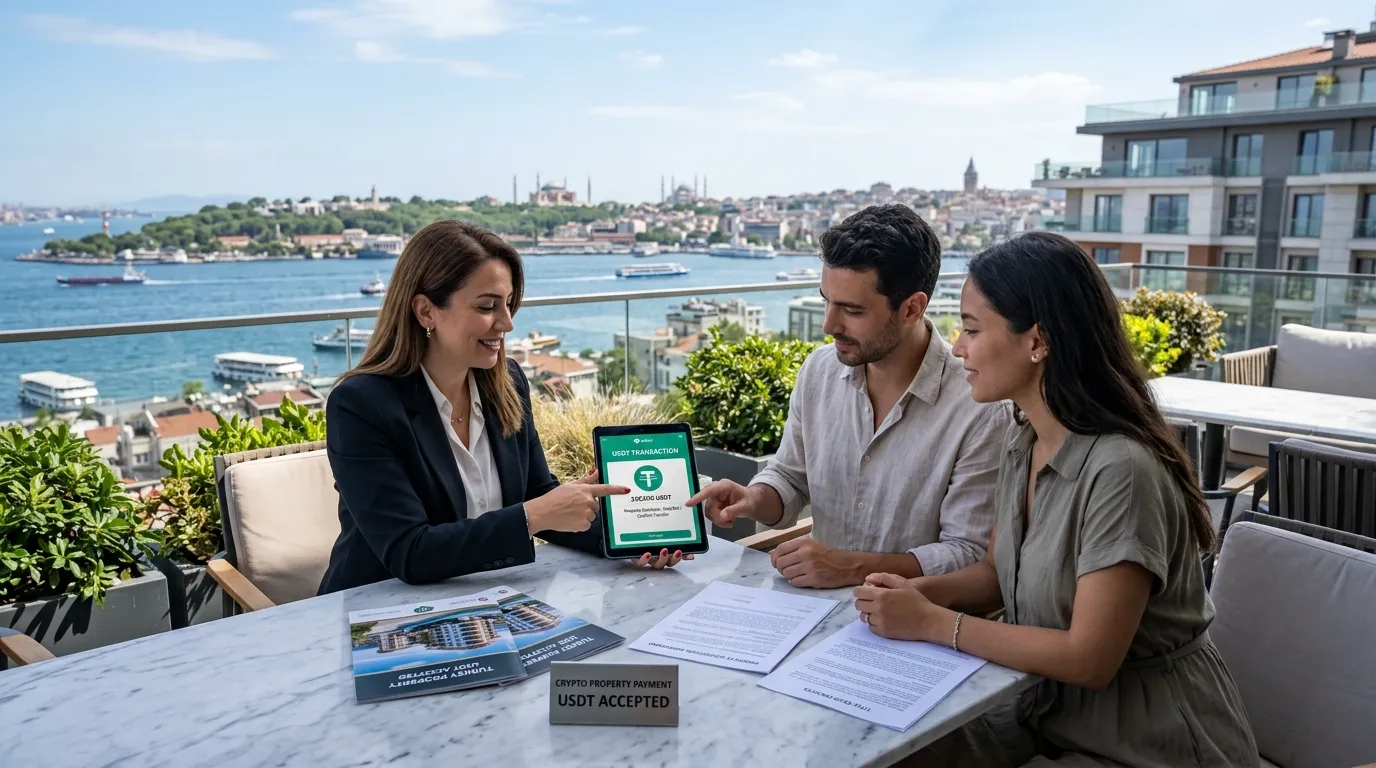
Can You Buy Property in Turkey with USDT?
Turkey has become one of those places where two worlds collide: a large, internationally active real-estate market and a population that is remarkably familiar with cryptocurrency. That combination naturally leads foreign investors to ask, “Can you buy property in Turkey with USDT?” The practical answer is yes, a buyer can potentially use wealth held in Tether (USDT) to fund a Turkish property acquisition, but the transaction is not as simple as sending stablecoins to a seller's wallet and walking away with a title deed. Turkish rules governing cryptocurrency payments, foreign-exchange procedures, banking documentation, title registration, anti-money-laundering requirements, and potentially citizenship-by-investment rules all affect how the deal should be structured.
This distinction matters because people often use the phrase “buy a house with crypto” rather loosely. An advertisement might say that a developer “accepts USDT,” but that can describe several different arrangements. The developer might actually receive cryptocurrency before converting it through an intermediary; a licensed service provider might convert the buyer's digital assets into fiat currency; or the buyer may liquidate USDT first and then complete what is legally and financially documented as an ordinary property purchase. Those structures are not interchangeable. The blockchain transfer is only one piece of the transaction; legal ownership changes through Turkey's official title-deed registration system.
USDT nevertheless has obvious appeal. Unlike Bitcoin or Ether, it is designed to track the U.S. dollar, which can make it easier for a buyer and seller to agree on a price without watching their purchasing power swing dramatically during negotiations. For an investor whose capital is already held in stablecoins, converting those assets into the correctly documented funds for a real-estate acquisition can also be more convenient than moving money through several unrelated accounts. Convenience, though, should never replace compliance. Crypto regulations evolve, banks have their own risk controls, and special procedures can apply to foreign purchasers. Before transferring a substantial amount of USDT, buyers should have the proposed payment route checked by a Turkish real-estate lawyer and appropriate tax or financial professionals.
The Short Answer: Can You Really Buy Turkish Real Estate with USDT?
You can potentially fund a property purchase in Turkey with USDT, but describing the process as a straightforward USDT-for-house swap can be misleading. Turkey has an established framework for registering real estate, and the transfer of ownership ultimately needs to occur through the country's official land-registry procedures. At the same time, Turkey has imposed restrictions on using crypto assets directly as payment for goods and services. That creates an important practical distinction between having USDT as the source of your investment capital and treating USDT itself as the legally recognized settlement mechanism for the real-estate transaction.
Imagine that you own $300,000 worth of USDT and want to purchase an apartment in Istanbul. The seller may advertise that they are “crypto friendly.” Instead of assuming this means you can simply scan a QR code and transfer 300,000 USDT, you need to determine exactly how the seller handles cryptocurrency. A compliant structure may involve converting the digital assets into fiat through an appropriate regulated channel, documenting where the money came from, moving the resulting funds through the required financial channels, and completing the official title transfer. In everyday conversation, you might still say that you “bought the apartment with USDT” because USDT funded the deal. Legally and administratively, however, several additional steps may sit between your wallet and the title deed.
That distinction becomes even more important when the buyer is a foreign national. Foreign purchasers can face additional requirements involving identity verification, valuation, foreign-exchange documentation, eligibility to acquire property in a particular location, and banking records. If the acquisition is intended to support an application for Turkish citizenship by investment, documentation becomes even more critical because the authorities need to verify that the statutory investment conditions have been satisfied. A wallet transaction by itself generally cannot replace the documentary trail required by government agencies.
So, when a Turkish developer or property agency says, “We accept USDT,” treat that statement as the beginning of your due diligence rather than the end. Ask who receives the USDT, where conversion occurs, which provider performs it, what fiat amount will be credited toward the purchase price, what documentation you receive, and how the amount appearing in the sales and title documentation will correspond to the money transferred. A well-structured crypto-funded purchase should leave a clear trail rather than disappearing into a maze of wallets and informal promises.
How USDT Property Purchases Work in Turkey
A USDT-funded real-estate transaction in Turkey generally involves three layers that buyers sometimes mistakenly blend together: the crypto transaction, the financial settlement, and the legal transfer of the property. Think of them as three lanes on the same highway. They need to travel in the same direction, but each lane has different rules. The crypto layer establishes where your digital assets went. The financial layer documents how the purchase funds were received, converted, and transferred. The legal layer establishes who actually owns the apartment, villa, land, or commercial unit. Getting only one of these layers right is not enough.
The process usually begins when a buyer selects a property and negotiates its price. Suppose an apartment is priced in U.S.-dollar terms and the purchaser holds the equivalent amount in USDT. Before moving the coins, the buyer and seller should agree in writing on the mechanism for determining the conversion rate, transaction costs, network fees, timing, and what happens if a transfer is delayed or sent incorrectly. The agreement should also make clear whether the seller is actually receiving crypto or whether an intermediary converts it into fiat. That may sound overly cautious, but blockchain transactions can be irreversible. A typo in traditional banking can sometimes be investigated and reversed; sending stablecoins to an incorrect wallet can create a far uglier problem.
The buyer also needs to coordinate the payment structure with the Turkish title-deed transfer process. Purchasing real estate is not comparable to purchasing a watch or laptop. Ownership exists through formal registration, and the relevant property information, seller identity, buyer identity, declared transaction details, taxes, and official documentation must line up. Foreign buyers may also need a Turkish tax number and other documents depending on their circumstances.
This is why reputable transactions tend to involve several professionals rather than a single salesperson promising to “handle everything.” A qualified Turkish lawyer can investigate the title, liens, mortgages, restrictions, permits, and contractual terms. Financial professionals can help establish an acceptable funding trail. If cryptocurrency conversion is involved, buyers should verify the regulatory status of the service provider and the requirements applicable at the time of the transaction. Crypto may make moving economic value feel instantaneous, but real estate remains a heavily documented asset. The safest transaction respects both realities.
Direct USDT Payments vs. Converting USDT to Turkish Lira
The biggest practical question is whether you can pay the seller directly in USDT or whether your stablecoins should first be converted into fiat currency. For buyers, the second route is often easier to reconcile with Turkey's regulatory and documentary requirements. Turkey introduced rules restricting the direct or indirect use of crypto assets in payments, which is why anyone contemplating a literal property-for-USDT exchange should obtain current Turkish legal advice rather than relying on a developer's marketing claim. A business saying “crypto accepted” does not automatically establish that every proposed payment structure complies with the regulations.
Conversion changes the picture. If your wealth begins as USDT but is converted through an appropriate provider and subsequently transferred through the banking system in the required form, cryptocurrency functions as the source of funds rather than necessarily as the payment instrument used to settle the registered property transaction. Picture selling shares before purchasing a home. You might casually say that your stock portfolio paid for your house, but the seller did not receive Apple or Tesla shares. The investments were converted into money, and that money funded the purchase. A properly structured USDT-funded acquisition can operate on a comparable principle.
The details matter enormously. Buyers should know which blockchain is being used because USDT exists across multiple networks. Sending tokens using the wrong network can create operational problems or even permanent losses. You also need to understand the conversion spread, provider fee, blockchain fee, and exchange rate used to calculate the final fiat proceeds. On a six-figure property transaction, what looks like a tiny percentage can translate into thousands of dollars. The contract should therefore explain who bears those expenses and how any shortfall between the expected and received amount will be handled.
Documentation is equally important. Preserve wallet transaction hashes, exchange statements, conversion receipts, bank records, invoices, contracts, and correspondence establishing the relationship between the crypto you owned and the money ultimately used for the property. This becomes particularly valuable if a bank, tax authority, compliance department, or citizenship authority later asks where the funds originated. A clean source-of-funds trail is one of the most valuable assets in a crypto-funded property deal. The objective is not simply to move USDT quickly. It is to move value in a way that remains understandable months or years later.
Why the Official Property Transaction Still Matters
A blockchain transfer does not give you legal ownership of Turkish real estate. This is one of the most important concepts for any crypto investor entering the property market. You can send USDT to a developer, receive a beautifully designed receipt, shake hands with the sales director, and even receive the apartment keys, yet none of those actions independently substitutes for the official legal transfer of ownership. For real estate in Turkey, the title-deed and land-registry process is what anchors your ownership rights.
Before completing a purchase, buyers should investigate the property's legal status. Does the person or company selling it actually own it? Is there a mortgage, lien, seizure, usufruct, or other encumbrance? Does the apartment correspond to the unit being advertised? Are the relevant construction and occupancy documents in order? These questions can feel boring next to the excitement of choosing a sea-view apartment in Antalya or a new development in Istanbul, but they are precisely where serious money can be protected or lost. Crypto does not remove ordinary real-estate risks; in some cases, the speed and irreversibility of crypto transfers can amplify them.
Foreign buyers should be especially careful about handing over the full purchase price before their lawyer has checked the title and contractual protections. A developer may ask for a reservation payment, deposit, or installment, and those arrangements should specify what happens if the transaction cannot proceed. If USDT is involved, the contract should also establish how a refund would be calculated. Will the buyer receive the same number of USDT tokens, the original fiat-equivalent value, or the amount received by the seller after conversion? Stablecoins may target a stable value, but fees, conversion spreads, depegging risk, freezes, and compliance interventions can still create differences.
The title transfer is also where the transaction becomes part of the formal property system. Government fees and taxes need to be addressed, identification must be verified, and applicable rules for foreign ownership must be satisfied. Buyers who need the property for residency or citizenship purposes have even stronger reasons to ensure the documentation is exact. Your wallet receipt proves a blockchain transaction; your registered title proves property ownership. Never confuse the two.
Is Buying Property with USDT Legal in Turkey?
The legal question requires more nuance than a simple yes or no. Owning or trading cryptocurrency in Turkey is not the same thing as being free to use cryptocurrency directly as a payment instrument. Turkey's Central Bank introduced the Regulation on the Disuse of Crypto Assets in Payments in 2021, which restricts the direct and indirect use of crypto assets for payments and imposes related restrictions on payment and electronic-money institutions. Since then, Turkey's broader crypto regulatory environment has continued developing, including rules affecting crypto-asset service providers. Consequently, anyone executing a transaction today should verify the latest regulations rather than treating an older blog post as current law.
This matters for real estate because advertisements often simplify a complicated structure into the phrase “buy property in Turkey with Bitcoin or USDT.” From a marketing perspective, that phrase tells crypto investors that the company can accommodate wealth held in digital assets. From a legal perspective, however, the precise mechanics determine whether the arrangement works. If cryptocurrency is converted into fiat through a permissible route and the real-estate settlement is then completed using the appropriate banking and title procedures, that is materially different from treating USDT itself as ordinary legal tender at the property closing.
Turkey also maintains anti-money-laundering and financial-compliance requirements. Large transactions can attract scrutiny regardless of whether the buyer's wealth came from cryptocurrency, securities, a business sale, or another source. Crypto can create additional questions because wallets do not necessarily display a person's legal identity in the way a bank account does. Buyers should therefore expect legitimate service providers to request identification and potentially evidence explaining how the crypto was acquired. Someone who purchased USDT on a regulated exchange using documented income may find this relatively straightforward. Someone presenting a large balance that has moved through numerous unidentified wallets, mixers, or high-risk platforms may encounter significantly more difficulty.
The sensible approach is to treat legal compliance as part of the purchase itself, not as paperwork to fix afterward. Before sending tokens, have a Turkish lawyer review the sales agreement and proposed funding method. Ask the relevant bank or financial provider what records it requires. If citizenship is part of your objective, obtain advice specifically covering citizenship-by-investment procedures because a perfectly valid property acquisition does not automatically mean that the investment has been documented in a manner acceptable for citizenship. In crypto real estate, how you pay can matter almost as much as how much you pay.
Turkey's Rules on Cryptocurrency Payments
Turkey's approach to cryptocurrency illustrates why terminology matters. Crypto assets can be owned, bought, sold, and transferred within the boundaries of applicable law, but the country has specifically regulated their role in payments. The Central Bank's 2021 regulation defined crypto assets for the purpose of the rules and prohibited their direct or indirect use in payments. That means a foreign investor should be cautious when someone describes a property transaction as nothing more than “send USDT and receive the deed.” A transaction involving hundreds of thousands of dollars deserves a more rigorous explanation.
The regulatory landscape has also evolved beyond the 2021 payment rule. Turkey has strengthened its oversight of crypto-asset service providers and brought the sector further within formal capital-markets and compliance structures. The direction is clear: cryptocurrency activity is increasingly expected to operate inside a regulated financial environment rather than an informal parallel economy. That can actually benefit legitimate property buyers. Stronger identity checks, recordkeeping, and provider oversight may feel slower than peer-to-peer transfers, but those controls can make it easier to demonstrate the origin and movement of investment funds.
Buyers should therefore avoid assuming that a transaction model used several years ago remains valid today. Crypto regulation changes quickly, and implementation can also evolve through secondary regulations, guidance, institutional practices, and compliance policies. A bank may apply controls that go beyond what a casual reading of legislation suggests. Likewise, an exchange or crypto service provider may limit certain transfers because of its own risk policies. The right question is not merely, “Is USDT legal in Turkey?” It is, “Is this specific method of converting, transferring, documenting, and applying my USDT to this property purchase compliant today?”
That question should be answered before the blockchain transaction takes place. Crypto transfers are famous for speed, while legal remediation is famous for being anything but fast. Spending a few days validating the transaction structure can prevent months of disputes over missing documentation, rejected transfers, compliance holds, or citizenship eligibility. When six figures are crossing borders and financial systems, boring paperwork is often your best friend.
The Difference Between Holding Crypto and Using It as Payment
One of the easiest ways to understand Turkish crypto rules is to separate asset ownership from payment functionality. Owning an asset does not automatically mean the law treats that asset as money you can use for every commercial settlement. Gold provides a useful analogy. You can own $200,000 worth of gold bars, but a property closing may still require you to sell the gold and route the proceeds through documented financial channels rather than putting the bars on a lawyer's desk. The economic source of the money is gold; the settlement mechanism is fiat currency.
USDT can play a similar role. You may have accumulated your investment capital entirely in stablecoins. If those tokens are converted appropriately and the resulting funds are used to purchase the property, USDT remains economically central to the deal without necessarily being the payment instrument recognized in the formal closing process. That nuance explains why two statements that sound contradictory—“Turkey restricts crypto payments” and “you can fund Turkish real estate using crypto wealth”—can both make sense depending on the transaction structure.
This distinction is particularly important when evaluating property advertisements. Some agencies use “USDT accepted” as shorthand for offering a crypto-to-fiat settlement solution. Others may propose a direct wallet transfer. Those are not identical services, and buyers should ask for the exact process in writing. Who is the counterparty receiving the tokens? Is it the property owner, developer, exchange, broker, or another company? What licenses or registrations does the intermediary have? What happens between receipt of USDT and arrival of fiat funds? Which records will be issued?
You should also resist arrangements designed primarily to make the transaction invisible. If a salesperson suggests that crypto allows you to avoid declaring the real purchase price, bypass banking requirements, conceal the source of funds, or eliminate taxes, treat that as a serious warning sign. Blockchain technology can make value portable, but it does not cancel property law, tax obligations, sanctions controls, or anti-money-laundering rules. A legitimate USDT property purchase in Turkey should become more transparent as professionals explain it—not more mysterious.
A Step-by-Step Process for Buying Property in Turkey with USDT
A successful USDT-funded purchase starts long before anyone presses “send.” The first phase is property due diligence: selecting the property, confirming the seller's ownership, investigating encumbrances, reviewing construction or occupancy status where relevant, agreeing on price, and deciding whether the acquisition has an additional objective such as rental income, residency, or citizenship. Only after those fundamentals make sense should the buyer design the crypto funding route. Reversing that order—sending USDT first and investigating the property later—is like paying for a car before checking whether the person selling it owns it.
Next comes transaction design. Your lawyer and appropriate financial professionals should establish how your USDT will be converted or otherwise handled under the current regulatory framework. The parties need a clear written agreement addressing the property price, deposit, payment milestones, currency, conversion mechanism, fees, deadlines, default provisions, and refunds. If the quoted property price is denominated in euros or U.S. dollars but settlement must involve Turkish lira or another prescribed banking procedure, the agreement should explain which exchange rate determines the amount owed. Ambiguity around currency can become surprisingly expensive when the underlying property is worth hundreds of thousands of dollars.
The buyer then completes identity and compliance requirements. Depending on the circumstances, this may include a passport, Turkish tax identification number, proof of address, source-of-funds records, bank documentation, exchange statements, and other KYC information. Foreign purchasers should confirm whether translated or notarized documents are necessary. If someone is acting through a power of attorney, that instrument must also satisfy the applicable requirements.
Once the money is positioned correctly and the property's legal status has been cleared, the parties can proceed toward the official title-deed transfer and required tax or fee payments. The buyer should retain a complete closing file afterward: sales contracts, payment records, bank receipts, crypto conversion evidence, title documentation, valuation materials, tax receipts, and relevant correspondence. The goal is to create an unbroken documentary bridge from your USDT wallet to your legally registered property. That bridge is what transforms a crypto balance into defensible real-estate ownership.
Step 1: Find a Property and Crypto-Compatible Seller
Finding a property seller who advertises crypto acceptance is easy compared with finding one who can explain a compliant crypto-funded closing process clearly. Istanbul, Antalya, Alanya, Bodrum, Mersin, and other internationally marketed areas have developers and agencies accustomed to overseas buyers, and some actively target cryptocurrency investors. Yet “we accept USDT” should never be the primary reason you choose a property. Location, title status, construction quality, realistic market value, rental potential, earthquake resilience, building documentation, and the developer's track record matter far more.
Start by identifying properties that satisfy your actual investment objective. If you want rental income, investigate genuine achievable rents rather than accepting a salesperson's projected yield. If you plan to live in the property, consider transportation, schools, hospitals, building management, maintenance fees, and neighborhood characteristics. If citizenship is the goal, confirm eligibility before paying a deposit because not every attractive property or transaction structure necessarily satisfies citizenship requirements. Marketing brochures can sell dreams; due diligence deals with what you will actually own.
Once a property survives that first filter, ask detailed questions about the seller's crypto process. Which stablecoins are accepted? Which USDT networks can be used? Who receives the tokens? At what moment is the exchange rate locked? Is conversion handled by a regulated provider? What receipt is produced? Where does the fiat money go? What happens if compliance checks delay conversion? If the transaction fails, how is the buyer refunded? A legitimate operator should be able to answer these questions without resorting to vague phrases such as “our crypto department handles it.”
Have an independent lawyer verify those answers and inspect the property. “Independent” matters because a lawyer introduced and effectively controlled by the seller may not provide the same protection as counsel whose duty is clearly to you. The amount spent on proper legal due diligence is tiny compared with the potential loss from purchasing a problematic title or transferring USDT to the wrong party. In crypto-funded real estate, choosing the counterparty is as important as choosing the apartment.
Step 2: Complete KYC, AML, and Source-of-Funds Checks
Crypto investors sometimes view KYC and anti-money-laundering checks as unnecessary friction, but in a property transaction they can protect the buyer as much as the financial institution. A properly documented source of funds makes it easier to explain where the purchase capital came from, demonstrate that you controlled it legitimately, and respond to questions from banks, regulators, tax authorities, or government agencies. The larger the transaction, the less realistic it is to expect serious institutions to accept “the money came from my wallet” as a complete explanation.
Suppose you purchased cryptocurrency gradually over five years. A useful evidence package might include statements from exchanges showing your purchases, bank statements showing the original fiat deposits, trading records, wallet histories, tax documentation where applicable, and records of the final USDT conversion. If the crypto came from business activity, mining, investment gains, or the sale of another digital asset, different evidence may be needed. The point is to build a coherent story supported by documents. Compliance teams are trying to connect identities, assets, and transactions; help them connect the dots rather than handing them a thousand unexplained blockchain addresses.
The provenance of the USDT also matters. Funds that have interacted with sanctioned addresses, stolen assets, mixers, illicit marketplaces, or other high-risk sources can trigger enhanced screening or freezes. Even a buyer who personally did nothing wrong can face delays if tokens have a problematic transactional history. This is one reason to avoid casually accepting large peer-to-peer transfers from unknown parties shortly before a real-estate purchase.
U.S. citizens and other buyers with substantial tax-reporting obligations should also coordinate with their own tax professionals. Converting or disposing of cryptocurrency can create reporting or tax consequences in the buyer's home jurisdiction even when the resulting money is immediately reinvested in foreign property. Buying a Turkish apartment does not erase the tax history of the crypto used to fund it. Property compliance, crypto compliance, and personal tax compliance overlap, but they are not the same thing, so each deserves attention.
Step 3: Convert and Document the Funds Correctly
Conversion is where the digital and traditional financial worlds meet. If your transaction requires USDT to become fiat before the property settlement, choose the conversion route carefully. The provider's regulatory status, transaction limits, liquidity, fees, banking relationships, compliance procedures, and ability to issue useful documentation are all more important than shaving a fraction of a percent from the quoted rate. When purchasing a $400,000 property, you want certainty that the money can move lawfully and be traced—not merely the cheapest-looking exchange screen.
Before initiating the transfer, verify the wallet address through a second communication channel and confirm the correct blockchain network. USDT can operate on networks including Ethereum, Tron, and others, and compatibility should never be assumed. For a substantial amount, parties sometimes use a small test transfer before sending the balance, although the exact process should be coordinated with the receiving provider. Keep the transaction hash and screenshots, but do not rely on screenshots alone. Obtain formal statements or receipts identifying the conversion and the resulting fiat amount wherever possible.
Exchange-rate mechanics deserve special attention. USDT generally aims to maintain parity with the U.S. dollar, but the actual amount you receive depends on market liquidity, spreads, commissions, network costs, and potentially banking charges. If the property's contractual price is stated in another currency, a second foreign-exchange conversion may also affect the final amount. The sales agreement should specify who absorbs any difference. Otherwise, the buyer may discover at closing that the USDT transferred was theoretically sufficient but the net proceeds are several thousand dollars short.
Finally, preserve the entire financial chain. Keep evidence showing ownership of the sending wallet, the USDT transfer, receipt by the provider, conversion, fiat transfer, bank receipt, and payment credited toward the property. If citizenship or another government process is involved, follow the documentation requirements applicable specifically to that program. A transaction hash is excellent evidence that tokens moved; it is not automatically evidence that every legal condition of a property investment was satisfied.
Step 4: Complete the Title Deed Transfer
The title deed, commonly referred to as the Tapu, is where the purchase becomes real in the legal sense. Until the ownership transfer has been properly registered, the fact that money or USDT has changed hands should not lull a buyer into believing the job is finished. Your lawyer should verify the title details immediately before closing because circumstances can change between an initial property search and the final transfer. The identity of the registered owner, property description, shares, encumbrances, and relevant restrictions need to correspond with the deal you agreed to.
The closing procedure for a foreign purchaser may involve several documents and official steps. Requirements can differ depending on the property, nationality, transaction purpose, and rules in force at the time. Official valuation or foreign-exchange documentation may be relevant in particular circumstances, and an interpreter may be required if the purchaser does not understand Turkish sufficiently for the official transaction. Rather than relying on a generic internet checklist, obtain a closing list tailored to your specific acquisition.
Timing payments around the title transfer is another major issue. Buyers understandably want to avoid transferring the full purchase price while still having no registered ownership; sellers understandably do not want to transfer valuable property without certainty of payment. Traditional transactions solve this tension through established banking and contractual mechanisms. Crypto-funded transactions need equally clear coordination. Your lawyer should help structure deposits, conversion, bank transfers, and closing obligations so that neither party is exposed unnecessarily.
Once ownership is transferred, review the issued title information carefully and preserve copies with your complete transaction file. Then address post-purchase matters such as compulsory earthquake insurance where applicable, utilities, municipal obligations, property management, and tax considerations. A Turkish apartment purchased with wealth that began as USDT ultimately becomes an ordinary piece of real estate carrying ordinary responsibilities. Crypto may finance the journey, but the destination is conventional legal ownership.
Taxes, Fees, and Exchange-Rate Issues
A common mistake among crypto buyers is focusing so intensely on USDT conversion that they underestimate ordinary Turkish property purchase costs. The headline property price is not necessarily your all-in cost. Depending on the transaction and circumstances, expenses can include title-deed transfer tax, valuation costs, legal fees, translation and notarization expenses, agency commissions, insurance, banking costs, crypto conversion spreads, and miscellaneous administrative charges. New-build transactions may also raise different tax considerations from secondary-market purchases. Ask for an itemized cost estimate before signing rather than discovering these expenses one by one.
Currency creates another layer of complexity. Turkish properties marketed to foreigners are frequently discussed in euros or U.S. dollars even though official procedures and accounting requirements may involve Turkish lira. USDT adds another link to that chain. Imagine a property advertised at $250,000. Your 250,000 USDT may appear to match the asking price perfectly, but a conversion provider could charge a spread and fee, banking charges could reduce the proceeds, and the relevant USD/TRY rate could change between quotation and settlement. Suddenly, “250,000 equals 250,000” is no longer true in practical terms.
Build a buffer into your funding plan rather than holding precisely the advertised price in USDT. You also need to decide contractually when the exchange rate is fixed. Is it determined when the reservation agreement is signed, when USDT arrives, when conversion occurs, when the bank transfer is made, or when the title deed changes hands? Those moments may occur on different days. During volatile currency conditions, a vague contract can create a significant dispute.
Tax obligations do not stop at the Turkish border either. Your home country may tax or require reporting of cryptocurrency disposals, overseas assets, rental income, or other aspects of the transaction. U.S. taxpayers, for example, live within a particularly broad tax and reporting system and should obtain advice suited to their individual situation. Do not assume that exchanging USDT for fiat and immediately using the proceeds for a house makes the crypto transaction invisible for tax purposes. Calculate the property cost, conversion cost, Turkish taxes, and home-country tax implications as separate pieces of the same investment puzzle.
Property Transfer Tax and Other Buying Costs
Turkey's title-deed transfer fee is one of the largest transaction costs buyers should budget for, but rates, bases, exemptions, and administrative practices can change. Rather than relying on an old percentage copied from a property blog, verify the current amount with the Land Registry, Revenue Administration, or your Turkish lawyer immediately before closing. Equally important, avoid schemes involving artificially understating the property price merely to reduce taxes. An inaccurate declared value can create legal, tax, resale, and citizenship complications that far outweigh any short-term saving.
Legal fees are another expense that should be viewed as protection rather than clutter. A good lawyer can check ownership, encumbrances, contracts, payment structure, powers of attorney, and closing documents. If you're spending hundreds of thousands of dollars, skipping independent legal review to save a comparatively small fee is a peculiar form of economy—like buying a yacht and refusing to pay for a life jacket. Translation and notarization costs may also apply when documents need to be formally translated or authenticated.
Crypto introduces its own cost category. Exchange or service-provider fees can be explicit, embedded in a spread, or both. Blockchain network charges are usually minor relative to a property price, but liquidity and conversion spreads can become meaningful on a large transaction. Banking charges and foreign-exchange conversion costs may appear afterward. Request a written quotation showing the expected net fiat amount produced by a specific USDT quantity rather than focusing only on the provider's advertised commission.
After purchase, remember recurring ownership expenses. Depending on the property, these can include municipal property taxes, building or complex maintenance fees, insurance, repairs, utilities, and income-related taxes if the unit is rented. Luxury developments can carry substantial monthly management fees, particularly when they include pools, gyms, security, landscaped grounds, and concierge services. A bargain purchase price can become less attractive if recurring costs eat into your rental yield. USDT may make the initial funding process novel, but the economics of owning property remain wonderfully old-fashioned: income minus expenses determines whether the investment actually performs.
Can US Citizens Buy Property in Turkey Using USDT?
A U.S. citizen can generally purchase eligible real estate in Turkey, subject to Turkish foreign-ownership rules and restrictions applying to specific properties or locations. Holding the purchase capital in USDT does not, by itself, create a separate nationality-based right to bypass the normal transaction process. The American buyer still needs to satisfy Turkish property, identification, payment, and registration requirements. The crypto funding route should therefore be designed around those obligations rather than treated as an alternative to them.
American buyers have an additional consideration: U.S. tax and financial reporting rules can follow them internationally. Selling, exchanging, or otherwise disposing of digital assets may have U.S. tax consequences depending on the asset and circumstances. Although USDT is intended to remain close to one dollar, transaction histories and cost basis still need proper records. Foreign bank accounts, entities, rental income, and other financial arrangements can introduce additional reporting questions. The exact requirements depend on the individual's structure and should be reviewed with a U.S. tax professional familiar with digital assets and international matters.
Sanctions and compliance screening can also affect the practical flow of funds. U.S.-linked exchanges, banks, and service providers may apply their own controls, while Turkish institutions conduct their own checks under local rules. A transaction that touches multiple jurisdictions effectively has to pass through several compliance gates. This is why trying to route the purchase through a random peer-to-peer trader simply because they offer a slightly better USDT rate can be a poor trade-off. Saving $500 is meaningless if a $300,000 transaction becomes difficult to document.
Americans should maintain particularly thorough records: acquisition history for the USDT, exchange statements, wallet addresses, transaction hashes, conversion records, Turkish banking documents, sales agreements, title records, and evidence of fees and taxes. If the property later produces rental income or is sold, those records may prove invaluable. The attraction of blockchain is that transactions can be remarkably transparent at the technical level. Your job is to connect that technical transparency to your legal identity and financial records. Done properly, a U.S. buyer can turn crypto wealth into Turkish real estate without treating compliance as an afterthought.
Can a USDT-Funded Property Purchase Qualify for Turkish Citizenship?
Turkey's citizenship-by-investment program is one reason crypto investors show so much interest in the country's property market. Under the framework that has applied in recent years, foreign investors have been able to pursue citizenship through qualifying real-estate investment meeting a statutory minimum value—commonly US$400,000 for the real-estate route—along with conditions such as maintaining the investment for a prescribed period. Program thresholds and procedural rules can change, however, so verify the current minimum and eligibility requirements through official Turkish sources and qualified counsel before committing funds.
The crucial point is that owning $400,000 worth of USDT and transferring it to someone selling a $400,000 apartment does not automatically create a citizenship-qualifying investment. Citizenship authorities care about the qualifying property, valuation, payment evidence, title annotations or restrictions, banking documentation, and compliance with the program's procedural requirements. If your money originates as USDT, it needs to enter the transaction in a way that produces the evidence required for the citizenship application. The funding origin and the qualifying investment are related but distinct concepts.
This is where investors can get caught by attractive marketing. An agent might advertise “Buy with USDT and get a Turkish passport,” compressing a complicated legal process into nine words. In reality, the property must be eligible, its qualifying value must satisfy the rules, payment needs to be documented appropriately, and the required holding restriction must be established. Additional residence and citizenship application procedures follow the property acquisition. A mistake at the payment stage may be difficult to repair after the funds have already moved.
Anyone pursuing citizenship should therefore assemble the legal and citizenship team before choosing the payment route, not afterward. Ask counsel to confirm in writing how the proposed USDT conversion and banking process will satisfy current program requirements. Verify the property independently rather than relying solely on the seller's claim that it is “citizenship approved.” And remember that a property can be perfectly legal to purchase yet unsuitable for a particular investment-migration strategy. If citizenship is your goal, structure every step around that goal from day one.
Risks of Buying Turkish Property with USDT
The most obvious crypto-specific risk is irreversibility. Bank transfers can be difficult to recover, but cryptocurrency transfers can be even less forgiving. Send USDT to the wrong address, select an incompatible network, or transfer funds to a fraudulent counterparty, and recovering the assets may be extremely difficult or impossible. Property transactions involve sums large enough that a single operational mistake can represent years of savings. Never copy a wallet address from an unverified message and send a six-figure amount simply because a salesperson says the closing deadline is today.
Counterparty risk comes next. Crypto-friendly real estate attracts legitimate businesses, but it also creates fertile ground for scams. Fraudsters understand that crypto investors are accustomed to fast transfers and may operate across borders. Fake developers, impersonated agents, compromised email accounts, fraudulent wallet substitutions, and nonexistent properties are all plausible threats. Verify the identity and authority of every party independently. Your lawyer should check the property through official records, while payment instructions should be authenticated through trusted channels.
Regulatory risk is subtler. Crypto rules evolve quickly, and a transaction method described online a year ago may no longer fit current requirements. Banks and service providers can also change their internal policies without a headline-grabbing legislative amendment. A structure that looks elegant on paper may fail when a bank refuses incoming funds because documentation is insufficient. Buyers need flexibility and should avoid locking themselves into irreversible transfers before all participating institutions have confirmed the process.
Then there are ordinary property risks: inflated prices, poor construction, undisclosed encumbrances, unfinished developments, unrealistic rental guarantees, earthquake exposure, high maintenance fees, difficult resale conditions, and unfavorable locations. USDT does not make a bad apartment a good investment. In fact, the novelty of paying with crypto can distract buyers from the fundamental question: Would you still buy this exact property at this exact price if you were paying from an ordinary bank account? If the answer is no, the ability to use USDT should not change it.
How to Make a USDT-Funded Property Purchase Safer
Safety begins with independent verification. Use a qualified Turkish lawyer who represents your interests, not merely someone presented as part of the developer's sales package. Have the lawyer confirm ownership, liens, restrictions, permits, contractual terms, foreign-buyer eligibility, and the proposed payment mechanism. If citizenship is involved, use professionals who actually understand investment-migration procedures rather than assuming every real-estate lawyer handles them routinely. Good professional advice is not a guarantee against every problem, but it dramatically improves your ability to identify avoidable ones.
Next, make the money trail boring. That may sound strange in an article about cryptocurrency, but boring financial records are exactly what you want. Use identifiable accounts and reputable providers. Keep exchange statements and wallet histories. Document conversions and bank transfers. Avoid unnecessary hops between wallets, exchanges, friends, offshore companies, and peer-to-peer traders just to move the same money. Every additional hop creates another question you may later need to answer.
Operational security deserves equal attention. Confirm wallet addresses through multiple channels, protect exchange accounts with strong authentication, watch for phishing attempts, and never allow an agent to control your private keys. Consider a small test transfer when appropriate and agreed with the provider. Do not share seed phrases with anyone claiming they need them for “verification”—legitimate compliance procedures do not require surrendering the keys that control your wallet. Be especially suspicious when payment instructions suddenly change shortly before closing.
Finally, align the contract, money, and title transfer. The contract should explain the price, currency, conversion method, payment milestones, fees, refunds, and closing conditions. Financial records should show that the agreed funds moved through the expected route. The title transfer should correspond to the property you investigated and paid for. When those three elements tell the same story, a crypto-funded acquisition becomes far easier to defend and manage. The safest way to buy property in Turkey with USDT is not to make the transaction less formal because crypto is involved; it is to make the transaction more carefully documented.
Conclusion
So, can you buy property in Turkey with USDT? You can potentially use USDT-held wealth to fund a Turkish real-estate acquisition, and numerous market participants cater to cryptocurrency investors. The important qualification is that Turkey regulates the use of crypto assets in payments, while real-estate ownership and foreign-buyer transactions operate through formal legal, banking, tax, and title-registration procedures. For many buyers, the practical solution is therefore not a simplistic wallet-to-wallet exchange of stablecoins for a deed but a properly documented route in which crypto is converted and the resulting funds are used to complete the official property transaction.
That approach may sound less futuristic than buying an apartment by scanning a QR code, but it protects what matters. A home is not an NFT sitting in the same wallet as your USDT. It is a legally registered physical asset governed by Turkish property law. The title needs to be valid, the seller needs authority to sell, applicable taxes and fees need to be handled, and the payment trail should withstand scrutiny. If residency or citizenship is part of the plan, documentation becomes even more significant.
The strongest buyers approach the process from both directions. They perform conventional property due diligence as though crypto did not exist, while simultaneously performing crypto and source-of-funds due diligence as though they were moving a major financial investment—which, of course, they are. They verify the seller, verify the property, verify the conversion provider, document the money trail, and coordinate payment with the title transfer.
USDT can be an efficient bridge between digital wealth and Turkish real estate, but the bridge needs solid legal foundations. Regulations and administrative practices can change, so confirm the current rules with Turkish counsel and the institutions actually handling your transaction before transferring tokens. Done carefully, the result is not merely a successful crypto transaction. It is something far more valuable: properly documented ownership of a real asset.














Have Question Or Suggestion ?
Please Share Your Thought, To Make It Real