Bosphorus Bridge Istanbul – The Iconic Link Between Continents
Connecting Europe and Asia, Istanbul’s iconic Bosphorus Bridge is gaining global attention thanks to the 2027 European Games and its dazzling LED displays.
Why Istanbul’s Bosphorus Bridge Is Suddenly in the Global Spotlight Again
The Hook: A Literal Bridge Between Worlds
Where Europe Meets Asia in a Single Crossing
There are famous bridges all over the world, but very few can claim to connect two continents. Istanbul’s Bosphorus Bridge, officially known today as the 15 July Martyrs Bridge, does exactly that. Stretching across the Bosphorus Strait, it links Ortaköy on the European side of Istanbul with Beylerbeyi on the Asian side, creating one of the most extraordinary transportation corridors on the planet.
For visitors arriving in Istanbul for the first time, the idea almost feels surreal. One moment you're standing in Europe, surrounded by Ottoman palaces, bustling cafés, and centuries of history. A short drive later, you're in Asia, experiencing a different rhythm of the same city. The bridge transforms geography into something tangible. It isn't simply a route over water; it's a physical connection between cultures, histories, and civilizations that have influenced the world for thousands of years.
This unique position has made the bridge one of Turkey’s most recognizable landmarks. Travelers photograph it endlessly, filmmakers use it as a visual symbol of Istanbul, and locals regard it as an essential part of daily life. Few structures anywhere can capture the imagination quite like a bridge that allows people to cross from one continent to another in just minutes.
Why the 2027 European Games Put the Bridge Back in Focus
The bridge has recently gained renewed international attention thanks to the upcoming Istanbul 2027 European Games. Organizers prominently featured the bridge within the event’s visual identity, using it as a symbol of connection, unity, and cooperation among nations.
The choice wasn't accidental. The bridge perfectly embodies the spirit of bringing people together. As Europe’s athletes prepare to gather in Istanbul, the structure serves as a reminder that the city has always been a meeting point between East and West. The symbolism is powerful: a bridge joining continents while an international sporting event unites countries.
This renewed spotlight has sparked global curiosity. Travel searches related to the bridge have increased, social media users are sharing dramatic nighttime images, and tourism campaigns are highlighting its role in Istanbul's modern identity. The bridge is no longer just an engineering landmark; it has become a global emblem for one of Europe's most anticipated sporting events.
The Scale and Engineering Behind the Icon
Key Dimensions That Still Impress Today
Even by modern standards, the bridge's dimensions are remarkable. The structure stretches approximately 1,560 meters (5,118 feet) in total length. Its towers rise about 165 meters above sea level, dominating the skyline from miles away. The deck itself hangs approximately 64 meters above the Bosphorus, allowing massive cargo ships and international vessels to pass beneath.
To appreciate these numbers, imagine a structure long enough to span an entire section of a major city while standing taller than many skyscrapers built during its era. When the bridge opened in 1973, it ranked among the world's longest suspension bridges, instantly placing Turkey on the global engineering map.
Every day, hundreds of thousands of residents and visitors depend on this crossing. It serves not only as an architectural masterpiece but also as a critical transportation artery connecting two densely populated sides of one of the world's largest metropolitan areas.
An Engineering Achievement of Its Era
The bridge represented a bold engineering challenge. The Bosphorus Strait experiences strong currents, busy maritime traffic, and complex geological conditions. Building a suspension bridge across such an important international waterway required cutting-edge design and construction techniques.
Engineers created a structure capable of withstanding heavy traffic loads, strong winds, and seismic activity. The suspension design distributes weight efficiently across enormous steel cables anchored securely on both shores. These cables support the bridge deck while maintaining flexibility during environmental stress.
More than fifty years later, the bridge continues to function as one of Istanbul’s most important transportation links. Its longevity demonstrates the quality of its design and the foresight of those who envisioned a connection that would transform the city forever.

A Brief but Fascinating History
The Vision That Began in 1957
The dream of connecting Europe and Asia by bridge did not appear overnight. Discussions gained momentum in 1957, when Turkish Prime Minister Adnan Menderes supported plans for a permanent crossing over the Bosphorus.
At the time, the proposal seemed ambitious, even unrealistic to some observers. The Bosphorus had separated communities for centuries, and constructing a bridge of this scale involved enormous technical and financial challenges. Yet the vision persisted because Istanbul was growing rapidly, and transportation demands were increasing every year.
The idea represented more than infrastructure. It symbolized Turkey's modernization and its desire to strengthen links between regions, economies, and cultures.
Istanbul Before the Bridge
Before 1973, crossing the Bosphorus was a very different experience. Ferries, passenger boats, and other watercraft provided the primary means of transportation between the two sides of the city.
These crossings could be beautiful, but they were often time-consuming and dependent on weather conditions. During peak periods, congestion created delays that affected businesses, commuters, and visitors alike. The Bosphorus was both a connector and a barrier.
Life revolved around maritime transportation. Entire routines were built around ferry schedules. While many residents still cherish those memories, there is little doubt that the bridge fundamentally changed how Istanbul functions.
Opening Day in 1973
The bridge officially opened on October 29, 1973, a date chosen with profound symbolic significance. The opening coincided with the 50th anniversary of the Republic of Turkey, transforming the inauguration into a national celebration.
For millions of Turks, the bridge represented progress, confidence, and a new chapter in the country's development. News coverage reached international audiences, showcasing Istanbul as a city embracing modern engineering while remaining deeply connected to its historical roots.
The opening instantly changed transportation patterns and accelerated urban development on both sides of the Bosphorus.
The Name Change and Modern Identity
Following the events of July 2016, the bridge was officially renamed the 15 July Martyrs Bridge in honor of those who lost their lives during the attempted coup.
The new name carries significant national meaning, reflecting an important moment in contemporary Turkish history. At the same time, many Istanbul residents still affectionately refer to it as the "First Bridge." The nickname distinguishes it from the newer Bosphorus crossings that have been built in recent decades.
Both names coexist in everyday conversation, illustrating how landmarks can carry multiple layers of historical and cultural significance.
The Nighttime Spectacle That Captivates Millions
The Massive LED Transformation
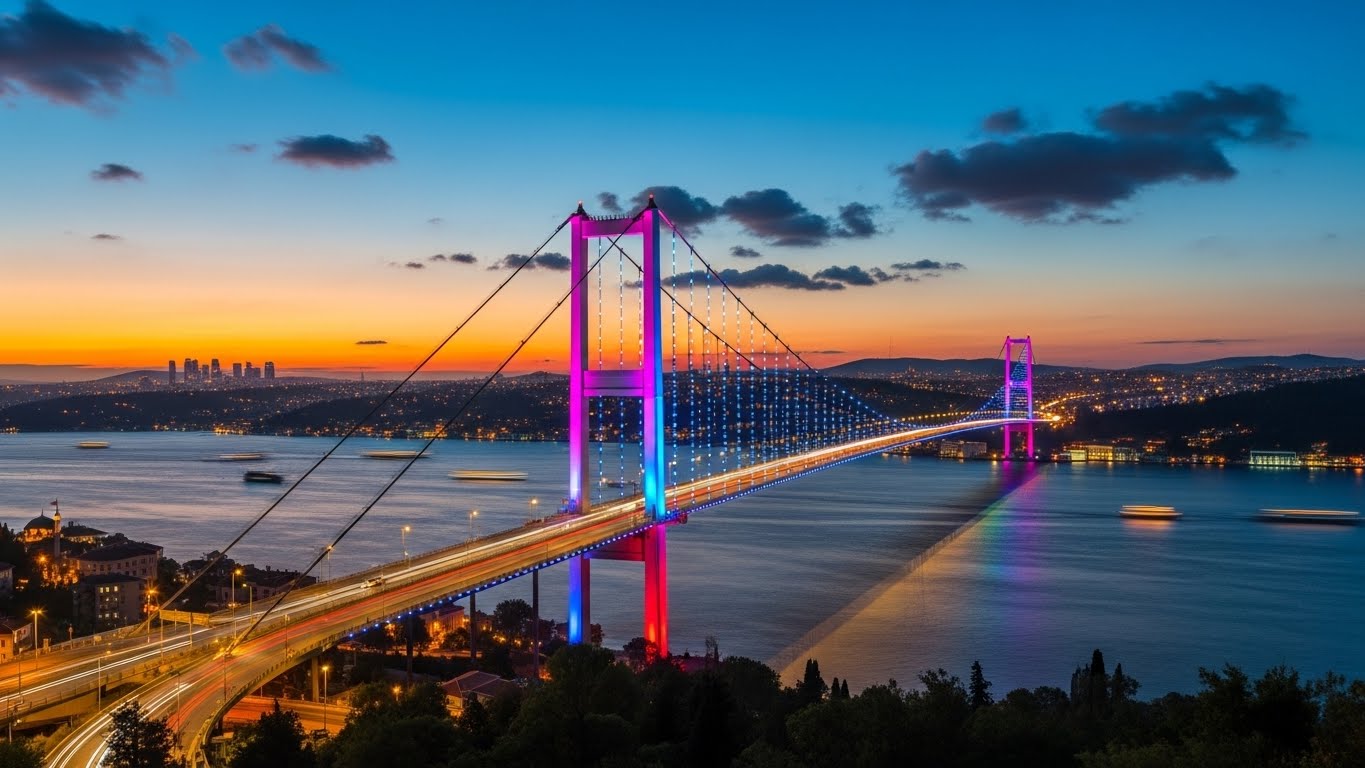
One of the most dramatic developments in recent years has been the bridge's lighting modernization. Advanced LED technology transformed the structure into a dynamic visual centerpiece after sunset.
The upgraded system utilizes powerful luminaires capable of producing brilliant illumination and sophisticated color effects. Thousands of individual lighting elements work together to create displays visible across large portions of the city.
The result is far more than decorative lighting. It turns the bridge into a living canvas that changes appearance throughout the night.
Colors, Patterns, and Skyline Magic
As darkness falls, the bridge begins a completely different performance. Vibrant blues, reds, greens, golds, and countless combinations illuminate the suspension cables and towers. The famous zigzag cable patterns become dramatically visible, emphasizing the bridge's elegant geometry.
The 105-meter-high towers appear to float above the water, while reflections shimmer across the Bosphorus below. During special holidays, national celebrations, and international events, custom lighting sequences transform the bridge into a symbol of collective celebration.
Photographers often describe the experience as magical. The structure becomes one of the defining visual elements of Istanbul’s skyline, rivaling even some of the city's most historic monuments.
Why It Became a Social Media Sensation
In today's digital world, visually striking landmarks often gain global attention through social media. The Bosphorus Bridge excels in this environment. Drone footage, time-lapse videos, and nighttime photography regularly attract millions of views.
The combination of moving lights, dramatic water reflections, and the unique continental crossing creates content that naturally sparks curiosity. Travelers share clips showing Europe and Asia connected by a glowing ribbon of light, while influencers use the backdrop for stunning visual storytelling.
For anyone creating travel content, the bridge provides exactly the kind of memorable imagery that performs exceptionally well across modern platforms.

How to Experience the Bridge Like an Insider
Why You Can’t Walk Across It Today
One surprise for many visitors is that pedestrians are no longer allowed to cross the bridge. While walking was once possible during specific periods, access today is restricted to authorized traffic and vehicles.
This limitation often disappoints travelers hoping for a continental stroll. Fortunately, there are still excellent ways to experience the structure up close and appreciate its scale.
Understanding this restriction before visiting can help travelers plan more rewarding alternatives.
The Sunset Drive Experience
Many locals recommend experiencing the bridge by car during sunset. As the sun begins to sink behind Istanbul's skyline, the Bosphorus takes on shades of gold, orange, and deep blue.
Driving from Europe to Asia during this period creates a memorable sequence of views. Historic neighborhoods, waterfront mansions, mosques, and passing ships combine into a constantly changing panorama.
Traffic can be heavy, but even that has an unexpected advantage. Slower movement often allows passengers more time to absorb the scenery and take photographs.
Seeing the Bridge from the Water
Bosphorus Cruises
Ask experienced travelers for the best perspective of the bridge, and many will point toward the water. Bosphorus cruises provide unobstructed views that reveal the bridge's full scale and elegance.
From beneath the span, the towers appear enormous. The suspension cables create striking geometric patterns against the sky, while the bridge frames the surrounding cityscape in dramatic fashion.
Day cruises offer excellent visibility, while evening cruises add the spectacle of the LED lighting system.
Public Ferries and Local Traditions
For a more authentic experience, public ferries provide an affordable and beloved alternative. These vessels are deeply woven into Istanbul's culture and remain one of the city's most enjoyable transportation options.
Many locals know a charming tradition associated with passing beneath the bridge: making a wish. As the ferry moves directly under the massive structure, some passengers quietly make a personal wish, believing the moment carries special significance.
Whether one believes in traditions or not, the experience adds an extra layer of charm to an already unforgettable journey.

The Enduring Symbol of Istanbul
More Than a Transportation Link
Although newer bridges and underwater tunnels now connect the two sides of Istanbul, the First Bridge remains the city's most recognizable crossing. Its significance extends far beyond transportation.
The bridge represents movement, connection, and coexistence. It symbolizes Istanbul's role as a place where different cultures, traditions, and perspectives meet. For residents, it serves as a familiar landmark woven into daily life. For visitors, it often becomes one of the most memorable sights of their journey.
Few structures anywhere in the world carry such a powerful geographic and cultural identity.
The Future of the First Bridge
As Istanbul continues to grow, the bridge's role will evolve alongside the city. Ongoing maintenance, technological upgrades, and international attention ensure that it remains relevant for future generations.
The renewed focus generated by the 2027 European Games demonstrates that the bridge continues to resonate with audiences worldwide. Decades after its opening, it still captures imaginations and inspires curiosity.
That lasting appeal is perhaps its greatest achievement. It isn't merely a bridge built across water. It is a bridge across continents, histories, and ideas.
Conclusion
The 15 July Martyrs Bridge, still affectionately known by many as the First Bridge, stands as one of the world's most remarkable landmarks. It connects Europe and Asia, carries hundreds of thousands of travelers daily, and serves as a symbol of Istanbul's unique position at the crossroads of civilizations.
From its ambitious origins in the 1950s to its celebrated opening in 1973, from its dazzling LED displays to its prominent role in the Istanbul 2027 European Games, the bridge continues to evolve while maintaining its iconic status. Even with newer crossings available, it remains the emotional and visual heart of the Bosphorus.
If you had to choose, would you rather stay on Istanbul's European side or its Asian side?
FAQs
The best time to see the Bosphorus Bridge is during sunset or at night when the lights are on. For photography lovers, early mornings also offer fantastic lighting and fewer crowds. No, pedestrians are not allowed to walk on the bridge under normal circumstances. The only exception is during the Istanbul Marathon, held annually in November. Because it physically connects two continents—Europe and Asia—it’s one of the most iconic landmarks in the world. It also has immense historical, cultural, and political significance. The bridge is approximately 1,560 meters (5,118 feet) long, with a main span of 1,074 meters (3,524 feet).
Have Question Or Suggestion ?
Please Share Your Thought, To Make It Real