New Istanbul airport
Istanbul Airport 2026 is set to hit 90M passengers, dominate cargo, boost real estate 140%, and redefine global aviation power. Here’s why investors are moving fast.
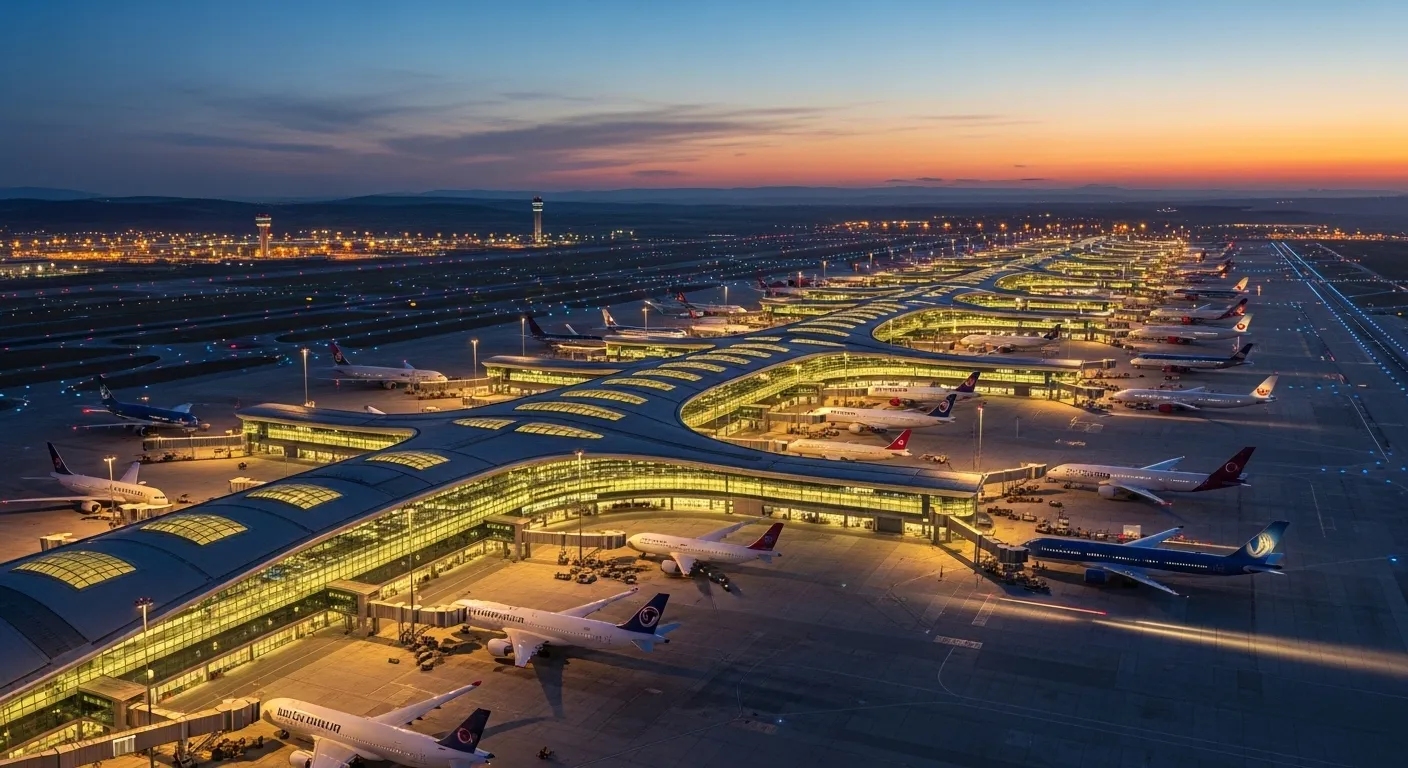
New Istanbul Airport 2026: The Economic Engine Reshaping Turkey
The Hook: Istanbul Is Now the World’s #1 Destination
Istanbul has officially reclaimed its historic position as the crossroads of the world. Today, it stands as the most visited city globally, attracting millions of travelers from every continent. But behind this tourism triumph lies a powerful engine driving the momentum — New Istanbul Airport 2026.
This airport is no longer just a place where planes land and take off. It has evolved into the beating heart of Turkey’s economic transformation. Every arriving aircraft carries tourists, investors, entrepreneurs, and opportunities. Every departure exports goods, services, and influence.
The numbers are staggering. The airport is targeting 90 million passengers in 2026, with infrastructure designed to expand Istanbul Airport capacity to 120 million passengers, and eventually to an ambitious 200 million annually.
That’s not simply growth — that’s global dominance.
But here’s the real shift: Istanbul Airport is no longer just transportation infrastructure. It is becoming a fully integrated economic city — a self-sustaining ecosystem of logistics, offices, hotels, retail zones, and investment opportunities.
If you want to understand where Istanbul’s economy is heading over the next decade, look north — toward the runways that never sleep.
The Numbers Speak: 90 Million Passengers in 2026
Let’s talk reality.
Reaching 90 million passengers in 2026 is not a marketing slogan. It is a calculated milestone backed by route expansion, infrastructure upgrades, and the aggressive global growth of Turkish Airlines, which flies to more countries than any other airline in the world.
What does 90 million passengers really mean?
It means:
Massive hotel demand
Increased real estate consumption
Job creation in aviation and services
Higher commercial activity
Stronger international trade links
Each passenger represents an economic ripple effect. Travelers need accommodation, food, transportation, shopping, and entertainment. Business travelers bring contracts. Investors bring capital.
When compared to Heathrow, Frankfurt, or Paris Charles de Gaulle, Istanbul Airport competes head-to-head — and in some categories, particularly international connections and air cargo, it surpasses them.
The 90 million target is only Phase One of a much larger ambition.
Because once you build momentum at that scale, expansion becomes inevitable.

Istanbul Airport Capacity: From 120 Million to 200 Million
What makes New Istanbul Airport 2026 unique is that it was designed for expansion from day one. Unlike older European airports limited by urban surroundings, Istanbul Airport sits on vast land prepared for phased growth.
The next stage aims to increase Istanbul Airport capacity to 120 million passengers annually, with long-term plans reaching an unprecedented 200 million passengers per year.
Think about that for a moment.
Two hundred million passengers moving through a single airport annually means:
A nonstop economic cycle
Permanent demand for housing
Increased need for office space
Logistics expansion
A thriving Airport City ecosystem
The infrastructure already anticipates this growth:
Modular terminal expansions
Additional runways
Smart passenger flow systems
High-capacity baggage automation
This isn’t reactive growth. It’s strategic scaling.
And whenever capacity rises, so does opportunity — especially in real estate investment near Istanbul Airport.

Construction Expansions 2026: Phase Two and Beyond
2026 marks a turning point in the airport’s evolution. Phase Two expansion includes infrastructure upgrades designed to handle higher volumes without compromising passenger experience.
Key upgrades include:
Expanded terminal sections
Increased security and passport control lanes
Enhanced baggage handling systems
Additional taxiways
The objective is simple: growth without congestion.
Mega-airports often struggle with overcrowding. Istanbul’s advantage is foresight. The blueprint always included future phases, allowing construction without operational disruption.
For investors, this is critical. Infrastructure expansion directly influences surrounding land value. History shows that transportation mega-projects consistently elevate nearby real estate prices.
2026 isn’t just expansion.
It’s acceleration.
The Fourth Runway (East–West) Launch – August 2026
In aviation, runways are power.
The launch of the fourth East–West runway in August 2026 significantly increases operational efficiency. More runways mean more simultaneous takeoffs and landings — and fewer delays.
Operational impact includes:
Reduced aircraft waiting time
Lower fuel waste
Increased hourly flight movements
Improved punctuality
For airlines, this means cost efficiency. For passengers, it means reliability. For the airport, it means increased traffic capacity.
And increased traffic equals increased economic circulation.
The fourth runway strengthens Istanbul’s position as a premier global transit hub between Europe, Asia, Africa, and the Americas.
This is not a minor upgrade.
It’s a competitive advantage.
Air Cargo Leadership: 2+ Million Tons Annually
While passenger traffic makes headlines, air cargo drives serious revenue.
Istanbul Airport now handles over 2 million tons of cargo annually, surpassing Frankfurt to become Europe’s air cargo leader.
Cargo dominance means:
Stronger trade routes
Faster global shipping
Increased demand for logistics infrastructure
Growth in e-commerce distribution
In today’s world of same-day and next-day delivery expectations, speed defines competitiveness. Istanbul’s geographic position — within a four-hour flight radius of 50+ countries — makes it a natural logistics powerhouse.
This cargo strength directly boosts warehouse demand, industrial zones, and commercial property investments.
The airport doesn’t just move people.
It moves global trade.
Transportation Revolution: Reach the Airport in 30 Minutes
Distance used to be a concern. Not anymore.
With the full expansion of the Istanbul Airport Metro M11, reaching the airport from central districts like Gayrettepe now takes approximately 30 minutes.
That single improvement transformed perception.
Fast access means:
Higher property value appreciation
Easier commuting for airport employees
Increased business mobility
Reduced traffic congestion
Time is currency. And when commuting time drops, investment appeal rises.
Istanbul Airport Metro M11 & Marmaray Connection
The 2026 completion of the Arnavutköy–Halkalı segment connects directly with the Marmaray line, linking Europe and Asia via an undersea tunnel.
This means passengers can travel from the Asian side of Istanbul directly to the airport without changing transportation modes excessively.
The integration of:
Metro M11
Marmaray
Highway connections
creates a seamless urban transport ecosystem.
Connectivity fuels development.
Development fuels property demand.
Istanbul airport map

Advantages of the new Istanbul airport
The airport is considered the largest in the world. In addition, it contains more than 300 flight points, 250 of which are international.
The airport has a car park and a garage that can accommodate about 40,000 cars at a time.
The airport is characterized by being the safest airport in the world, as security radar systems have surrounded it in addition to very advanced surveillance systems and cameras, as well as internal security devices characterized by installing and identifying explosives before detonating.
Planes can go to the airstrip at the airport containing 143 pedestrian bridges and 655 between walkways, electronic stairs, and elevators.
The airport will secure flights that will take 3 hours to travel to approximately 41 countries and flights that will take 5 hours to travel to 66 countries worldwide.
The airport includes children's play centers, conference rooms, health centers, places of worship, and a hotel with 451 rooms.
Istanbul airport Code: IST
A new metro line will be opened linking the new airport with the Halkalı metro, passing by the Kayaşehir – Başakşehir metro, covering a distance of 34 km.
The importance of the geographical location of Istanbul throughout history, as Turkey became, with the entry into service of Istanbul Airport, the essential transit center between the four northern, southern, eastern, and western axes of the world.

Istanbul's new airport and its impact on the real estate sector
After the opening of Istanbul's new airport, its effects have appeared on the most prominent sectors in Turkey, the most important of which are the sectors of the economy, tourism, and real estate.
At the level of the tourism sector, tourist demand has increased in Turkey, and tourism rates and daily and seasonal returns have risen.
As for the real estate sector, there has been an increase in real estate investment opportunities in the surrounding areas and close to Istanbul Airport, and this particular thing has begun to see its signs through the high prices of apartments in Istanbul in the areas surrounding the airport, especially the real estate of Basaksehir.
Finally, the new Istanbul airport has constituted a significant turning point in the path of Turkish economic progress and development, as Turkey aspires to reach one of the top ten countries in the world in terms of the economy by next year. It is expected that the return from the airport's revenues will amount to about 5% of the total revenue Turkish economy.
The importance of Istanbul's new airport:
This vast project has gained the city of Istanbul additional strategic importance and created a new transportation network and transport routes that construction and real estate companies in Turkey have worked to exploit and employ to achieve an additional benefit. Therefore, the construction of the new Istanbul airport has been positively reflected. On real estate prices in Turkey.
Many find that the real estate investment sector in Turkey is the sector that benefits most from the new Istanbul airport project and the associated transportation network, as the prices of real estate located near the airport or in the surrounding areas have witnessed an impressive jump as they have a strategic location and value.
High investment and real estate experts expect that real estate in the vicinity of the airport will witness further growth and gain additional importance due to the global importance enjoyed by this airport and thanks to the projects of express transportation routes that work to connect the airport with the rest of Istanbul, which contribute to raising prices Real estate more and more as the areas through which these roads pass are witnessing a quantum leap in the investment value of their real estate, such as the Besiktas area, the Sisli area, the Kagithane area, in addition to the Ayoub and Arnavutkoy regions.
Real Estate Impact: The Golden Zones Around the Airport
Whenever a mega-transport hub expands, surrounding areas transform.
The same pattern is unfolding near New Istanbul Airport 2026.
Why Are Surrounding Areas Called “Golden Zones”?
Because infrastructure drives appreciation. And infrastructure at this scale creates long-term demand.
Key growth drivers include:
Metro connectivity (M11 line)
Employment growth
Logistics expansion
Commercial activity
International investor interest
Real estate investment near Istanbul Airport has shifted from speculative to strategic. Investors are no longer asking if values will rise — they’re asking how much.
The northern corridor of Istanbul is evolving into a new economic belt.
And the data supports it.
Arnavutköy: 140% Land Value Increase & Apartment Prices 2026
Just a few years ago, Arnavutköy was considered a quiet suburban area.
Today, it’s often referred to as the “economic gateway of Istanbul.”
Land prices increased by approximately 140% within three years — a direct reflection of airport-driven development and metro expansion.
Apartment Prices in Arnavutköy 2026
Although prices have risen, they remain more affordable than central Istanbul districts, leaving room for further appreciation.
Demand comes from:
Airport employees
Airline staff
Logistics workers
Investors seeking rental income
International buyers
With metro connectivity strengthening and commercial projects increasing, Arnavutköy stands at the center of transformation.
And transformation is where early investors benefit most.
Başakşehir & Kayaşehir: The Modern Urban Extension
While Arnavutköy offers proximity, Başakşehir and Kayaşehir offer modern urban planning.
These districts feature:
Contemporary residential complexes
Schools and hospitals
Shopping centers
Parks and green areas
Strong municipal infrastructure
They attract professionals working at the airport who seek quality living standards with manageable commuting times.
Rental demand remains stable due to continuous airport employment growth.
These areas represent the residential backbone supporting the airport economy.
And when employment remains constant, rental stability follows.
Rental Yields Near Istanbul Airport: 25% Higher Returns
One of the most compelling investment indicators is rental yield.
Properties near Istanbul Airport have shown rental returns up to 25% higher compared to certain central city districts.
Why?
Because:
Demand is employment-driven (stable and ongoing)
Supply remains controlled
Infrastructure continues expanding
Business travel fuels short-term rental demand
Investors increasingly prefer areas tied to infrastructure growth rather than saturated city centers.
When a region is supported by transportation, trade, and international connectivity, vacancy risk decreases.
And lower risk attracts more capital.
Conclusion: Why Istanbul Airport Is Turkey’s Economic Engine for the Next Decade
When you step back and view the complete picture, it becomes clear:
New Istanbul Airport 2026 is not just a transportation project. It is a national economic strategy.
It integrates:
Passenger expansion
Cargo dominance
Metro connectivity (M11)
Direct Marmaray linkage
Airport City development
$2.3 billion logistics investment
Real estate transformation
Few infrastructure projects in modern Europe combine aviation, trade, urban development, and technology at this scale.
The airport is reshaping northern Istanbul, redefining property markets, strengthening global trade links, and positioning Turkey as a central node in international mobility.
The question isn’t whether Istanbul Airport will influence the next decade.
The question is how you position yourself within its growth trajectory.
Are you looking for real estate investment opportunities near Istanbul Airport? Contact our advisors to receive a curated list of the most promising 2026 projects.
Istanbul's new airport is located in the Arnavutköy area on the European side of the city
Yes, there is a hotel available inside the new Istanbul Airport called YOTEL Istanbul Airport
Ataşehir is very centrally located. It takes approximately:
- 25–30 minutes to Sabiha Gökçen Airport (SAW).
- 50 minutes to Istanbul Airport (IST).
- 15 minutes to Kadıköy (the cultural heart of the Asian side).
- 20 minutes to Taksim (via the bridge, depending on traffic).
- With the new Metro M4 and M12 lines, public transport connectivity has arguably solved previous accessibility issues.
It is a game-changer. With the completion of the Halkalı-Istanbul Airport Metro (integrated with Bağcılar’s existing lines), residents can now reach the airport in under 35 minutes without traffic. This has made the district a prime location for pilots, cabin crew, and frequent business travelers, significantly boosting rental demand in 2026.
Başakşehir is strategically located as the "gateway" to the new Istanbul. It is:
- 20–25 minutes from Istanbul Airport (IST) (one of the closest districts).
- 35–45 minutes from Taksim/Şişli (depending on traffic).
- However, with the fully integrated M3, M9, and M11 Metro lines, commuting to key business hubs like Maslak or Levent is now predictable and traffic-free.

.webp)
Have Question Or Suggestion ?
Please Share Your Thought, To Make It Real