Turkey vs Greece Golden Visa – Which Is Better in 2026?
Compare Turkey and Greece's Golden Visa programs in 2026. Explore costs, citizenship, benefits, and which option suits your lifestyle and investment goals best.
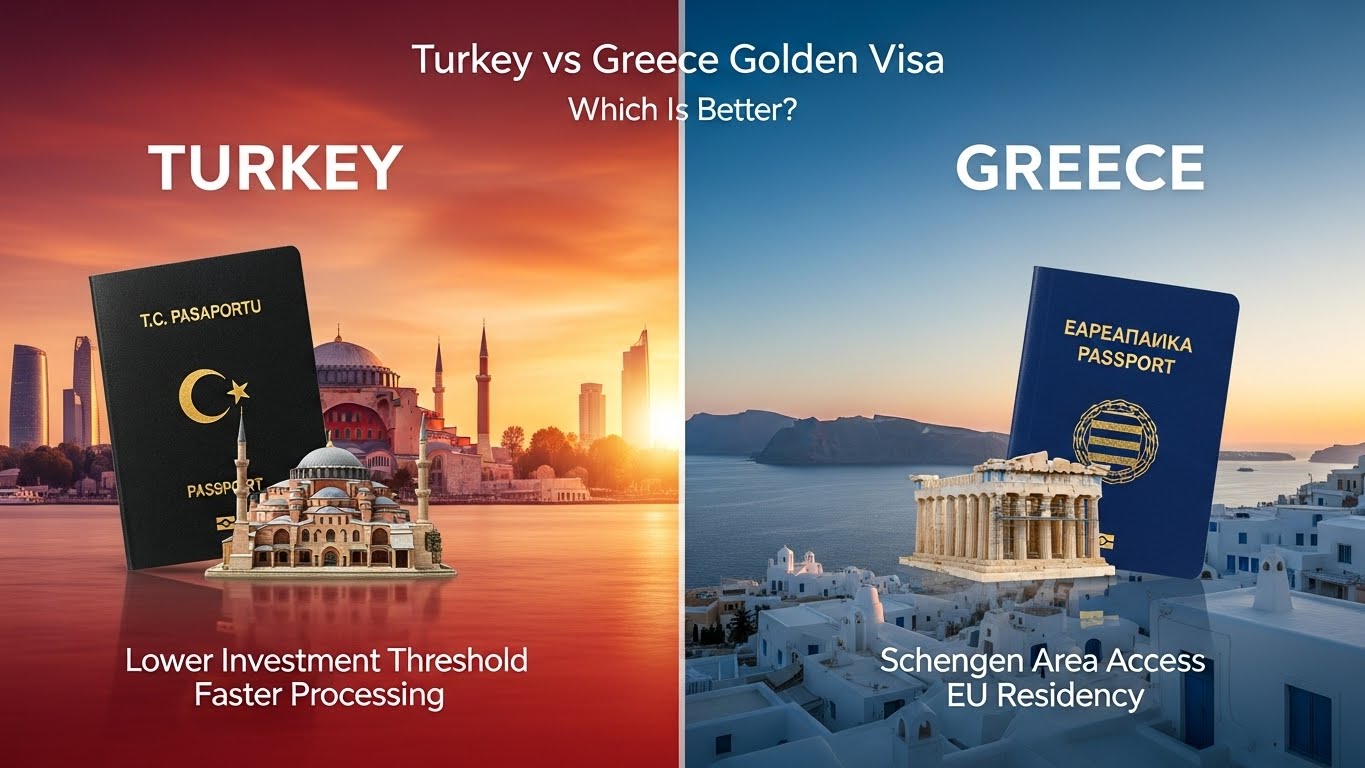
If you've been considering second residency or even future citizenship through real estate investment, you're probably eyeing Europe's Golden Visa programs. But the big question for 2026 is: Turkey or Greece—who offers the better Golden Visa deal? On the surface, both nations offer sun-soaked coastlines, deep historical roots, and investment incentives for foreign nationals. However, under the hood, the programs differ quite a bit in terms of investment thresholds, residency rights, long-term benefits, and much more.
With geopolitical shifts, regulatory updates, and real estate markets in flux, the year 2026 marks a turning point for both Turkey and Greece in the Golden Visa race. Whether you're an investor, a retiree looking to relocate, or a remote worker seeking a backup plan, this comprehensive comparison will guide you through every major aspect of the two programs. Let’s unpack which Golden Visa truly stands out in 2026.
Understanding the Golden Visa Concept
Before we dive into specifics, let’s make sure we’re on the same page. A Golden Visa is essentially a residency-by-investment program offered by several countries. In exchange for a significant investment—often in real estate or business—you’re granted temporary or permanent residency, with the possibility of citizenship down the line.
Why is this a big deal? Because Golden Visas unlock:
The right to live in the country
Freedom to travel (often across Europe)
Pathways to citizenship
Tax optimization and global mobility
Golden Visas are especially attractive to people from countries with limited passport power, political instability, or high taxes. They’re also a great Plan B if you're eyeing retirement or international business expansion.
Turkey Golden Visa 2026 Overview
Turkey doesn’t officially call its program a “Golden Visa,” but its Citizenship by Investment (CBI) program acts just like one—except it’s even more powerful. Why? Because it leads directly to citizenship, not just residency.
As of 2026, here’s what you need to know:
Minimum real estate investment: $400,000 (unchanged from 2023)
Other options: Bank deposit of $500,000, government bonds, job creation
Citizenship granted in 3–6 months
Full family included (spouse + dependent children under 18)
What’s new in 2026?
Tightened due diligence checks
Longer processing times due to increased demand
Rumors of a potential increase in the minimum investment (watch this space!)
Still, the Turkish program remains one of the fastest and most direct routes to second citizenship.
Greece Golden Visa 2026 Overview
Greece, on the other hand, offers one of Europe’s most accessible residency-by-investment programs. While it doesn’t offer citizenship upfront, it opens the door to Schengen travel, EU lifestyle, and eventual naturalization.
As of 2026, here’s the scoop:
Minimum investment: €500,000 for real estate in Athens, Thessaloniki, and islands; €250,000 in less populated areas
Residency granted within 3–5 months
No physical stay required (but citizenship requires it)
Can include family members (spouse, kids, and dependent parents)
2026 updates:
A new Digital Application Portal has sped up paperwork
Enforcement of property value compliance checks
Tax incentives for foreign investors renewed
Greece’s program is popular among those looking for a European base without the full commitment of citizenship (yet).
Investment Options Compared
Let’s talk money. Both programs let you choose between real estate and other financial routes, but the flexibility and outcomes differ.
Turkey:
Real estate (primary method)
Bank deposit in Turkish lira
Purchase of government bonds
Investment in a Turkish company
Greece:
Real estate (most popular)
Capital contribution to a Greek company
Investment in bonds or mutual funds
Strategic investments (for larger portfolios)
Key Differences:
Greece allows lower entry points in smaller towns
Turkey allows more diverse investment options
Greece is ideal for EU access, Turkey for direct citizenship
So, it depends on your goals: Is it mobility or nationality?
Cost of Investment: Turkey vs Greece
Let’s break down the total cost of acquiring a Golden Visa in both countries.
| Cost Component | Turkey | Greece |
|---|---|---|
| Minimum Investment | $400,000 (real estate) | €250,000–€500,000 (real estate) |
| Legal & Govt. Fees | ~$5,000–$10,000 | €10,000–€15,000 |
| Taxes | 4% VAT (some exemptions) | 3–24% (transfer taxes, VAT) |
| Maintenance/Upkeep | Lower (cheaper labor, taxes) | Higher (EU-level costs) |
Turkey is cheaper upfront and in the long run. Greece is more expensive but grants EU access.
Residency and Citizenship Pathways
When evaluating the long-term benefits of any Golden Visa program, two factors are key: residency rights and the pathway to full citizenship. This is where Turkey and Greece diverge significantly, especially in what they offer by 2026.
Let’s start with Turkey, which offers a direct Citizenship by Investment program. This means that once your investment is verified and approved, you’re eligible to apply for Turkish citizenship almost immediately. The usual timeline ranges from 3 to 6 months, and it doesn't require you to live in Turkey full-time. Once you become a citizen, you're granted a Turkish passport, full voting rights, and the ability to work or do business as a Turkish national. That’s a huge perk, especially for investors looking for a Plan B passport or long-term relocation.
Greece, on the other hand, offers residency first, with citizenship only becoming available after seven years of continuous residence. And yes, they do require you to physically reside in Greece for most of those years, which is a sticking point for many passive investors. The program grants you a renewable five-year residence permit, which is ideal for real estate investors or frequent travelers, but less attractive for those looking to fast-track citizenship.
Here’s a snapshot:
| Feature | Turkey | Greece |
|---|---|---|
| Citizenship Timeline | 3–6 months | 7+ years |
| Residency Requirement | None | Yes (for citizenship) |
| Dual Citizenship Allowed | Yes | Yes (but with restrictions) |
| Language Test for Citizenship | No | Yes (Greek language proficiency) |
So if you’re looking to secure a second passport quickly, Turkey is the clear winner. But if EU residency and eventual access to the entire European Union is your goal, Greece offers a strategic advantage—though you’ll have to be patient.
Processing Time and Bureaucracy
When you’re ready to invest half a million or more, you want the process to be as smooth as possible, right? Unfortunately, that’s not always the case. Let’s talk red tape.
In Turkey, despite the promise of speedy citizenship, 2026 has seen slight delays in application approvals due to increased demand and tightened security protocols. The Citizenship by Investment Unit is taking longer to process due diligence, especially for applicants from high-risk countries. Typically, the whole process still wraps up in 6 to 8 months, but it’s slower than it was a couple of years ago.
Meanwhile, Greece has stepped up its game. Thanks to its fully digital Golden Visa portal launched in late 2025, processing times have dropped significantly. Investors can now submit applications online, track progress, and schedule biometric appointments with less friction. Most applications are now approved in 3 to 5 months, making Greece more efficient than ever.
Here’s how they compare:
| Criteria | Turkey | Greece |
|---|---|---|
| Application Method | Semi-digital | Fully Digital (as of 2026) |
| Average Approval Time | 6–8 months | 3–5 months |
| Bureaucratic Hurdles | Moderate | Low (post-2025 updates) |
| Rejection Rate | Low | Low |
So if efficiency and ease of application are high on your list, Greece may win this round.
Real Estate Market Comparison
Both countries hinge their Golden Visa programs heavily on real estate investment, so the next question is: Which market gives you more bang for your buck in 2026?
Turkey offers real estate that’s still relatively undervalued compared to the European average. Cities like Istanbul, Antalya, and Bodrum offer luxury properties at prices that are a fraction of what you’d pay in Western Europe. Plus, the booming tourism industry in Turkey makes short-term rental income an attractive possibility.
In contrast, Greece’s real estate market has seen a surge in value, especially in key cities like Athens, Thessaloniki, and island locations like Mykonos and Santorini. The new €500,000 threshold for urban centers reflects this demand. Rental yields are decent, especially in tourist-heavy zones, but property management and taxes are more complex due to EU regulations.
Key market differences in 2026:
| Factor | Turkey | Greece |
|---|---|---|
| Price per m² (avg.) | $1,500 – $3,000 | €2,500 – €6,000 |
| Rental Yield | 5–8% (short-term) | 3–6% (short-term) |
| Real Estate Taxes | Low to moderate | Moderate to high |
| Growth Potential | High (emerging market) | Stable (mature market) |
If you're thinking like an investor, Turkey's market has higher upside, especially if you know where to buy. Greece, however, offers more stability and the prestige of EU real estate—ideal for more conservative investors.
Cost of Living: Turkey vs Greece
Let’s talk lifestyle—because getting a Golden Visa isn’t just about investment returns; it’s about where you and your family might actually live. In this regard, Turkey offers a clear cost advantage.
From groceries to healthcare, housing to entertainment, Turkey’s overall cost of living is about 30–50% lower than in Greece. In cities like Izmir or Antalya, you can live comfortably on $1,500 to $2,000/month, even with a family. In contrast, living in Athens or any major Greek city could easily push you toward €2,500–€3,500/month, depending on your lifestyle.
Healthcare in Turkey is also high quality and more affordable, with many private hospitals meeting international standards. Greece has a solid public healthcare system, but wait times can be long, and private care is often necessary.
Here’s a quick lifestyle breakdown:
| Expense Category | Turkey (Monthly Avg.) | Greece (Monthly Avg.) |
|---|---|---|
| Rent (2BR apt) | $500–$800 | €800–€1,200 |
| Utilities | $70–$100 | €120–€180 |
| Groceries | $200–$300 | €300–€500 |
| Healthcare (private) | $40–$100 | €70–€200 |
So if your priority is living well for less, Turkey is the clear winner here. But if you value the European lifestyle, Greece might still be worth the higher price tag.
Travel and Mobility Benefits
One of the top reasons people invest in Golden Visas is the promise of greater travel freedom. So, how do Turkey and Greece stack up in 2026?
With a Greek Golden Visa, you gain visa-free access to the entire Schengen Zone, which includes 26 countries. That’s huge if you’re someone who travels frequently for business or leisure. However, remember—it’s not a passport, so your global mobility depends on your original nationality until you naturalize as an EU citizen (after 7+ years).
On the flip side, Turkey’s Golden Visa program leads directly to a Turkish passport, which in 2026 allows visa-free or visa-on-arrival access to 111 countries, including Japan, South Korea, and much of Latin America. However, the EU and USA still require a visa for Turkish passport holders.
| Feature | Turkey | Greece |
|---|---|---|
| Schengen Access | No (citizenship only) | Yes (immediate with residency) |
| Visa-Free Countries | 111 | Based on original passport |
| Passport Strength (if citizen) | Medium | Very High (once EU citizenship obtained) |
If you’re looking for instant Schengen access, go with Greece. If you want a Plan B passport fast, Turkey delivers more long-term mobility.
Tax Implications and Financial Transparency
Taxes—often overlooked but arguably one of the most important aspects of moving or investing abroad. In 2026, the tax implications of choosing between Turkey and Greece’s Golden Visa programs are more relevant than ever, especially with global crackdowns on offshore income and transparency regulations tightening across the EU.
Starting with Turkey, the country has relatively favorable tax policies for foreign investors. As of 2026:
No worldwide income tax unless you become a tax resident (spending more than 183 days in Turkey per year)
Capital gains tax on real estate is waived if you hold the property for 5+ years
Corporate and personal income tax rates range from 20%–35%
No inheritance or wealth tax for non-residents
Additionally, Turkey is not part of the EU and, while a member of the OECD, it has been somewhat more relaxed in terms of enforcing Common Reporting Standards (CRS) compared to Greece. This can offer more financial privacy, although scrutiny is increasing globally.
Greece, being a part of the European Union, has more stringent tax regulations. Here's what investors face in 2026:
Golden Visa holders don’t automatically become tax residents unless they spend 183+ days/year in Greece
Greece does tax global income if you're a tax resident
Capital gains taxes, property taxes, and VAT can add up
Greece has signed tax treaties with over 57 countries, which helps avoid double taxation
One bright spot is Greece’s non-dom tax regime, allowing foreign investors to pay a flat tax of €100,000 per year on worldwide income if they meet certain criteria. But it’s not automatic—you have to apply and meet residency and financial thresholds.
| Tax Type | Turkey | Greece |
|---|---|---|
| Worldwide Income Tax | No (unless resident) | Yes (if resident) |
| Capital Gains on Real Estate | Waived after 5 years | Taxed |
| Wealth or Inheritance Tax | No (non-resident) | Yes |
| Tax Transparency | Moderate | High (EU rules) |
If lower taxes and financial privacy are your priorities, Turkey is the better option. But if you’re fine with EU financial compliance and double-taxation treaties, Greece may offer more protection in the long run.
Cultural and Lifestyle Factors
Let’s get personal—because your lifestyle matters as much as your portfolio. Are you looking for laid-back Mediterranean charm or a culturally diverse crossroad of Europe and Asia? The vibe between Turkey and Greece couldn’t be more different, even though they're neighbors.
In Turkey, you get:
A blend of European, Middle Eastern, and Asian cultures
Dynamic cities like Istanbul with world-class shopping, dining, and nightlife
Rich Islamic and Byzantine history
Friendly locals, though language can be a barrier (Turkish is widely spoken)
In Greece, you’re looking at:
Classic European lifestyle with a focus on family and community
Slower pace of life, especially in rural areas and islands
Vibrant culture rooted in Orthodox Christianity and ancient traditions
Greek is the primary language, but English is widely spoken, especially in cities and among younger generations
Greece might feel more “Western” to expats, while Turkey provides a more multicultural experience. Both offer delicious cuisine, warm weather, and spectacular coastlines, but the religious, social, and political atmospheres are noticeably different.
So, if you’re after a cosmopolitan, East-meets-West experience, Turkey offers more diversity. If you want a European lifestyle with island vibes and ancient ruins at your doorstep, Greece delivers that classic charm.
Safety and Political Stability
Safety is a top concern when relocating or investing in another country, and in 2026, both Turkey and Greece remain relatively stable, though they each come with unique risks.
Greece, as a member of the EU and the Schengen Zone, enjoys strong political and institutional stability. It ranks high on global safety indexes, with low violent crime rates and reliable public infrastructure. Protests and political strikes do occur occasionally (mostly in urban centers), but they are rarely violent.
Turkey, while safe in most major cities and tourist regions, continues to deal with regional instability. Tensions with neighboring countries, periodic unrest in the southeast, and the complex political landscape can raise concerns for risk-averse investors. That said, areas like Istanbul, Antalya, and Bodrum remain safe and expat-friendly.
2026 Update:
Greece has maintained its position in the top 30 safest countries globally.
Turkey has improved in stability rankings due to increased government reforms, though some western countries still issue cautious travel advisories.
| Safety Indicator | Turkey | Greece |
|---|---|---|
| Political Stability | Moderate | High |
| Violent Crime Rate | Low in major cities | Very Low |
| Terrorism Risk | Moderate (regional) | Low |
| Expat Community Safety | High in tourist zones | High everywhere |
Bottom line? For those prioritizing stability and EU protections, Greece may feel more secure. But Turkey still offers a safe environment in its well-established expat hubs.
Which Program is Better for Families?
If you’re relocating with family, the Golden Visa decision isn’t just about money—it’s about education, healthcare, and family integration. So which country caters better to family life in 2026?
Greece has:
Access to high-quality EU education, including international schools in Athens and Thessaloniki
Free public healthcare for residents (though many expats opt for private)
A family-friendly society with a strong emphasis on community and traditions
Relatively easy family reunification policies under the Golden Visa program
Turkey also accommodates families well:
A growing number of international schools (British, American, and IB curriculums) in Istanbul and Ankara
Affordable private healthcare with modern hospitals
Inclusive application process that covers spouse and children under 18
Lower overall cost of living for large households
The main difference lies in long-term benefits. In Greece, children may eventually access EU universities and scholarships, while Turkish citizenship opens up regional opportunities but not EU-wide benefits.
So for global education and EU access, Greece is a stronger pick. But for affordability and family lifestyle, Turkey still holds its own.
Retirees and Remote Workers: Which Country Wins?
The rise of location-independent work and global retirement planning has made Golden Visa programs more appealing than ever. So, which destination—Turkey or Greece—is more ideal in 2026 for retirees and digital nomads?
Let’s start with retirees.
Greece offers a relaxed pace of life, beautiful weather, rich culture, and access to excellent healthcare across the EU. If you’re a pensioner from a country with a tax treaty (e.g., USA, UK, Canada), your foreign pension might be exempt from double taxation. Greece also introduced a favorable tax regime for foreign pensioners, applying a flat 7% tax rate on foreign-sourced pensions—valid for 15 years if you move your tax residence to Greece. This makes Greece highly attractive for long-term retirement.
Meanwhile, Turkey is significantly more affordable. A couple can live comfortably in Antalya, Alanya, or Fethiye on $1,500/month, including rent. Healthcare is top-tier and inexpensive, with international hospitals and a growing expat medical network. While Turkey doesn’t offer a dedicated retirement visa, its Citizenship by Investment path makes permanent residency and eventual integration seamless for retirees.
For remote workers, Greece launched a Digital Nomad Visa, which allows remote employees and freelancers to live in Greece for up to 2 years, with renewable options. They must earn at least €3,500/month and work for a non-Greek employer or clients abroad. Golden Visa holders also enjoy the flexibility to live in Greece without working locally.
Turkey does not have a dedicated digital nomad visa, but many remote workers use tourist visas, residence permits, or CBI status to stay long term. Internet infrastructure in major Turkish cities is reliable, with growing co-working spaces and nomad-friendly cafés.
| Feature | Greece | Turkey |
|---|---|---|
| Digital Nomad Visa | ✅ Available | ❌ Not yet |
| Retirement Taxes | 7% flat on pensions | No specific regime |
| Cost of Living | Moderate–High | Low |
| Healthcare | Excellent (EU quality) | Excellent & affordable |
| Remote Work Infrastructure | Developed | Developing quickly |
Greece wins for digital nomads and tax-resident retirees wanting EU access. Turkey is ideal for low-budget retirement and CBI-based long stays.
Future Outlook: 2026 and Beyond
Any savvy investor knows to look not just at today, but what’s around the corner. So, what does the future hold for Turkey and Greece’s Golden Visa programs?
Greece is doubling down on attracting high-net-worth individuals, remote workers, and investors. The shift in 2023 from €250,000 to €500,000 minimum in key cities signals an attempt to control speculative investments while keeping the door open in rural areas. Going into 2026 and beyond, Greece is expected to:
Further digitize the application process
Tighten EU compliance standards
Possibly limit short-term rentals in urban areas to ease housing pressures
Still, Greece remains committed to its Golden Visa, especially as tourism and foreign investment continue to fuel its economy.
Turkey, meanwhile, is navigating economic reform and political realignment. The Golden Visa (CBI) program continues to be a major revenue stream, and despite occasional rumors about increasing the threshold to $600,000 or more, it remains competitive. Expect:
Enhanced due diligence for applicants
Focus on attracting non-EU investors
Continued real estate growth, especially in coastal areas
Also, geopolitical positioning makes Turkey a strategic bridge between Europe and Asia, which could be more valuable than ever in a multipolar world.
Pros and Cons Summary
To wrap it all up, let’s take a clear-eyed look at the advantages and disadvantages of both programs.
Turkey Golden Visa (CBI)
✅ Direct citizenship in 3–6 months
✅ Lower investment threshold ($400K)
✅ Strong real estate ROI
✅ No physical residency requirement
❌ Passport not EU-compatible
❌ Political and currency volatility
❌ No Schengen access (until citizenship)
Greece Golden Visa
✅ Instant Schengen mobility
✅ EU residency with long-term path to citizenship
✅ High quality of life & healthcare
✅ Digital nomad and retiree-friendly
❌ No direct citizenship
❌ Higher investment in popular areas (€500K+)
❌ Tax exposure if you become resident
Expert Verdict: Which is Better in 2026?
So, which Golden Visa is better in 2026—Turkey or Greece? The answer depends on your priorities.
If your main goal is fast-track citizenship, affordable real estate, and lifestyle flexibility—Turkey is your best bet. Especially for non-EU nationals looking for Plan B citizenship, it’s a straightforward, low-barrier path to a new passport.
But if you dream of EU residency, easy Schengen access, a high-quality lifestyle, and long-term family security in Europe—Greece takes the crown. It’s perfect for those planning to spend time in Europe, integrate, and eventually pursue EU citizenship.
There’s no one-size-fits-all answer, but here’s a quick final cheat sheet:
| Profile | Best Choice |
|---|---|
| Investor seeking quick citizenship | Turkey |
| EU-focused retiree or digital nomad | Greece |
| Real estate investor chasing ROI | Turkey |
| Family relocating for education | Greece |
| Cost-conscious expat | Turkey |
Conclusion
When it comes to Turkey vs Greece Golden Visa in 2026, both offer compelling paths to new opportunities—but they cater to very different goals.
Turkey gives you the keys to a second passport quickly, with minimal red tape and a booming real estate market. Greece offers a slower but more prestigious path, with EU benefits, long-term security, and travel freedom baked in.
The real question is: What’s more important to you—speed or structure, flexibility or EU prestige, cost savings or continental access? Answer that, and your Golden Visa decision will become crystal clear.
FAQs
1. Can I buy property in both Turkey and Greece and hold both Golden Visas?
Technically yes, but each country has separate visa processes and requirements. You can invest in both, but dual Golden Visa benefits don’t stack—residency and citizenship processes are independent.
2. Is it easy to get citizenship through Greece’s Golden Visa?
No. You must live in Greece for 7 years, show ties to the country, and pass a Greek language and history test. It’s possible but requires commitment.
3. Which Golden Visa is better for digital nomads?
Greece, thanks to its dedicated Digital Nomad Visa, EU internet infrastructure, and easy Schengen travel. Turkey lacks a formal remote work program.
4. What happens if I sell my investment property?
In both countries, if you sell the qualifying property before a specific period (Turkey: 3 years, Greece: maintain minimum investment), you lose your visa status or citizenship eligibility.
5. Can I rent out my property under the Golden Visa?
Yes, both programs allow you to rent out your investment property, but you must follow local rental and taxation rules. Greece may restrict Airbnb in certain zones.
Have Question Or Suggestion ?
Please Share Your Thought, To Make It Real