Istanbul Aidat Fees by District in 2026: What Residents Really Pay
Compare 2026 Istanbul aidat fees by district, building type, and amenities to estimate your real monthly housing costs before renting or buying.
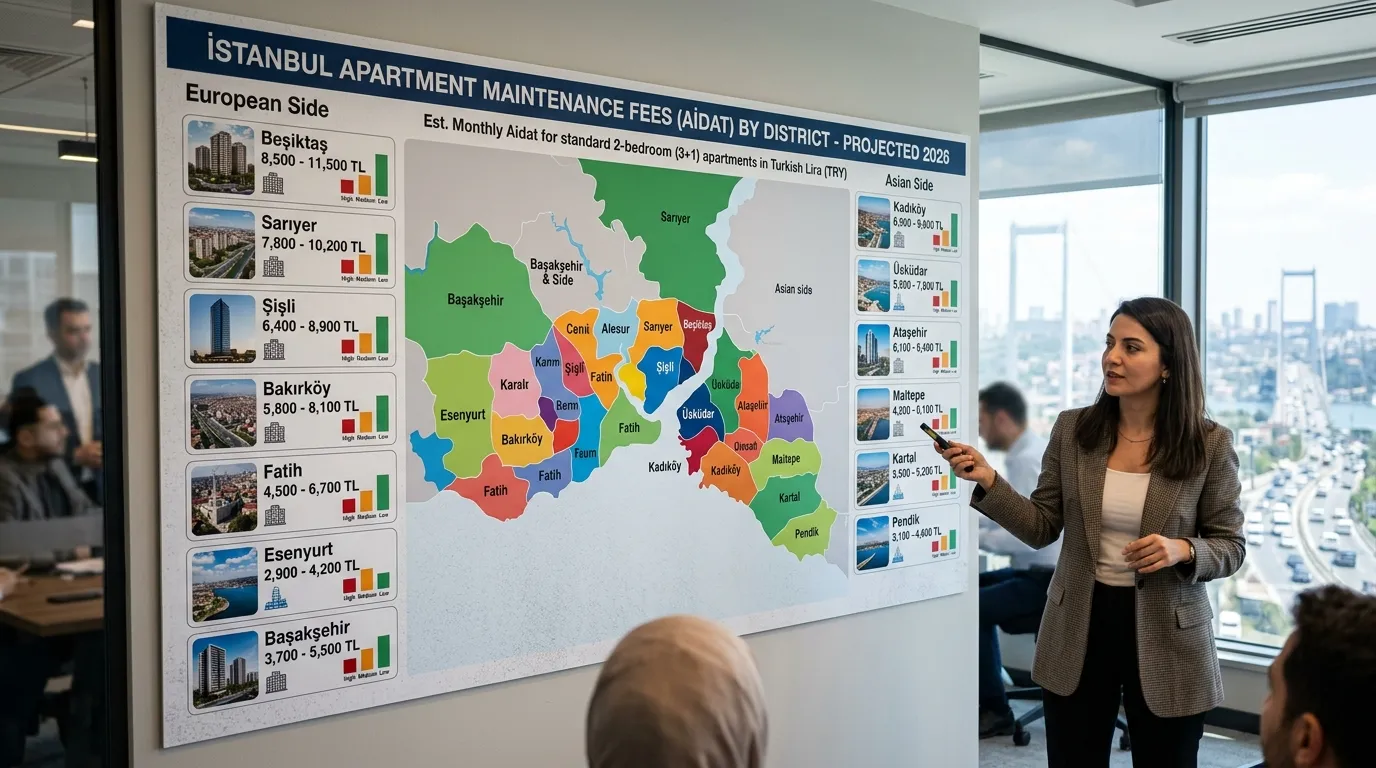
Istanbul Aidat Fees by District 2026: A Practical Guide to Apartment and Site Maintenance Costs
Anyone searching for an apartment in Istanbul eventually encounters a deceptively small word with potentially large consequences: aidat. You might find a flat advertised at an attractive monthly rent, calculate the deposit and moving expenses, and assume you know roughly what living there will cost. Then someone casually mentions a monthly aidat of several thousand Turkish lira. In a large residence or luxury compound, the number can be considerably higher. Suddenly, that apparently affordable apartment looks rather different. This is why understanding Istanbul aidat fees by district in 2026 matters almost as much as comparing rents, especially for tenants, property buyers, investors, and foreigners unfamiliar with Turkish apartment management.
There is no official universal “aidat price” for a district. Aidat is generally determined at the level of an individual apartment building, residence, or residential complex according to its operating budget, services, allocation method, and management decisions. Two properties standing a few streets apart can therefore have dramatically different monthly charges. A traditional apartment with a staircase, elevator, caretaker, and basic cleaning might have a relatively modest fee, while a nearby residence with 24-hour security, indoor parking, landscaped gardens, swimming pools, a gym, generators, technical teams, and reception staff can operate more like a small hotel. The postal address may be nearly identical; the economics are not.
That distinction becomes particularly important in Istanbul's sprawling housing market. Districts such as Beşiktaş, Sarıyer, Şişli, Kadıköy, Ataşehir, Başakşehir, Beylikdüzü, and Esenyurt contain very different types of housing stock, from decades-old neighborhood apartment blocks to high-rise branded residences. Instead of treating district averages as guaranteed prices, this guide uses practical 2026 market-oriented ranges and building categories to help you understand what you may encounter. Exact current charges should always be verified directly with the building or site management before signing a lease or purchasing property.
What Is Aidat in Istanbul and What Does It Usually Cover?
In Turkey, aidat is essentially the recurring contribution collected from apartment owners or occupants to meet the common expenses of a building or residential complex. Calling it simply a “maintenance fee,” however, can undersell what is involved. Imagine an apartment building as a tiny municipality. Someone has to clean the shared areas, illuminate the corridors, maintain the elevator, repair the entrance door, pay staff, service mechanical equipment, and keep common facilities functioning. In a simple building, that miniature municipality has a tiny budget. In a 1,000-unit residential development with pools and security gates, it may have an extensive workforce and substantial monthly operating expenses.
Typical aidat expenditure can include common-area electricity and water, cleaning, caretaker or concierge costs, security, landscaping, elevator maintenance, technical services, waste-related common expenses, facility upkeep, and management costs. Depending on the development, residents may also be contributing toward swimming pools, gyms, saunas, children's areas, sports facilities, shuttle services, generators, parking systems, reception desks, CCTV networks, or other communal infrastructure. Heating or hot-water arrangements can complicate the picture further because some developments collect certain consumption charges separately rather than including them in the headline aidat. That is why asking “How much is the aidat?” is only the first question. The better question is: “Exactly what does this aidat include, and which monthly expenses are billed separately?”
Aidat also should not automatically be treated like rent. Different expenses can create different responsibilities between an owner and tenant, particularly where routine use-related common expenses are distinguished from major structural or ownership-related costs. Lease terms matter as well. Anyone entering a rental agreement should therefore have the allocation of recurring building charges clearly documented instead of relying on a verbal understanding. For buyers, aidat deserves even closer attention because it becomes part of the property's ongoing carrying cost and can affect investment yield for years.
Why Aidat Fees Vary So Much Between Istanbul Buildings
The biggest mistake people make when comparing Istanbul aidat prices is assuming district determines the fee. District matters indirectly because it influences land values, development patterns, building quality, and the prevalence of luxury projects, but the building itself usually matters far more. Consider two apartments in Şişli. One is inside a modest 25-year-old building with 18 units, one elevator, weekly cleaning, and no security. The other sits inside a modern tower with reception staff, underground parking, security personnel, a fitness center, and extensive mechanical systems. Asking for a single “Şişli aidat” that accurately describes both is like asking for one price that represents every hotel room in Istanbul.
Staffing is one of the clearest cost drivers. A building that employs a caretaker and cleaning worker has a very different cost base from a site requiring security shifts around the clock, gardeners, technicians, pool personnel, receptionists, cleaners, and management staff. Energy is another factor. Elevators, pumps, ventilation, lighting, pools, garages, and common heating systems all consume energy, and the more infrastructure a development operates, the more exposed its budget can become to changing utility and service costs. Regular maintenance contracts and repairs add another layer.
The number and size of apartments also matter. Large developments can distribute some fixed costs among hundreds of owners, creating economies of scale, but that advantage disappears quickly when the development offers expensive amenities. Allocation methods may also mean that larger apartments pay more than small units. Occupancy levels can create additional complications in certain projects. For a renter or buyer, the practical lesson is simple: don't judge aidat by the neighborhood's reputation alone. Obtain the latest fee for the specific unit, ask how it is calculated, request information about extra charges, and find out whether a significant increase or major common-area expenditure has recently been approved.
Istanbul Aidat Fees in 2026: What Residents Should Expect
For planning purposes in 2026, Istanbul residents can encounter everything from relatively modest monthly charges in basic neighborhood apartment buildings to five-figure TL monthly fees in premium residences and villa compounds. Rather than pretending there is a single citywide figure, a more useful framework is to divide properties into categories. A conventional apartment building offering limited shared services may commonly sit toward the lower end of the market. Modern apartment blocks with elevators, parking, regular staffing, and better common areas tend to move into the middle. Full-service gated sites and branded residences can climb rapidly because residents are paying not only for maintenance but also for an entire package of facilities and personnel.
For a broad 2026 budgeting framework rather than an official tariff, basic buildings might be encountered around roughly ₺1,000–₺3,000 per month, while better-equipped standard complexes can commonly move into approximately ₺2,500–₺6,000 territory. Modern sites with meaningful security, landscaping, parking, and leisure infrastructure may run around ₺4,000–₺10,000+, while luxury towers, premium compounds, large units, and projects with extensive services can exceed ₺10,000 per month, sometimes by a substantial margin. These bands are intentionally broad because apartment size, allocation formulas, and services can change the bill even within the same project.
Think of those figures as a screening tool, not a quotation. If you're looking at an apartment whose rent is ₺40,000 but its aidat is ₺8,000, your housing calculation should begin around ₺48,000 before private utilities and other household expenses. That is a 20% addition to the headline rent. Buyers should make the same adjustment when estimating rental yield. A property that looks attractive on gross rent can become less appealing once recurring management costs, vacancies, taxes, maintenance responsibilities, and other ownership expenses enter the calculation. The most reliable 2026 figure will always come from the site's latest management statement or current management office confirmation.
European Side vs Asian Side Aidat Costs
Is the European side automatically more expensive for aidat than the Asian side? Not really. Istanbul's two sides contain such a wide mixture of housing that a simple continental comparison can be misleading. The European side includes extremely expensive central and Bosphorus-adjacent areas, but it also includes huge outer-district developments where common costs are spread among many units. The Asian side contains conventional neighborhood housing as well as sophisticated towers and premium developments in areas such as Ataşehir, Kadıköy, Üsküdar, and parts of Maltepe and Kartal. Building type remains the more powerful predictor.
On the European side, Sarıyer, Beşiktaş and Şişli can expose residents to high aidat when the property is a luxury residence or premium complex. Başakşehir also deserves attention because its newer master-planned sites often provide security, landscaping, garages, recreational facilities, and substantial common infrastructure. Beylikdüzü and Esenyurt can appear cheaper from a rental or purchase-price perspective, yet newer gated developments there may still carry meaningful monthly management charges. A lower apartment price does not guarantee a low monthly fee.
On the Asian side, Ataşehir is perhaps the clearest example of why building format matters. Its modern residential towers and mixed-use projects can carry substantial fees, whereas an ordinary apartment elsewhere in the district may operate much more cheaply. Kadıköy presents a similar contrast between older neighborhood buildings and newer premium developments. Üsküdar varies considerably depending on location and project type, while Kartal and Maltepe have seen enough modern residential development to produce a wide aidat spectrum. Instead of asking whether Europe or Asia is cheaper, compare properties according to four variables: unit size, number of shared amenities, staffing intensity, and the current building budget. Those tell you much more than which side of the Bosphorus you're standing on.
Istanbul Aidat Fees by District in 2026
The table below provides indicative 2026 monthly budgeting ranges, not government-set rates or guaranteed district averages. Actual fees can fall below or rise well above these numbers, particularly for unusually small units, luxury properties, villa sites, serviced residences, or developments undergoing major expenditure. Figures should therefore be used to shortlist properties and formulate questions for management rather than as substitutes for the current aidat statement.
| Istanbul district | Indicative monthly aidat range | Typical reason for variation |
|---|---|---|
| Beşiktaş | ₺1,500–₺10,000+ | Older apartments vs premium residences |
| Şişli | ₺1,500–₺12,000+ | Traditional blocks and luxury towers coexist |
| Sarıyer | ₺2,000–₺15,000+ | Premium compounds, villas and extensive facilities |
| Kağıthane | ₺1,500–₺8,000+ | Rapid growth of newer residential projects |
| Beyoğlu | ₺1,000–₺7,000+ | Historic buildings vs serviced developments |
| Fatih | ₺1,000–₺4,000+ | Large stock of conventional apartment buildings |
| Bakırköy | ₺1,500–₺8,000+ | Established apartments and premium coastal projects |
| Başakşehir | ₺2,000–₺9,000+ | Gated communities and landscaped sites |
| Beylikdüzü | ₺1,500–₺7,000+ | Large modern residential complexes |
| Esenyurt | ₺1,250–₺6,000+ | High-rise developments with varied service levels |
| Kadıköy | ₺1,500–₺10,000+ | Older neighborhood stock vs premium projects |
| Üsküdar | ₺1,500–₺8,000+ | Building age and project quality vary widely |
| Ataşehir | ₺2,000–₺12,000+ | Tower residences and mixed-use developments |
| Ümraniye | ₺1,500–₺7,000+ | Conventional housing plus newer compounds |
| Maltepe | ₺1,500–₺8,000+ | Coastal/new projects can carry higher charges |
| Kartal | ₺1,500–₺8,000+ | Modern towers alongside ordinary apartments |
| Pendik | ₺1,250–₺6,500+ | Large sites, newer housing and outer-area apartments |
The enormous overlap is intentional. It demonstrates the central reality of the Istanbul aidat market in 2026: a district name cannot tell you what an individual household will pay. Even the same development may charge different amounts to different units because of floor area, ownership shares, service packages, or the management plan. When comparing listings, add a dedicated “aidat” column to your spreadsheet or notes. Record the quoted fee, the date it was confirmed, what it includes, and whether management expects a revision. That simple habit makes property comparisons far more realistic.
Beşiktaş, Şişli, Sarıyer and Kağıthane
These four European-side districts illustrate Istanbul's extraordinary housing diversity. Beşiktaş has prestigious neighborhoods, older apartment stock, Bosphorus proximity, and premium developments. An older building without a pool, gym, security team, or elaborate common infrastructure may have manageable aidat even when the apartment itself is expensive. Put the same household into a full-service residence and the recurring charge can jump dramatically. This creates an important distinction between the cost of the location and the cost of operating the building.
Şişli intensifies that contrast. Traditional apartment blocks sit alongside towers and mixed-use developments where residents may receive security, reception, parking management, technical support, fitness facilities, and other services. A tenant comparing two similarly priced rentals could therefore face very different total monthly housing costs. Sarıyer adds premium gated communities and villa-style developments to the equation. Landscaping, security checkpoints, large common grounds, sports facilities, pools, and complex infrastructure can make these communities expensive to operate. At the upper end of Sarıyer's housing market, treating aidat as a minor incidental expense would be a serious budgeting error.
Kağıthane has transformed through extensive modern development, making it another district where the age and format of a property matter enormously. New does not necessarily mean excessive aidat, especially when a well-designed project spreads fixed expenses efficiently across many units. Yet new developments also tend to offer more facilities than old neighborhood buildings. If affordability is the priority, compare the amenities you will genuinely use. Paying every month for a pool, elaborate lobby, sauna, or extensive fitness center makes little sense if those features have no value to you. In these districts, the cheapest-looking rent is not always the cheapest home.
Beyoğlu, Fatih, Zeytinburnu and Bakırköy
Central and western districts tell a different story. Fatih contains a large amount of conventional apartment housing, so residents can often encounter simpler building budgets than they would in full-service tower districts. Yet older does not automatically mean cheaper forever. Aging elevators, roofs, façades, plumbing, pumps, and other shared systems can generate repairs or extraordinary expenditures. A low monthly aidat can look attractive until owners are asked to contribute toward a significant building project. Buyers should therefore examine not only today's monthly charge but also the physical condition of the common property.
Beyoğlu is particularly difficult to generalize because its housing ranges from historic buildings to renovated premium properties and modern developments. A beautiful older building may operate with relatively limited routine services but could face substantial restoration or maintenance needs. Zeytinburnu, meanwhile, has experienced significant modern development, including projects with extensive common amenities. This means its aidat landscape can differ sharply from what someone might expect based purely on district-level property prices.
Bakırköy combines mature residential neighborhoods with higher-end projects and desirable coastal locations. Again, the service model determines much of the monthly bill. For anyone considering these districts in 2026, ask management whether major repairs, strengthening work, façade work, elevator replacement, or other extraordinary projects are anticipated. A monthly aidat figure tells you about recurring expenses today; it does not necessarily reveal tomorrow's special assessment. Buyers should also ask whether the unit has outstanding common-expense debt and obtain appropriate documentation during due diligence. Think of the aidat as one frame in a film rather than the entire movie: useful, but meaningful only when viewed alongside the building's condition and financial plans.
Başakşehir, Küçükçekmece, Avcılar, Beylikdüzü and Esenyurt
These districts are especially relevant to families and investors attracted to newer housing developments. Başakşehir is strongly associated with planned residential environments and gated communities. Such projects may offer landscaped grounds, playgrounds, underground parking, security, sports areas, and community facilities. These amenities can improve everyday life, particularly for families, but they require continuous staffing and maintenance. As a result, a modern apartment can carry an aidat that deserves to be treated as a genuine component of monthly housing expenditure.
Küçükçekmece and Avcılar contain both conventional neighborhood housing and larger sites. Beylikdüzü has many spacious developments and planned residential complexes, while Esenyurt offers an enormous range of high-density projects at different price and service levels. This is where apartment hunters can fall into the “cheap rent” trap. Suppose one property rents for less than another but comes with materially higher aidat. Once you add management fees, commuting costs, utilities, and other expenses, the apparent bargain may disappear.
Large complexes can nevertheless provide good value when management is efficient. Hundreds or thousands of units allow certain costs to be shared widely, and residents may receive facilities that would be expensive to access privately. The key question is not whether aidat is “high” in isolation but whether it is proportionate to the services and condition of the site. Ask to see what facilities are operating, not merely what the listing advertises. A closed pool, neglected landscaping, unreliable elevators, or weak maintenance combined with a substantial monthly fee should prompt questions. Good aidat value is about the relationship between price, service quality, reserves, and management—not simply finding the lowest number.
Kadıköy, Üsküdar and Ataşehir
On Istanbul's Asian side, Kadıköy remains one of the most desirable and varied residential markets. Its established neighborhoods contain countless conventional apartment buildings where common expenses may be relatively straightforward. Yet redevelopment and premium projects have introduced newer buildings with parking systems, security, fitness areas, and sophisticated technical infrastructure. The difference between aidat in an older walk-up or simple elevator building and a contemporary residence can therefore be dramatic even within a small geographic area.
Üsküdar follows a similarly mixed pattern. Properties range from ordinary residential blocks to high-value developments and compounds. Bosphorus prestige does not by itself create high aidat; operational complexity does. An expensive apartment in a relatively simple building can theoretically carry a lower monthly common fee than a less expensive unit in an amenity-heavy complex elsewhere. This is one reason investors should resist using property value as a shortcut for predicting maintenance costs.
Ataşehir, particularly areas dominated by towers and mixed-use developments, deserves careful scrutiny from aidat-conscious tenants. Tall buildings require extensive mechanical systems. Multiple elevators, pressure systems, fire-safety equipment, ventilation, garages, security, reception services, and common recreational facilities create ongoing costs that a six-story neighborhood building simply does not face. Yet those costs may be entirely reasonable for someone who values the convenience. The decision is personal: do you want a home, or do you want a home bundled with a lifestyle package? Once you see aidat through that lens, comparisons become easier. You're not merely comparing square meters; you're comparing operating models.
Ümraniye, Maltepe, Kartal and Pendik
Moving through the Asian side, Ümraniye, Maltepe, Kartal, and Pendik can offer buyers and renters a broad spectrum of newer and more conventional housing. Ümraniye's continuing development has produced modern sites alongside established apartment neighborhoods. Maltepe and Kartal include towers and projects benefiting from transport connections and coastal proximity, while Pendik stretches across a large and diverse residential area. In all four, newer housing can make the purchase price or rent attractive relative to Istanbul's most expensive central neighborhoods, but aidat still requires separate evaluation.
Kartal offers a useful example. A high-rise residence may come with panoramic views and impressive shared facilities, yet operating a tower is inherently different from maintaining a small apartment block. Elevators run long distances, mechanical and safety systems are more extensive, and underground facilities can consume significant energy. Maltepe's larger developments can have similar characteristics. Pendik, with a wider range of sites and conventional apartments, can offer lower-cost possibilities, although amenity-rich projects remain capable of charging significant fees.
The smart comparison is total occupancy cost per month. Take rent, add aidat, estimate household utilities, and account for transportation or parking expenses that differ between properties. If buying, add the recurring ownership costs relevant to your situation and consider future building expenditure. A ₺3,000 monthly difference in aidat becomes ₺36,000 over twelve months before any subsequent increases. Stretch that across several years and a seemingly small property-selection decision can become meaningful. Istanbul apartment hunting rewards people who think in annual numbers rather than being hypnotized by the monthly headline.
Luxury Residence and Gated-Community Aidat Fees
Luxury Istanbul residences occupy a separate aidat universe because their operating model resembles hospitality as much as traditional apartment management. Residents may have a staffed reception desk, valet-related services, several layers of security, sophisticated parking infrastructure, pools, spa facilities, gyms, meeting spaces, children's areas, landscaped gardens, technical teams, generators, and multiple high-speed elevators. Every feature adds a maintenance contract, employee requirement, energy cost, repair risk, or all four. The result is a monthly fee that can easily reach five figures in Turkish lira, particularly for larger units or highly serviced projects.
Does that automatically make a luxury residence poor value? No. Someone who regularly uses the gym, pool, secure parking, reception services, and communal facilities might otherwise spend meaningful amounts purchasing equivalent conveniences elsewhere. A family may place substantial value on controlled access and children's facilities. Another resident who spends most of the year traveling may see the same services as expensive decoration. Value is therefore personal even when the fee itself is objective.
Investors should be especially careful. High aidat can narrow the pool of potential tenants because renters usually compare the rent-plus-aidat burden, not rent alone. If two comparable units command similar rents but one carries much higher common charges, the more expensive site may require superior amenities, prestige, location, or tenant demand to compensate. Ask management for the current fee applicable to the exact unit, whether heating or utilities are separate, and whether any special assessments exist. In premium Istanbul property, “aidat included?” can be one of the most financially important three-word questions you ask.
Which Amenities Push Monthly Aidat Higher?
The most expensive amenities are not always the flashiest ones. A decorative lobby may look luxurious, but 24-hour staffing and energy-intensive infrastructure can have a much greater impact on recurring expenses. Security is a good example. True round-the-clock coverage requires multiple shifts rather than one employee. Add reception personnel, technical staff, cleaners, gardeners, and management, and payroll becomes a major recurring line item. Pools introduce heating, filtration, chemicals, cleaning, repairs, humidity control in indoor facilities, and staff responsibilities. Elevators require inspection, servicing, electricity, and eventual component replacement.
Underground parking can add ventilation, lighting, pumps, access-control equipment, fire systems, and cleaning. Landscaped grounds require water, labor, plant replacement, and equipment. Large sites may operate generators, water systems, CCTV networks, barriers, intercoms, fire-control systems, and numerous pumps. None of these feels expensive when viewed individually. Together, they behave like dozens of small taps left running into the building's budget.
Before choosing a development, conduct what might be called an amenity audit. Walk through the facilities and mentally mark each one as “use frequently,” “use occasionally,” or “never use.” If most expensive amenities land in the final category, a simpler building could offer better personal value. If you genuinely use the facilities, a higher aidat may make perfect sense. The objective isn't to avoid common charges at all costs. It is to stop paying blindly for a package you neither understand nor want.
How to Calculate the Real Monthly Cost of an Istanbul Apartment
A sensible Istanbul housing budget begins with a simple equation: rent + aidat + private utilities + recurring property-specific expenses = practical monthly housing cost. People naturally focus on rent because it dominates listings, yet that number can conceal substantial differences between apartments. Imagine Apartment A costs ₺45,000 in monthly rent with ₺2,000 aidat, while Apartment B costs ₺42,000 with ₺7,000 aidat. Apartment B looks cheaper in the search results but starts out ₺2,000 more expensive each month before other differences are considered. Across one year, that gap becomes ₺24,000.
The same discipline matters when buying. Investors often calculate gross rental yield by dividing annual rent by purchase price, but that is only the first layer of analysis. Depending on who bears particular costs under the lease and applicable rules, common expenses can affect marketability, achievable rent, vacancies, and net returns. Owner-specific expenses, taxes, insurance, repairs, transaction costs, and periods without a tenant can further alter performance. An investment should therefore be modeled with realistic cash flows rather than a glossy headline yield.
Before committing to a unit, request the current aidat amount in writing, ask when it last changed, determine whether the amount varies according to apartment size, and clarify every charge billed outside it. Ask whether central heating, hot water, parking, or facility access creates additional bills. For a purchase, review available management information and investigate outstanding liabilities associated with the unit. A five-minute conversation with site management can reveal more about real ownership or occupancy costs than an hour spent scrolling through polished listing photos.
Can Landlords or Building Management Increase Aidat in 2026?
Aidat should not be thought of as a permanently fixed number written into the DNA of an apartment. Common expenses change as staff wages, utilities, maintenance contracts, repairs, insurance, equipment, and service costs change. Building and site management operate within Turkey's condominium/property-management framework, management plans, budgets, and decisions of the relevant owners' bodies. Consequently, residents can encounter revised monthly contributions when operating budgets are updated or when additional common expenses arise.
For tenants, the legal and contractual question can be more nuanced than “the tenant pays all aidat.” Routine common expenses connected with occupation may be treated differently from major ownership-related or structural expenditure, and the exact lease terms and nature of a charge matter. If a disagreement involves a significant sum, a lawyer familiar with Turkish property and tenancy law is a safer source than assumptions circulating in a residents' WhatsApp group. Property owners should likewise understand the distinction between ordinary operating expenses and major works instead of assuming every invoice can simply be passed through.
From a practical perspective, request documentation when a substantial increase occurs. Ask management what changed in the budget, whether the adjustment is recurring or temporary, and whether a major project is involved. Well-run sites should be able to explain where residents' money goes. A higher fee backed by transparent staffing, maintenance, and operating costs is a very different situation from an unexplained increase accompanied by deteriorating service. Transparency does not necessarily make aidat cheaper, but it makes the cost easier to evaluate.
How to Reduce or Avoid Unexpected Aidat Costs
The best way to reduce aidat surprises is to investigate before signing anything. Property listings sometimes display outdated common charges, and an agent may be repeating a number supplied months earlier. Contact the building manager or site administration directly and ask for the current amount for the specific apartment. Confirm the date. Ask whether a new annual budget has recently been approved or is expected soon. If you're buying, investigate whether the unit has unpaid common expenses and whether extraordinary works or contributions have been discussed.
Next, match your property search to your actual lifestyle. If you do not use pools, gyms, saunas, elaborate gardens, children's clubs, reception desks, or extensive shared spaces, filtering out amenity-heavy residences can dramatically reduce exposure to high common costs. A well-maintained ordinary apartment building can sometimes deliver everything a resident actually needs: a safe entrance, reliable elevator, clean staircase, and functioning common systems. Less infrastructure means fewer things consuming energy, requiring employees, or waiting to break.
Finally, compare annual rather than monthly costs. Multiplying aidat by twelve changes the psychology of the decision. ₺5,000 per month is ₺60,000 per year; ₺10,000 becomes ₺120,000 before future changes. That doesn't mean either figure is inherently excessive—the services may justify it—but annualizing the expense forces you to evaluate its real weight. When two Istanbul properties seem equally attractive, this calculation can be the tie-breaker that saves a substantial amount over a multi-year stay.
Conclusion
Understanding Istanbul aidat fees by district in 2026 requires moving beyond the idea that every neighborhood has a standard monthly rate. It doesn't. The decisive factors are generally the individual building, apartment size or allocation basis, staffing structure, amenities, infrastructure, management budget, and condition of the property. Beşiktaş and Sarıyer can contain both comparatively simple apartment buildings and costly premium developments. The same principle applies in Kadıköy, Ataşehir, Başakşehir, Beylikdüzü, Esenyurt, Kartal, and virtually every other major residential district.
For rough planning, residents may encounter basic-building charges in the lower thousands of Turkish lira, middle-range charges in better-equipped complexes, and substantially higher five-figure costs in luxury or highly serviced developments. These are indicative ranges, not official district tariffs, and Turkey's changing cost environment means a figure seen in an old listing can become obsolete quickly. Verify the fee with management before making a financial commitment.
The smartest apartment hunter therefore asks three questions: What is the current aidat? What exactly does it include? What could make it change? Add the answer to the rent rather than treating it as an afterthought. For buyers, examine management finances, building condition, outstanding charges, and foreseeable major works as part of due diligence. Istanbul property is complicated enough without allowing a predictable monthly expense to become a surprise. When aidat is included in your calculations from day one, comparing apartments becomes clearer, more realistic, and considerably less stressful.



Have Question Or Suggestion ?
Please Share Your Thought, To Make It Real