Istanbul Asking Price vs Selling Price 2026: What Buyers Should Know
Learn how Istanbul asking prices differ from final selling prices in 2026, what affects negotiation, and how buyers can estimate real market value.
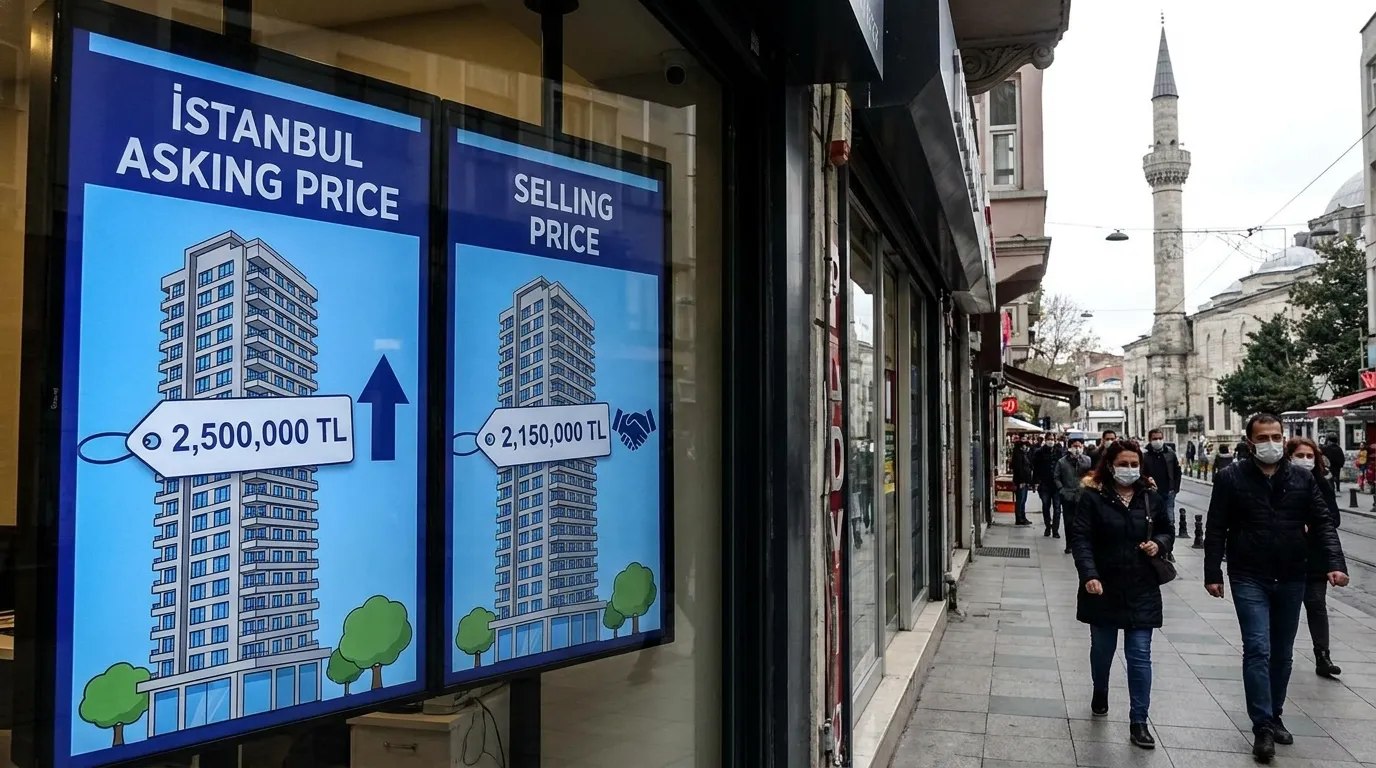
Istanbul Asking Price vs Selling Price 2026
Searching for an apartment in Istanbul can feel strangely straightforward during the first ten minutes. You open a property portal, choose a neighborhood, set the number of bedrooms, and suddenly hundreds of homes appear with neat photographs and precise prices. It is tempting to assume those numbers represent what Istanbul property is actually worth. They often do not. In the Istanbul real estate market in 2026, one of the most important distinctions for a buyer is the difference between the asking price displayed by a seller or agent and the selling price ultimately agreed between the parties. Think of the asking price as the opening move in a conversation rather than an automatically reliable statement of market value. Some properties are priced close to what their owners genuinely expect to receive, while others enter the market with room deliberately built in for negotiation. There are also owners who test an ambitious number because they are in no hurry to sell.
That difference becomes particularly important in a city as large and fragmented as Istanbul. There is no single "Istanbul property market" behaving uniformly from one street to another. A renovated apartment near the Bosphorus, a family flat in Kadıköy, a new-build unit in Başakşehir, and an older apartment on the western outskirts may all respond differently to negotiation. Building age, earthquake resilience, floor level, view, title status, tenant occupancy, parking, transport access, project reputation, and even the seller's personal circumstances can affect the final number. A buyer who merely compares advertisements may therefore end up comparing four different sellers' expectations rather than four genuine market values.
For that reason, understanding Istanbul asking price vs selling price in 2026 is less about finding one universal discount percentage and more about learning how the market reaches a transaction price. The best question is not simply, "How much can I knock off?" It is, "What evidence supports the price I am prepared to pay?" Once you approach the market that way, negotiation becomes much less emotional. Instead of chasing an arbitrary discount from an inflated listing, you can focus on the property's realistic value, its alternatives, its weaknesses, and the seller's motivation. That shift can make the difference between securing a genuinely good purchase and celebrating a large "discount" on a home that was overpriced from the beginning.
What Asking Price and Selling Price Really Mean in Istanbul
The asking price in Istanbul is the amount at which an owner, developer, or intermediary presents a property to prospective buyers. It is a marketing number. That does not mean it is fictional or deliberately misleading; plenty of serious sellers price properties sensibly. Still, an asking price remains an invitation to transact rather than proof that another buyer has actually paid that amount for a comparable home. This distinction matters because property portals primarily show supply-side expectations. When you scroll through listings and see several two-bedroom apartments advertised around a similar level, you are observing what owners currently want. You are not necessarily observing what buyers recently agreed to pay.
The selling price, by contrast, is the amount the buyer and seller finally agree upon after due diligence and negotiation. In practice, the transaction can involve several numbers along the way. An owner may advertise one figure, an interested buyer may make a lower opening offer, the owner may counter, and the parties may eventually meet somewhere between the two. The result can also be affected by payment timing, furniture, fixtures, outstanding dues, whether a tenant must vacate, and how quickly title transfer can occur. This is why two superficially identical apartments in the same building can produce different transaction outcomes.
There is another important complication: buyers should distinguish the commercially agreed purchase price from figures appearing in administrative, tax, valuation, financing, or title-related documentation. Those concepts should never casually be treated as interchangeable. Turkish property transactions involve legal and tax requirements, and the appropriate declared values and fees should be handled correctly with qualified local professionals. A supposed "discount" is not valuable if it depends on an arrangement that creates legal, tax, financing, or documentation risk.
The practical lesson is simple. When someone tells you an Istanbul apartment is "worth" a certain amount because that is what similar homes are advertised for, treat the claim as a starting point. Ask what comparable homes have actually transacted for, how recently they sold, how similar they really were, and whether the seller of the property you are considering has received credible competing offers. Market value emerges from transactions, not advertisements alone.
Why Listing Prices Can Give Buyers the Wrong Impression
Online listings are indispensable for understanding Istanbul's housing supply, but they can create an illusion of precision. Imagine ten apartments in one neighborhood advertised at increasingly ambitious prices. A new seller sees those advertisements and thinks, "Mine is at least as good as theirs," so the eleventh apartment is listed at the upper end of the range. Another seller then uses that listing as a reference. Before long, asking prices can begin reinforcing one another even though relatively few properties have actually changed hands at those levels. This is one reason a portal-based average should not automatically be interpreted as a realized selling-price average.
Duplicate listings can make the picture even messier. The same property may appear through multiple agents, sometimes with slightly different photographs, descriptions, or prices. Old advertisements can remain visible after market conditions change. A property can also disappear from a portal without having been sold; the owner might have withdrawn it, changed agents, rented it instead, or simply decided to wait. If you assume every vanished advertisement represents a completed sale near its last asking price, your analysis can quickly drift away from reality.
Presentation creates another trap. Istanbul listings frequently emphasize gross square meters, while buyers naturally care about the usable space they are actually purchasing. Two apartments described with a similar headline area can feel radically different once you walk through the front door. One may have efficient rooms, balconies, storage, and good natural light; another may lose substantial space to circulation areas or have a layout that makes the nominal size less useful. Building quality, renovation standards, orientation, floor, elevator access, parking, views, noise, and structural characteristics can similarly create large differences that a portal filter does not capture.
A disciplined buyer therefore uses listings as market intelligence, not as a substitute for valuation. Track how long comparable properties remain available. Note reductions in asking prices. Visit enough units to understand what different price levels actually buy. Ask agents specific questions rather than merely requesting their opinion of the market. Most importantly, compare like with like. A beautifully renovated vacant apartment with a view is not a valid benchmark for an occupied unit requiring major work simply because both have the same bedroom count and postcode. In Istanbul, the details hiding behind the advertisement often explain more about the eventual selling price than the headline figure itself.
How the Final Selling Price Is Actually Determined
The final selling price is created where seller expectations meet buyer willingness, but that meeting point depends on far more than bargaining skill. Start with the property's alternatives. If several genuinely comparable homes are available and sellers are competing for a small pool of qualified buyers, the purchaser usually has more room to negotiate. If the apartment has a rare Bosphorus view, an exceptional location, a scarce layout, strong building credentials, or multiple serious buyers, the seller may have little reason to move. Negotiating power is therefore not a personality trait; it is largely a function of alternatives and urgency.
Seller motivation can dramatically alter the equation. An owner who needs liquidity, is relocating, has already committed to another purchase, or has held an unsold property for months may prioritize certainty and speed. Another owner may have no debt, no deadline, and no intention of accepting anything below a personal target. These two sellers can own nearly identical apartments and still reach very different final prices. That is why asking, tactfully, how long the property has been available and what the seller's preferred transaction timeline looks like can be more useful than immediately demanding a percentage discount.
Buyer quality matters as well. A serious buyer who has funds organized, documentation ready, professional representation arranged where appropriate, and a realistic title-transfer schedule can be more attractive than somebody offering a slightly higher number but carrying significant execution risk. Certainty has economic value. In a negotiated transaction, an owner may prefer a clean offer that can proceed promptly over a theoretically better offer surrounded by financing uncertainty, endless conditions, or repeated attempts to renegotiate.
Due diligence can then change the number again. Renovation requirements, building condition, title issues, occupancy arrangements, unpaid obligations, valuation results, or other material discoveries may justify revisiting assumptions made during the initial viewing. The strongest negotiation is consequently evidence-led. Rather than saying, "I want 15% off because buyers always negotiate in Istanbul," explain why your number reflects comparable alternatives and the property's actual characteristics. A well-supported offer may still be rejected, but it protects you from the far more expensive mistake of paying an unjustified premium merely because the seller began with an ambitious asking price.
Why the Asking-to-Selling Price Gap Matters in 2026
The gap between asking and selling prices matters because percentages can be deceptive. Suppose Property A is realistically worth around the level at which it is listed and ultimately sells after only a modest concession. Property B is marketed substantially above what comparable buyers are willing to pay and eventually accepts a much larger reduction. The purchaser of Property B may proudly say they negotiated a huge discount, yet they could still have paid more relative to fair market value than the purchaser of Property A. A discount is not the same thing as value. That principle should sit at the center of any Istanbul buying strategy in 2026.
This distinction becomes particularly useful in a market where owners, agents, developers, domestic buyers, international buyers, and investors can all evaluate prices through different lenses. Some owners anchor expectations to the amount they previously paid plus inflation. Others think in foreign currency. Investors may focus on rental yield, while an owner-occupier may place a premium on a specific school catchment, commute, street, view, or building. Developers can have their own inventory strategies and payment plans. With so many reference points operating simultaneously, the advertised price can reflect the seller's framework as much as the property's immediate clearing price.
For a buyer, the asking-to-selling gap also affects budgeting. If you assume every property can be purchased materially below its listing price, you may waste weeks viewing homes that remain outside your realistic budget. Go too far in the opposite direction and treat every asking price as fixed, and you may leave money on the table. A smarter approach is to create a target range based on evidence before negotiating. That range should account for comparable properties, condition, transaction costs, required renovations, financing considerations, and the premium or discount justified by the particular home.
The 2026 buyer should therefore resist simplistic headlines claiming that Istanbul homes "usually" sell exactly X percent below asking. Even when such a figure comes from a legitimate dataset, an overall average may have limited predictive power for a specific apartment. Negotiation varies by district, property type, price band, seller motivation, and the accuracy of the original listing price. What matters is not discovering a magical citywide discount. It is identifying the property-specific gap between the seller's expectation and a defensible market value.
Inflation, Exchange Rates, and Seller Expectations
Few forces complicate Turkish property conversations as much as inflation and exchange-rate movements. When the nominal value of money changes rapidly, sellers can become reluctant to think about their home purely through today's Turkish-lira figure. An owner may remember what the property represented in dollars or euros at an earlier point, compare its price with construction costs, or calculate how much money would be required to purchase a replacement home. Buyers may use an entirely different reference point. The resulting negotiation can feel as though two people are discussing the same apartment while using different measuring tapes.
This creates a phenomenon known as price stickiness. Sellers do not necessarily reduce asking prices immediately when buyer demand softens. Instead, a property may remain advertised at an ambitious nominal level for a prolonged period. The owner waits; buyers make lower offers; neither side initially moves. Eventually the transaction may happen after a price adjustment, a change in the seller's circumstances, or a buyer deciding that the property's unique qualities justify the premium. In other cases, no sale occurs at all. This is another reason advertised inventory should not be confused with completed transactions.
Currency comparisons require similar caution. An international buyer who earns or holds savings in euros, pounds, dollars, or another currency may naturally translate every Istanbul price into their home currency. That is useful for personal budgeting but does not automatically reveal whether a Turkish property is cheap or expensive. Local construction costs, land scarcity, domestic demand, interest rates, rental economics, neighborhood quality, and replacement costs continue to matter. A favorable exchange-rate movement can improve an individual buyer's purchasing power without making every advertised property good value.
In 2026, buyers should consequently record both the date and currency context whenever they compare prices. A transaction from many months earlier cannot simply be copied forward without considering what changed in the meantime. Equally, a seller's statement that a home "used to be worth" a certain foreign-currency amount does not establish today's market price. The most useful evidence remains recent, genuinely comparable transactions and current competing inventory, interpreted within the economic environment rather than detached from it. In a volatile nominal-price environment, fresh evidence has an unusually short shelf life.
Property Type, Condition, and Urgency to Sell
Not every Istanbul property has the same negotiation profile. A standard apartment in a large development with several similar units for sale is relatively easy to compare. If five near-identical apartments compete for the same buyer, pricing becomes transparent quickly. A unique historical property, waterfront residence, unusually large penthouse, or apartment on a particularly coveted street is different. There may be few true comparables, giving both seller and buyer more room to disagree about value. Scarcity can strengthen the seller's position, although uniqueness alone does not justify any price the owner chooses.
Condition can be equally influential. Buyers sometimes look at an older apartment, estimate renovation costs, and simply subtract that amount from the seller's asking price. The logic is understandable but incomplete. If the asking price already reflects the poor condition, subtracting the full renovation budget again can double-count the disadvantage. On the other hand, if the owner has priced an unrenovated property as though it were comparable to turnkey homes nearby, a substantial adjustment may be justified. The key is to compare the subject property with appropriately similar alternatives and then make explicit adjustments.
Urgency is the less visible variable. A seller's motivation rarely appears in an advertisement, yet it can be one of the strongest determinants of the final deal. A vacant investment apartment that has accumulated carrying costs for months may be approached differently from a family home whose owner is merely exploring whether someone will pay an exceptional price. Likewise, developers managing many units can make pricing decisions based on inventory, payment structure, campaign timing, or broader project strategy rather than the motivations of an individual homeowner.
Buyers should gather this information without turning the viewing into an interrogation. Ask when the property came to market, whether the owner currently occupies it, whether there have been previous offers, what is included in the sale, and what timeline the seller prefers. Listen for consistency between different conversations. The objective is not to exploit somebody's personal circumstances; it is to understand the commercial structure of the transaction. Property quality tells you what you are buying. Seller motivation helps tell you how flexible the transaction may be. Together, those factors are far more informative than assuming every Istanbul listing contains the same built-in negotiation margin.
Istanbul Asking Price vs Selling Price by Property and Location
Istanbul's enormous geographic scale makes citywide price comparisons particularly dangerous. The metropolis stretches across Europe and Asia, contains highly diverse housing stock, and encompasses neighborhoods serving completely different buyer profiles. Even within a single district, crossing a major road or moving several streets closer to the sea can change desirability. Averages flatten these differences. When evaluating asking price versus selling price in Istanbul, location should therefore be treated at the neighborhood and, where possible, micro-location level rather than merely at the district level.
Consider what actually drives a buyer to choose one street over another. Access to Metro, Marmaray, Metrobus, ferries, major roads, schools, universities, hospitals, parks, shopping areas, employment centers, and the waterfront can all affect demand. So can noise, traffic, steep terrain, parking availability, street quality, neighborhood character, and the surrounding building stock. Istanbul's topography makes even walking distance deceptive: two apartments may appear equally close to a station on a map while one involves a steep climb that materially changes daily convenience.
Building-specific characteristics add another layer. Buyers increasingly pay close attention to construction age, structural characteristics, documentation, maintenance, and earthquake-related considerations. A new or well-regarded building can command a meaningful premium over older stock nearby, while an older apartment may still attract strong demand if its location, plot, layout, or redevelopment potential is compelling. The headline neighborhood price per square meter cannot capture all of this.
The correct comparison set is therefore narrow. Start with the same immediate area, then match building age and quality, usable area, floor, orientation, view, parking, elevator, condition, and occupancy as closely as possible. Expand geographically only when there are too few useful examples. This method takes more work than checking a portal average, but property purchases are precisely where that extra work pays. In Istanbul, the closer your comparable properties resemble the home you are buying, the more meaningful your estimate of its likely selling price becomes.
Prime Central Districts and High-Demand Neighborhoods
Prime Istanbul is exactly where a simple rule such as "offer 10% below asking" becomes least dependable. In neighborhoods associated with the Bosphorus, established central living, prestigious streets, or scarce high-quality housing, two apartments that look similar in an online search can have dramatically different market values. Beşiktaş, Sarıyer, Şişli, Kadıköy, and Beyoğlu, for example, contain micro-markets rather than one uniform price environment. A quiet apartment with an unobstructed view, parking, an elevator, strong building credentials, and a desirable orientation may face very different demand from a darker unit on a noisy road only a short walk away. On the Asian side, the same principle applies in sought-after parts of Kadıköy and surrounding residential areas, where lifestyle, transport links, street character, and building quality can materially influence what a serious buyer will pay. The asking-to-selling price gap in Istanbul's prime neighborhoods therefore has to be judged property by property.
Scarcity is particularly important. Suppose an owner asks an ambitious price for an ordinary apartment and six comparable alternatives are available within several blocks. A buyer can negotiate confidently because walking away is inexpensive. Now imagine a genuinely rare apartment: perhaps it has a protected Bosphorus outlook, a large terrace, excellent parking, a particularly attractive floor plan, or a location where suitable stock rarely appears. Even if its asking price initially looks high, the buyer's alternatives may be weak. The seller knows this, and a substantial discount becomes harder to obtain if other qualified purchasers recognize the same scarcity. That does not mean prime-property sellers can name any number they like. An unrealistic listing can still sit unsold. It simply means that negotiation leverage decreases when replacement options disappear.
Another issue is the "prestige premium." Buyers sometimes pay for an address, view, building, or lifestyle that cannot be captured neatly by a citywide price-per-square-meter calculation. That premium may be perfectly rational for an owner-occupier who expects to live there for many years, but an investor should scrutinize it carefully because rental income may not rise proportionally with the acquisition price. If you are comparing prime Istanbul properties in 2026, separate the measurable elements from the emotional ones. Calculate what comparable housing costs, identify the premium attached to the property's exceptional features, and decide whether those features are valuable to you. A seller's emotional attachment does not have to become part of your purchase price.
Developing and Outer Istanbul Districts
The negotiation dynamics can look quite different as you move into developing districts, peripheral neighborhoods, and areas where large volumes of newer housing have been constructed. Here, buyers may encounter multiple apartments in the same complex—or even the same building—with nearly identical floor plans. That abundance is useful because it makes comparison easier. If one owner asks substantially more than three owners selling comparable units, the expensive seller needs a convincing explanation: perhaps a superior floor, orientation, renovation, view, parking arrangement, or furnishing package. Without such an advantage, the cheaper competing inventory becomes a powerful negotiating tool. You are no longer telling the seller that the property "feels expensive"; you can point to realistic substitutes.
Yet cheaper headline prices should not automatically be interpreted as bargains. Outer Istanbul is vast, and accessibility can make or break the long-term usefulness of a property. A development may look attractively priced per square meter but require lengthy daily travel to employment centers. Another may benefit from established rail connections, schools, retail, hospitals, and mature community infrastructure. Buyers should distinguish between infrastructure that exists today and infrastructure that is merely promised. Future transport projects can add value, but paying the entire anticipated future premium before the improvement is delivered transfers much of the development risk from the seller to you.
New-build and developer inventory introduces another wrinkle into the Istanbul asking price vs selling price equation. The headline price may not tell the full commercial story because developers can compete through payment schedules, financing arrangements, upgrades, furniture packages, or campaign incentives rather than simply reducing the advertised number. A nominal discount on a cash purchase may therefore need to be compared with the economic value of an installment plan. Conversely, a supposedly attractive payment plan can carry a higher embedded purchase price. Compare alternatives on a like-for-like basis and calculate the total amount you will actually pay.
Resale owners in large developments can sometimes be more flexible, especially when several investors are trying to exit similar units at once. But building dues, occupancy levels, rental demand, maintenance quality, management standards, and surrounding supply all deserve attention. A low purchase price accompanied by high recurring costs or weak resale liquidity can prove expensive over time. The goal is not to find Istanbul's largest percentage discount. It is to buy an asset whose final selling price makes sense relative to its location, quality, carrying costs, and realistic future demand.
How Buyers Can Estimate a Property's Real Market Value
Estimating market value begins with abandoning the idea that one number will magically appear from a property portal. A sensible valuation is usually a range. Imagine you are buying a 120-square-meter apartment. You find five supposedly comparable listings, but one is newly renovated, one has a sea view, another is ten years newer, and two quote gross rather than clearly usable areas. Averaging their advertised price per square meter produces a beautifully precise number built from messy ingredients. It is the property equivalent of averaging the price of five cars without checking their model year, mileage, or condition.
Instead, build a comparable-property set. Begin in the same micro-location and identify homes with similar building age, size, condition, floor level, orientation, view, parking, elevator access, and occupancy status. Record the asking price and the date you observed it. If the advertisement remains active, monitor changes. A price reduction is information. A property remaining unsold for a long period is information too, although it does not reveal the exact price at which the owner would eventually transact. Whenever reliable evidence of completed transactions is legally and practically available to you through appropriate professionals and records, give that evidence greater weight than anonymous claims about what a neighbor supposedly received.
Next, adjust for differences rather than pretending they do not exist. If your target apartment requires substantial renovation while the best comparable is turnkey, account for the difference. If your apartment has a genuinely superior view, recognize that advantage. If one unit includes parking in an area where parking is scarce, do not treat it as identical to one without. Avoid false precision: you probably cannot prove that a particular view is worth exactly 7.4%. A valuation range acknowledges uncertainty and is often more useful in negotiation than an artificially exact figure.
Finally, separate market value from your maximum price. Those numbers can differ. You may rationally pay a modest premium for an apartment next to family, a specific school, your workplace, or a transport connection that transforms your daily life. An investor may instead impose a strict yield requirement and walk away once the price exceeds it. Both approaches can be sensible. What matters is knowing which part of your offer is supported by the market and which part reflects your personal utility. That awareness prevents a seller from defining value for you simply by placing a number at the top of an advertisement.
Comparing Recent Transactions Instead of Online Listings
Recent transactions are valuable because they answer the question advertisements cannot: what did a buyer actually agree to pay? Unfortunately, obtaining perfectly comparable and fully transparent transaction evidence can be harder than scrolling through listings. Buyers should therefore triangulate. Speak with reputable local professionals, obtain an independent valuation when appropriate, examine credible transaction information available through lawful channels, and compare it with current competing inventory. No single source should be treated as infallible. The objective is to make several imperfect signals point toward the same reasonable range.
Recency matters enormously in an inflationary or rapidly changing market. A comparable sale from a long time ago may describe a different economic environment. Simply increasing an old transaction price by a broad inflation measure is not necessarily enough because local property demand can move differently from consumer prices. Mortgage conditions, construction costs, currency movements, buyer sentiment, new supply, and neighborhood-specific developments can all affect residential property. A sale from the same building completed recently can therefore be much more informative than a citywide average from an earlier period.
Verification matters too. Istanbul property discussions are full of anecdotes: "The apartment upstairs sold for this," "A foreign buyer offered that," or "The owner rejected an even higher offer last month." Some stories are accurate; others become distorted as they pass from person to person. Treat unverifiable statements as clues rather than evidence. Ask whether the transaction actually completed, whether the units were comparable, what condition the property was in, and whether furniture, parking, or other elements were included. Even a genuine sale can be a poor comparable if the underlying properties differ materially.
For buyers purchasing for investment, translate the proposed selling price into operating economics as an additional check. What is a realistic long-term rent after considering vacancy and recurring expenses? How does the implied gross yield compare with plausible alternatives? For owner-occupiers, compare the acquisition cost with equivalent housing choices and the length of time you expect to stay. Transaction comparables tell you what the market has done; these additional tests tell you whether the deal makes sense for your objective. When both analyses support roughly the same range, you can negotiate with far more confidence.
Calculating a Sensible Negotiation Range
A negotiation range should begin with estimated value, not with a fashionable discount percentage. Assume, purely as an illustration, that a property is advertised at TRY 12 million. After reviewing strong comparables, its condition, and its advantages and disadvantages, you estimate a reasonable market range of TRY 10.8 million to TRY 11.3 million. Your strategy should revolve around that range. Offering 20% below asking simply because somebody online recommended it would produce TRY 9.6 million, which may be too low to start a productive conversation if the seller already has interest near fair value. Conversely, accepting TRY 11.8 million merely because it represents a "discount" would still put you above your evidence-based range.
The opening offer has several jobs. It should create room for negotiation without communicating that you are unserious. It should also be defensible. Instead of presenting an unexplained low number, connect your offer to observable facts: recent comparable units, renovation requirements, building characteristics, current alternatives, or the certainty and speed of your transaction. This turns the conversation away from ego. You are not telling an owner that their home is bad; you are explaining what the available market evidence allows you to pay.
Set a walk-away price before negotiations become emotional. Istanbul property viewings can be seductive. A sunset over the Bosphorus, an enormous terrace, a beautifully staged living room, or the thought of losing a property to another buyer can push people beyond their original discipline. Decide in advance what you will pay and why. If new due-diligence information improves or weakens the investment case, update the limit rationally. Do not increase it merely because several rounds of negotiation have made you psychologically invested in "winning."
Remember that price is only one negotiable variable. Furniture, fixtures, payment timing, handover date, vacancy, deposits, and other lawful contractual terms can have economic value. Sometimes a seller genuinely cannot move further on headline price but can accommodate another condition that matters to the buyer. The strongest negotiators understand the whole transaction rather than obsessing over one percentage. Your objective is a favorable deal, not the largest cosmetic discount from an arbitrary asking price.
How to Negotiate Below the Asking Price in Istanbul
Good negotiation starts before you make an offer. Visit the property carefully and learn enough about the local inventory to know whether you have alternatives. Ask how long the home has been marketed and whether its price has changed. Understand whether it is occupied, whether the seller has a preferred completion timeline, and what exactly is included. Then organize your own side of the transaction. If you need financing, know your position. If you are purchasing internationally, understand how funds, documentation, professional advice, and title-transfer requirements will be handled. A buyer who looks capable of completing can negotiate from a stronger position than someone who merely announces a high offer.
When making the offer, keep it clear. There is rarely a benefit in insulting the property or pretending you dislike something you obviously want. Sellers are people, and negotiations can become unnecessarily emotional when a buyer attacks a home in which somebody has lived for years. Focus on evidence. You might explain that comparable properties fall within a particular range, that the unit requires measurable work, or that you can proceed according to a timeline attractive to the owner. Your offer should sound like the result of analysis rather than a number pulled from the air.
Do not negotiate against yourself. If you make an offer and the seller does not immediately respond, silence is not an instruction to raise it. Give the other side time to consider the proposal. If the seller counters, evaluate the counter against your predetermined range rather than focusing solely on the distance between their number and yours. Splitting the difference sounds fair but can be irrational when the original asking price was unrealistic. Halfway between an inflated number and a reasonable number is still potentially inflated.
Most importantly, preserve your ability to walk away. This is not theatrical brinkmanship; it is financial discipline. Istanbul has a huge property market, and most buyers will have alternatives unless the asset is truly unique. If the seller's minimum remains above the value you can justify, thank them and move on. They may return later, or they may find somebody prepared to pay more. Either outcome is acceptable. A property you did not overpay for is not a deal you lost.
Negotiation Mistakes Buyers Should Avoid
The first common mistake is assuming that every asking price contains a standard discount. It does not. One seller may deliberately price 15% above their target, while another may list close to the minimum they will accept. Applying the same opening-offer formula to both properties makes little sense. The second mistake is measuring success by the percentage reduction rather than the final value. Paying TRY 10 million for a property sensibly worth around TRY 9 million is not a victory simply because its owner initially asked TRY 12 million.
Another mistake is revealing your maximum budget too early. If your ceiling is substantially above your initial offer, announcing that ceiling gives away useful information without receiving anything in return. Be truthful, but you do not need to volunteer every detail of your financial capacity. At the same time, avoid fabricated claims about competing properties or imaginary deadlines. A negotiation built on easily disproved statements can destroy trust at precisely the moment when you need cooperation for due diligence and closing.
Foreign buyers should also resist negotiating entirely through exchange-rate psychology. An apartment can feel inexpensive because your home currency recently strengthened against the lira, but the seller is operating within a Turkish property market with its own supply, replacement costs, and expectations. Your improved purchasing power is good for your budget; it is not evidence that the owner should accept an arbitrary reduction. Base the offer on the property.
The most expensive mistake, though, is allowing the excitement of an agreed price to replace proper checks. A verbal "yes" from the seller is the beginning of the transaction, not the end of your responsibilities. Legal status, title information, relevant building and property documentation, physical condition, valuation where required or advisable, taxes, fees, contractual protections, and professional advice still matter. Saving money through negotiation and then accepting avoidable legal or structural risk is like bargaining brilliantly for a car without checking whether it has an engine. Due diligence is part of the price.
Costs Beyond the Agreed Selling Price
The selling price is the largest number in most Istanbul property purchases, but it is not the only one that belongs in your budget. Depending on the transaction, buyers may encounter title-transfer-related charges and taxes, professional fees, valuation expenses, translation or notarization costs, insurance requirements, financing expenses, agency-related costs where applicable, and other administrative charges. Rules, rates, exemptions, and practices can change, so a 2026 buyer should verify current obligations with the relevant Turkish authorities and qualified legal, tax, and property professionals rather than relying on an old blog post or a social-media calculation.
Renovation deserves its own contingency. Buyers routinely underestimate what happens after receiving the keys. Painting can become electrical work; a kitchen refresh can reveal plumbing issues; an apparently cosmetic renovation can grow once contractors inspect the property properly. Obtain realistic quotations where possible and keep a buffer. If the apartment is in a managed building or residential complex, investigate recurring dues and what they cover. A relatively inexpensive unit with unusually high monthly costs may be less attractive over a long holding period than a slightly more expensive alternative with efficient management.
International purchasers should also think about currency conversion and transfer costs. The exchange rate displayed in a search result is not necessarily the rate at which a large property payment will actually be converted. Banking spreads, transfer charges, timing, compliance procedures, and currency movements between agreement and completion can affect the effective acquisition cost. Discuss payment mechanics early rather than discovering them when a deadline is approaching.
This leads to a better way of comparing properties: calculate the all-in acquisition cost. Start with the negotiated purchase price, add transaction expenses, immediate renovation or furnishing, financing-related costs where relevant, and any other unavoidable expenditure required to make the property usable for your purpose. Then compare that total with competing options. A home purchased for slightly less but requiring extensive work may cost more overall. Negotiating the headline price is satisfying, but sophisticated buyers keep their eyes on the number that ultimately leaves their pocket.
Conclusion
The central lesson of Istanbul asking price vs selling price in 2026 is that an advertised number is a starting point, not a verdict. Istanbul's property market is too diverse for a universal negotiation percentage to work reliably. Some realistically priced properties may transact close to asking, particularly when they are scarce and attract several serious buyers. Others may require substantial adjustment because the seller began with an optimistic expectation, competing supply is plentiful, or the property has disadvantages that the listing price fails to reflect. The size of the discount alone tells you surprisingly little.
A stronger buying process begins with narrow, recent comparables. Compare properties in the same micro-market and adjust for building quality, condition, usable space, floor, orientation, view, parking, transport, occupancy, and other characteristics that materially affect demand. Where reliable completed-transaction evidence is available, prioritize it over listing anecdotes. Then establish a valuation range, determine your own maximum, and negotiate from evidence. That approach is slower than blindly subtracting 10% or 20% from every advertisement, but it gives you something far more useful: a reasoned basis for deciding when to proceed and when to walk away.
The same discipline should continue after the price is agreed. Include transaction expenses, renovation, professional advice, financing, currency conversion, and recurring ownership costs in your calculation. Complete appropriate legal and technical due diligence, and verify current Turkish requirements rather than assuming that historical rules still apply in 2026. A low selling price cannot compensate for a problematic property.
Ultimately, the best Istanbul deal is not necessarily the home with the biggest gap between its first asking price and final selling price. It is the property purchased at a defensible all-in price, with its risks understood and its characteristics aligned with your goals. If you remember only one idea, make it this: negotiate against market value, not against the seller's opening number.












Have Question Or Suggestion ?
Please Share Your Thought, To Make It Real