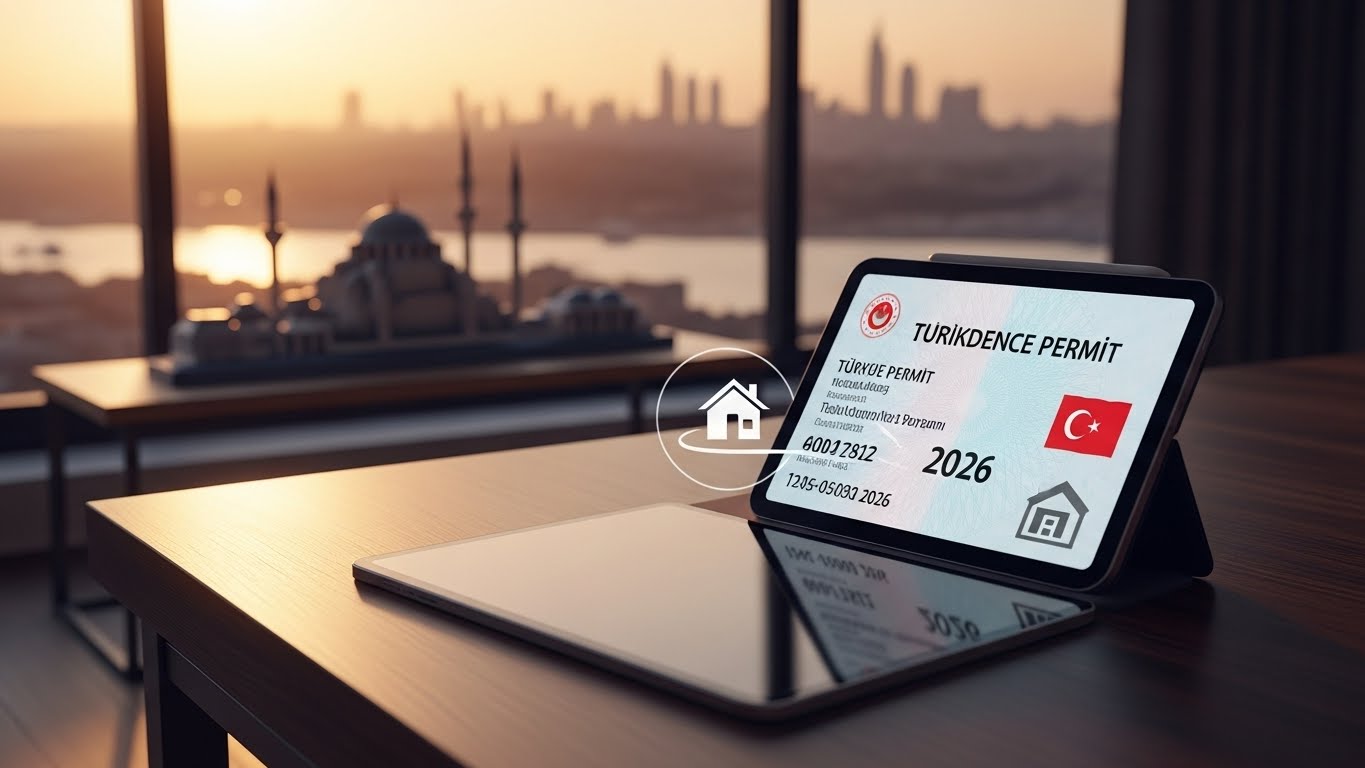
Real Estate Residence in Turkey 2026: How Property Investment Grants Legal Residency
Discover the 2026 guide to Turkish real estate residency. Learn about the $200,000 investment rule, open areas, and the legal path to long-term stability.
The Philosophy of Stability in the Land of Anatolia
Let’s be honest from the start: most people do not arrive in Turkey with a perfectly calculated master plan. Some come for tourism and fall under the spell of its natural beauty; others come for work, while many arrive seeking refuge from life’s pressures or economic instability in their home countries.
However, over time, a fundamental question begins to surface: "How much longer will I remain 'temporary'?"
This question isn’t just about a fleeting anxiety; it is the natural concern of anyone looking to build a life, enroll children in schools, or establish a business. This is where Real Estate Residency enters the frame as a radical solution. In 2026, property residency is no longer just an "extra" option or a social status—it has become the most secure and transparent legal path. Owning a property means you are no longer subject to the "fluctuating moods" of tourist visa regulations, which now see thousands of rejections annually. With your own home, you have a fixed address, a private door, and a key. These details may seem small, but they create a world of difference in psychological and legal security.
Turkey has changed dramatically in recent years. Laws have become clearer—and yes, stricter—but also more logical and sustainable. The Turkish state today seeks stable residents, not passers-by. It welcomes those who buy to live and contribute to society. This shift is what has given real estate residency exceptional legal weight in 2026.
📌 If this question already feels familiar, your situation deserves a clear legal answer.
📲 WhatsApp Direct Contact
👉 https://wa.me/905454891015
I. What is Real Estate Residency in Turkey? (The Core Concept)
In its simplest terms, real estate residency is a formal legal message to the Turkish authorities: "I am here to stay... this is my second home."
Real Estate Residency (Taşınmaz Belgesi) is granted to foreigners who own residential property registered in their name at the Land Registry (Tapu) and use it for actual living purposes. This detail—"residential use"—is the heart of the 2026 regulations. Authorities now strictly distinguish between an investor who lives in their property and those attempting to circumvent the law.
Practical Definition
It is a type of "Short-Term Residence Permit" (Kısa Dönem İkamet İzni), usually granted for one or two years and is renewable as long as the property remains in the owner's name. It is the legal bond linking your right to stay with your ownership of land and building.
Critical Legal Alerts:
Commercial Property: Buying a shop or office does not grant you real estate residency, regardless of the price. The property must be classified as "Residential" (Mesken/Konut) on the Title Deed (Tapu).
Land Ownership: Purchasing agricultural or construction land does not qualify for residential residency.
Under-Construction Properties: In 2026, it is nearly impossible to apply using only a "Sales Contract." Authorities require a finalized, ready Title Deed (Tapu).
II. Who is Eligible to Apply?
Almost all nationalities permitted to own property in Turkey (which includes the vast majority of the world, especially Arab nations) can apply. This includes:
Individuals: Any adult who purchases a property in their name.
Families: The owner, their spouse, and children under the age of 18.
Partners: If the property is registered under multiple names (provided each person’s share meets the required legal value).
In 2026, family members are granted a Family Residency linked to the property owner’s permit, making school enrollment and health insurance procedures much smoother for the entire household.
III. The $200,000 Rule: The 2026 Update
This is the point that has caused the most discussion. If you are following old news, you might have heard of a $75,000 threshold. That law is no longer in effect.
The $200,000 Requirement in 2026
According to the updates that stabilized in 2026, the property value must be no less than $200,000 USD to qualify for real estate residency.
The Fine Details:
Value on the Title Deed (Tapu): Relying on a "Real Estate Appraisal Report" is no longer enough. The price recorded on the Tapu itself must be at least $200,000 based on the Central Bank's exchange rate on the day of purchase.
Currency Exchange Document (Döviz Alım Belgesi): You must prove that the funds were transferred from abroad in foreign currency and exchanged at the Turkish Central Bank for Turkish Lira before the purchase.
Why the increase? The Turkish government in 2026 aims to improve the quality of foreign investment. Low-cost properties created overcrowding in traditional neighborhoods. By raising the minimum to $200,000, the state ensures that residents have the financial means for a dignified life and contribute to the organized, modern construction sector.
📌 Not sure whether ownership changes your legal position? It does.
📲 Ask directly on WhatsApp
👉 https://wa.me/905454891015
IV. Finding Apartments in Istanbul Suitable for Residency
stanbul remains the top destination, but searching for apartments for sale in Istanbul that meet residency criteria requires accuracy. You must ensure the property is in an "open" neighborhood and meets the $200k valuation.
Legal Value: ($200,000 registered in the Tapu).
Location: (Must be in an area "open" to foreigners).
Property Type: (Strictly residential).
Areas like Başakşehir, Beylikdüzü, and Kartal are prime destinations for modern projects. For instance, projects like Rams City Haliç or Hayat Flora are excellent examples of developments that often align with these modern standards.
Before starting your journey, it is essential to review the Full Guide to Buying a House in Turkey 2025 to understand the legal steps clearly.
V. The "Map Trap": Closed Neighborhoods in Istanbul
This is the biggest pitfall for investors. The Turkish Ministry of Interior has closed hundreds of neighborhoods to new foreign residency registrations (both tourist and real estate) because the foreign population exceeded 20% of the total residents.
Guide to Restricted Areas:
Fatih: Almost entirely closed to new residencies.
Esenyurt: Most vital neighborhoods are closed.
Avcılar: "Denizköşkler" and other specific neighborhoods.
Zeytinburnu & Şile: Large sections are restricted.
Before buying, you must verify the status of the neighborhood through the official Migration Management portal.
VI. Renewing Your Residency in 2026
The good news is that renewing real estate residency in 2026 is one of the easiest legal processes—provided you follow the rules. Unlike tourist permits, which can be rejected without clear reasons, real estate residency is renewed as long as the "reason for stay" remains valid.
Requirements for a Successful Renewal:
Continued Ownership: The property must not have been sold.
Address Registration (Nüfus): This is the most important condition in 2026. Your address must be registered in the Civil Registry (Nüfus) and linked to your specific property number.
Health Insurance: A valid Turkish health insurance policy.
Clean Record: No major legal violations or crimes.
📌 If your current permit renewal already causes stress, it’s time to change the strategy.
🔗 Speak with a residency specialist:
https://www.deal-tr.com/en/contact-us
VII. Real Estate Residency vs. Turkish Citizenship 2026
Investors often confuse these two paths. This table clarifies the definitive differences:
| Feature | Real Estate Residency | Turkish Citizenship |
|---|---|---|
| Minimum Amount | $200,000 USD | $400,000 USD |
| Document Type | Residency Card (Foreigner) | Turkish Passport (Citizen) |
| Sale Restriction | None (but you lose residency if sold) | Cannot be sold for 3 years |
| Political Rights | No right to vote or run for office | Full rights to vote and run for office |
| Right to Work | Requires a separate Work Permit | Works as any Turkish citizen |
| Continuity | Requires periodic renewal | Permanent for life and future generations |
| Processing Time | 30 - 60 Days | 6 - 12 Months |
Export to Sheets
VIII. Required Documents for 2026
The file must be 100% complete, as officials in 2026 are no longer lenient with missing paperwork:
Title Deed (Tapu Senedi): Original and a certified copy.
Numarataj: Obtained from the municipality to define the property coordinates.
UAVT Code: The property’s code in the unified tracking system.
Earthquake Insurance (DASK): Must be valid.
Appraisal Report: Must match the price on the Title Deed.
Valid Passport: For at least 6 months.
Biometric Photos: 4 photos with a white background.
Tax Receipts: Proof of payment of residency fees.
IX. The Roadmap: Step-by-Step
Search & Buy: Select a residential apartment in an open area with a $200k Tapu value.
The Tapu Phase: Transfer funds via bank, get the Currency Exchange Document, and receive your Title Deed.
Municipality & Nüfus: Get your Numarataj and register your residence.
The Appointment: Apply via the official website (e-ikamet) under "Short-term residence - property ownership."
The Interview: Attend the appointment with your full file and provide fingerprints.
Delivery: The card is usually mailed via PTT to your home within 3 weeks.
Frequently Asked Questions (FAQs)
1. Can I get residency if I buy in installments? In 2026, you can only apply after the full amount is paid and you have received the Title Deed (Tapu). Preliminary contracts do not grant residency.
2. I bought a property for $75,000 before 2023. Will I lose my residency? No. The law is not applied retroactively to those who already hold the residency and continue to renew it. However, it applies to any new purchase made after the law changed.
3. Can I rent out my property? Legally, yes. However, be careful: if you rent it out and it is no longer your registered address in the Nüfus (Civil Registry), you may face problems during renewal because this residency is intended for actual living.
Conclusion
Real estate residency in Turkey 2026 is not just a piece of plastic; it is an investment in peace of mind. The Turkish market has proven its resilience, and the new laws—while strict—aim to protect serious investors from chaos.
One final tip: Do not leave your renewal to the last minute. Start the process 60 days before your current permit expires to ensure your legal status remains uninterrupted.
Would you like us to help you audit your current property documents or find projects that meet the $200,000 criteria in open areas? We are here to serve you at Deal-tr.com.
Have Question Or Suggestion ?
Please Share Your Thought, To Make It Real