Cyprus vs Turkey: Where to Live, Invest, and Travel in 2026
Explore a complete comparison between Cyprus and Turkey for living, travel, and real estate in 2026. Discover which destination suits you best.
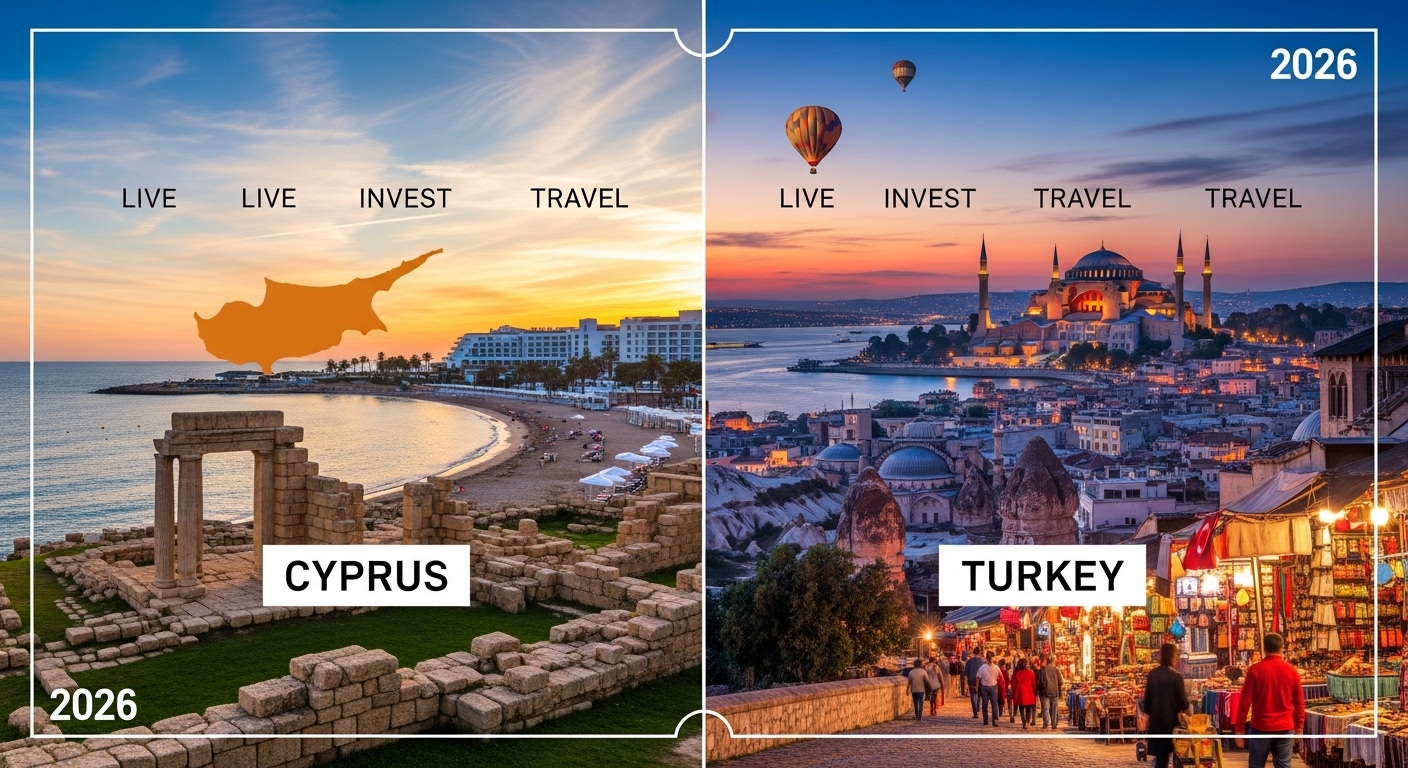
Cyprus vs Turkey: Where to Live, Invest, and Travel in 2026
Introduction
Cyprus and Turkey – two fascinating destinations on the eastern edge of Europe and the crossroads of the East and West. Though neighbors by proximity, these countries differ vastly in culture, politics, economy, and lifestyle. Whether you’re a traveler, expat, student, or investor trying to choose between the two, this guide gives you a side-by-side comparison to help you make an informed decision.
Why compare Cyprus and Turkey? For one, their historical and political relationships have shaped both nations in unique ways. Turkey is a sprawling republic that bridges Europe and Asia, while Cyprus is a small island nation in the Mediterranean with deep European ties. From ancient empires to modern-day political tensions, especially concerning Northern Cyprus, these countries have a shared yet divided history.
So, which country comes out on top for quality of life, economic opportunities, tourism, and beyond? Let’s dive into this detailed comparison.
Geography and Location of Turkey vs Cyprus: Strategic Position for Investment 2026
Cyprus is a small island nation located in the eastern Mediterranean Sea. It’s the third-largest island in the Mediterranean after Sicily and Sardinia. Meanwhile, Turkey is a massive transcontinental country, with most of its landmass in Asia and a small portion in Europe (around Istanbul). It’s bordered by eight countries and surrounded by three seas—the Aegean, Mediterranean, and Black Sea.
In terms of land area, Turkey is approximately 783,000 km² while Cyprus is just over 9,200 km². That’s a massive difference, making Turkey nearly 85 times larger than Cyprus. This sheer size gives Turkey a much more diverse topography—from the snowy mountains of Eastern Anatolia to the sun-drenched beaches of Antalya.
Cyprus has a typical Mediterranean climate—hot, dry summers and mild, wet winters. Turkey’s climate, however, varies widely. The coastal areas enjoy a Mediterranean climate, while the interior regions have a continental climate with snowy winters and dry summers.
Geographically, Turkey holds strategic importance due to its location between Europe and Asia, making it a central hub for trade, migration, and military strategy. Cyprus, although smaller, is also of geopolitical interest, especially given its location close to the Middle East.

Turkey vs Cyprus History & Political Background: Impact on Real Estate Investment
Turkey and Cyprus share a long and complex history, particularly marked by the conflict in the 1970s. The roots of modern Turkey stem from the fall of the Ottoman Empire and the rise of the secular Turkish Republic in 1923 under Mustafa Kemal Atatürk. Cyprus, on the other hand, was under British colonial rule until it gained independence in 1960.
However, tensions between Greek Cypriots and Turkish Cypriots led to a division of the island in 1974 when Turkey invaded the northern part of Cyprus following a Greek-led coup. As a result, the island remains divided today—southern Cyprus is governed by the Republic of Cyprus (a recognized EU member), while the northern part is the self-declared Turkish Republic of Northern Cyprus, recognized only by Turkey.
This political divide continues to influence both domestic and international relations. Turkey’s relationship with Cyprus has affected its EU accession talks, while Cyprus remains cautious in its dealings with Turkey.
Government and Political System in Turkey vs Cyprus: Impact on Investment & Stability
When it comes to governance, Turkey and Cyprus operate under very different systems, and these differences have far-reaching implications for civil liberties, political participation, and international relations.
Turkey is a presidential republic. Since the constitutional referendum in 2017, the country shifted from a parliamentary to a presidential system, giving significant powers to the President. Recep Tayyip Erdoğan has been a dominant figure in Turkish politics for two decades, and critics often describe Turkey’s political environment as increasingly authoritarian, with limitations on press freedom, judicial independence, and civil rights.
Cyprus, by contrast, operates as a unitary presidential representative republic. The Republic of Cyprus has a multi-party system, and while the President holds executive power, the political environment is considered more open and democratic. Since it’s a member of the European Union, Cyprus adheres to EU laws, including human rights regulations and press freedoms. However, the northern part of Cyprus, which is controlled by the Turkish Republic of Northern Cyprus (TRNC), operates with its own separate government structure, heavily influenced by Turkey, and lacks international recognition.
Overall, Cyprus tends to offer more political transparency and civil freedoms, particularly in the southern part governed by the Republic of Cyprus. Turkey’s political climate has been under intense international scrutiny, especially regarding democratic backsliding and freedom of speech.
Economy Overview
Turkey boasts one of the largest economies in its region. As of recent statistics, its GDP hovers around $1 trillion USD, making it a significant emerging market. It’s diversified with strong sectors in manufacturing, agriculture, automotive, textiles, and increasingly in tech and fintech. However, the country has also faced serious economic challenges in recent years, including high inflation, currency devaluation, and political instability affecting investor confidence.
Cyprus, on the other hand, has a much smaller economy—around $30 billion USD in GDP—but it's stable and largely service-oriented. Key sectors include tourism, real estate, shipping, and financial services. The country has rebounded from the 2013 financial crisis and now maintains steady economic growth, low unemployment rates, and a favorable tax system that attracts international businesses.
While Turkey provides more market opportunities due to its size and diversity, Cyprus offers stability, lower risk, and EU access. Investors often weigh the potential for higher returns in Turkey against the relative safety and predictability of Cyprus.
Cost of Living in Turkey vs Cyprus 2026: Prices, Rent & Lifestyle Comparison
Living expenses differ significantly between the two countries, but each has its own advantages depending on your lifestyle and location.
In Turkey, the cost of living is generally lower than in most European countries. Cities like Istanbul, Ankara, and Izmir offer affordable housing options, cheap public transport, and reasonably priced food. That said, inflation has made day-to-day expenses more unpredictable. Groceries, utilities, and dining out remain affordable by Western standards, but prices can fluctuate frequently due to economic instability.
Cyprus, while more expensive than Turkey, still offers a relatively moderate cost of living compared to Western Europe. Rent, especially in cities like Nicosia, Limassol, and Larnaca, can be quite high. Utilities and imported goods are also pricier due to the island’s dependency on external supply chains. However, healthcare and education costs are reasonable, and for EU citizens, there are added benefits and subsidies.
Northern Cyprus stands out for its affordable cost of living, especially compared to Southern Cyprus and Western Europe. Whether you're a student or an expat, understanding day-to-day expenses can help you budget better. Dive into this complete guide:
👉 Cost of Living in Northern Cyprus – Full Guide for Expats and Students
Here’s a quick comparison of average monthly living expenses for a single person:
| Category | Turkey (Istanbul) | Cyprus (Nicosia) |
|---|---|---|
| Rent (1BR Apt) | $300–$500 | $700–$1,000 |
| Groceries | $100–$150 | $200–$300 |
| Utilities | $40–$70 | $100–$150 |
| Dining Out | $5–$15 per meal | $10–$25 per meal |
| Transport | $20–$40 | $40–$60 |
So, if budget is your main concern, Turkey is clearly the more affordable option. But if you’re seeking EU residency perks and long-term stability, Cyprus might be worth the extra cost.

Tourism in Turkey vs Cyprus 2026: Best Destinations, Attractions & Travel Experience for Investors & Expats
Both countries are tourist magnets, but they offer different flavors of travel experiences.
Turkey is a treasure trove for history buffs, beach lovers, and adventure seekers. From the stunning mosques of Istanbul and the ancient ruins of Ephesus to the unique landscapes of Cappadocia and the turquoise coast of Antalya, Turkey has it all. It also offers ski resorts, mountain trekking, and thermal spas. The infrastructure is well-developed, with a robust domestic airline network, trains, buses, and highways.
Cyprus, while smaller, is equally captivating. Its beaches, particularly in Ayia Napa and Protaras, are among the best in Europe. The Troodos Mountains offer scenic escapes, and the island’s archaeological sites date back to the Bronze Age. The divided capital, Nicosia, offers a unique cultural experience, showcasing the stark contrast between the Greek Cypriot south and the Turkish Cypriot north.
Tourism in Cyprus is largely seasonal, peaking in summer, whereas Turkey receives visitors year-round thanks to its diverse climate and attractions. Both countries are friendly to tourists, but Cyprus scores slightly higher in safety and ease of travel.
Northern Cyprus is often overlooked by mainstream travelers, yet it offers a stunning, authentic Mediterranean experience. If you’re looking to explore this hidden gem, check out this detailed article:
👉 North Cyprus Tourism – Discover the Hidden Mediterranean Gem
Want a full breakdown of where to go, what to see, and how to get around the island in 2025? Here’s your ultimate travel checklist:
👉 The Ultimate Travel Guide to Northern Cyprus 2025
Education System in Turkey vs Cyprus 2026: Universities, Costs & Best Options for International Students
Turkey’s education system is extensive, with compulsory education lasting 12 years. It has many state and private universities, including prestigious institutions like Boğaziçi University, Middle East Technical University (METU), and Istanbul Technical University. The medium of instruction is mostly Turkish, though some universities offer programs in English, especially for international students.
Cyprus also has a strong education system, divided between public and private sectors. It’s home to several international universities that offer degrees in English, making it an appealing option for international students. The University of Cyprus and European University Cyprus are notable institutions. In Northern Cyprus, you’ll find universities like Eastern Mediterranean University and Near East University, which attract students from across Africa and Asia due to affordable tuition and English-language programs.
When comparing the two, Cyprus offers a more EU-aligned education system and is often preferred for students seeking a European degree. Turkey, with its sheer size, provides more options, but navigating the language barrier can be a hurdle for some international students.
Healthcare in Turkey vs Cyprus 2026: Quality, Costs & Best Options for Expats and Investors
When choosing between Turkey and Cyprus for living, retirement, or even short-term travel, healthcare is a major factor to consider. Both countries have developed healthcare infrastructures, but the quality, accessibility, and cost vary significantly.
Turkey offers a mix of public and private healthcare systems. The public healthcare system is accessible and relatively inexpensive for Turkish citizens and residents, funded largely through the Social Security Institution (SGK). For expats who are enrolled in SGK, public hospitals are very affordable. However, long wait times and overcrowding in public hospitals can be an issue. That’s why many opt for private hospitals, which offer high-quality care, modern facilities, and English-speaking staff—especially in major cities like Istanbul, Ankara, and Izmir. The private sector is expanding rapidly and is a major player in Turkey's booming medical tourism industry.
Cyprus, on the other hand, has a universal healthcare system known as GESY (General Healthcare System), launched in 2019. GESY provides access to affordable and comprehensive care for all citizens and legal residents. Healthcare in Cyprus is generally of high quality, especially in the southern part, and many doctors have trained in the UK or other EU countries. While the system is still relatively new and facing some growing pains, it offers a solid blend of public and private options.
In Northern Cyprus, healthcare services are more limited and not recognized by international health institutions. However, many Turkish Cypriots travel to the south or to Turkey for advanced care.
Turkey vs Cyprus 2026: Final Comparison of Cost, Lifestyle, Investment & Real Estate Opportunities
Turkey: More advanced medical tourism, larger hospital network, but overcrowded public hospitals. Affordable private care.
Cyprus: Universal healthcare system with EU standards, but smaller scale and higher private healthcare costs.
For retirees or expats seeking consistent, EU-regulated healthcare, Cyprus often comes out ahead. But for those looking for affordable procedures and world-class medical tourism, Turkey is a strong contender.
Culture and Lifestyle
Despite their geographic proximity, the cultures of Cyprus and Turkey are distinct, though with overlapping influences due to history and religion.
Turkey is a complex blend of East and West. You’ll find Ottoman palaces, bustling bazaars, call to prayer echoing from minarets, but also hip cafes, western fashion, and pop music. Family is central to Turkish life, and hospitality is deeply ingrained in the culture—guests are often treated like royalty. Traditional foods like kebabs, börek, and baklava are central to social gatherings. The lifestyle can be both conservative and modern, depending on the region—liberal cities like Istanbul differ sharply from more traditional towns in Anatolia.
Cyprus, especially the southern part, feels more Mediterranean and European. The culture is laid-back, family-oriented, and heavily influenced by Greek traditions. People enjoy long meals with wine and meze, celebrate festivals with traditional dances, and often take life at a slower pace. English is widely spoken, making it easy for foreigners to integrate. Northern Cyprus, while culturally Turkish, has a more relaxed atmosphere compared to mainland Turkey.
Both cultures value hospitality, strong family ties, and traditional music and food. However, Turkey is more diverse and fast-paced, while Cyprus offers a quieter, Mediterranean way of life.
Language and Religion
Language and religion are pillars of national identity in both Turkey and Cyprus, and they play a significant role in shaping each country’s social and political environment.
In Turkey, the official language is Turkish, spoken by the vast majority of the population. While English is taught in schools and used in tourism sectors, it’s not widely spoken in rural areas or official institutions. Religion-wise, Turkey is predominantly Muslim—over 99% of the population is Muslim, mostly Sunni. Although Turkey is officially a secular state, religious influence is growing in politics and public life.
Cyprus has two official languages: Greek and Turkish. In the Republic of Cyprus (south), Greek is the dominant language, but English is widely spoken, especially in business and education. In Northern Cyprus, Turkish is the main language, and English is also common in urban areas and universities.
In terms of religion, southern Cyprus is primarily Greek Orthodox Christian, while the north is predominantly Muslim, following Turkish Cypriot traditions. Religious freedom is protected across the island, but churches and mosques often reflect the political and cultural divisions.
Safety and Crime Rates
Both Turkey and Cyprus are considered relatively safe, especially for tourists. But like anywhere, safety varies by region and situation.
Cyprus consistently ranks as one of the safest countries in Europe. Violent crime is rare, and petty crime (like pickpocketing) is minimal. Even in cities, walking around at night is generally safe. The police presence is strong, and crime rates are low across both the south and the north, although policing and reporting standards in Northern Cyprus are different due to its political status.
Turkey is also safe for the most part, especially in tourist areas. However, in recent years, the country has faced political protests, some terrorist threats, and security concerns in eastern regions near the Syrian border. Big cities like Istanbul may experience petty crime, scams, or political demonstrations, but tourist zones are heavily policed. As with any destination, staying informed and taking precautions helps ensure a safe experience.
If peace of mind and low crime rates are top priorities, Cyprus may have the edge.
Infrastructure and Transportation in Turkey vs Cyprus 2026: Airports, Public Transport & Impact on Real Estate Investment
Infrastructure in both countries is well-developed but varies widely in scope and quality.
Turkey has invested heavily in infrastructure over the past two decades. It boasts a vast network of highways, modern airports (like Istanbul Airport, one of the world’s largest), high-speed trains between major cities, and well-organized bus systems. Public transport in cities is efficient and affordable, with metros, trams, and ferries. Internet access is widespread and improving, although rural areas may lag behind.
Cyprus has reliable but more limited infrastructure due to its size. There are no trains, but bus networks connect towns and cities. Driving is the most common mode of transport—on the left side of the road, British-style—and roads are in good condition. Larnaca and Paphos airports serve international travelers. Internet and mobile coverage are generally good, especially in urban areas.
Turkey wins in terms of scale and innovation, while Cyprus offers a more relaxed, car-friendly infrastructure ideal for slower-paced living.
Immigration and Residency
Whether you’re considering a short-term stay, permanent relocation, or acquiring a second passport, both Turkey and Cyprus offer a variety of residency and immigration options. But the pathways and benefits vary significantly between the two.
Turkey has a relatively straightforward residency system for foreigners. Short-term residence permits are available for tourism, education, or property ownership. Recently, Turkey has gained popularity for its Citizenship by Investment Program. Foreigners who invest at least $400,000 USD in real estate can apply for Turkish citizenship, making it one of the more affordable options globally. The process is quick (usually 3–6 months), and the passport allows visa-free travel to over 110 countries.
Cyprus, on the other hand, offers residency programs tailored to high-net-worth individuals. The Cyprus Permanent Residency Program requires a minimum investment of €300,000 in real estate, plus proof of income and clean criminal record. While Cyprus suspended its Citizenship by Investment scheme in 2020 due to EU pressure and scandals, long-term residency remains a viable option, especially for retirees and investors.
Moreover, since Cyprus is an EU member, residency can lead to EU citizenship after several years of legal residence. This is a major perk for those looking for long-term European mobility and stability.
In summary:
- Turkey: Easier and cheaper for fast-track citizenship through property investment.
- Cyprus: More expensive but offers access to EU residency and lifestyle benefits.
Real Estate Investment in Turkey vs Cyprus 2026: Property Prices, ROI & Citizenship Opportunities Compared
Real estate is one of the most practical and popular ways to invest in either Turkey or Cyprus. Whether you're looking for rental yields, capital appreciation, or a vacation home, both countries offer distinct advantages.
Turkey’s Real Estate Market
Turkey’s property market is booming, especially in major cities like Istanbul, Izmir, Ankara, and coastal areas like Antalya and Bodrum. Key factors:
- Low property prices: You can buy a decent apartment in Istanbul for around $100,000–$150,000.
- High rental yields: Especially in touristic and student-heavy areas.
- Citizenship by Investment: As mentioned, $400,000 spent on real estate qualifies you for a Turkish passport.
- Market volatility: Economic instability and currency devaluation can impact property values, but it also attracts foreign buyers looking for deals.
One major upside is the large selection of off-plan and newly built properties. Foreigners can own property outright (with some restrictions near military zones), and the process is relatively straightforward.
Cyprus Real Estate Market 2026: Property Prices, Investment Opportunities & EU Residency Benefits
Cyprus’ real estate is more expensive but comes with EU perks. Key features:
- Minimum €300,000 investment required for permanent residency.
- High demand in coastal cities like Limassol, Larnaca, and Paphos.
- Strong expat and retiree market, especially from the UK and Russia.
- Safe, stable investment environment with EU protections.
Esentepe, located on the north coast of Cyprus, is one of the most popular spots for real estate investment thanks to its natural beauty and growing infrastructure. Get to know this rising star:
👉 Living in Esentepe – A Complete Guide to North Cyprus’ Coastal Gem - If you're considering buying property in Northern Cyprus, here's a step-by-step roadmap to guide your investment journey:
👉 How to Buy Property in Northern Cyprus – Step by Step - Looking more toward the Turkish real estate market? Especially for citizenship opportunities through investment? You’ll love this guide:
👉 Turkish Citizenship by Real Estate Investment 2025 – Complete Guide
Real estate in Cyprus is considered a long-term, low-risk investment. The rental yields are more modest (around 3–5%), but capital appreciation is strong, especially in tourist regions.
| Feature | Turkey | Cyprus |
|---|---|---|
| Minimum Investment | $400,000 (citizenship) | €300,000 (residency) |
| Rental Yield (avg.) | 5–8% | 3–5% |
| Capital Appreciation | High (volatile market) | Moderate (stable growth) |
| EU Access | No | Yes |
| Legal Protection | Good (but not EU-level) | Strong (EU laws apply) |
| Popular Locations | Istanbul, Antalya, Izmir | Limassol, Larnaca, Paphos |
In conclusion, if you’re looking for fast citizenship, high yields, and affordable entry—Turkey is your market. But if you prioritize long-term EU access, legal security, and stable capital growth—Cyprus is the better pick.
Business and Investment Opportunities
Both countries offer exciting opportunities for entrepreneurs and investors, but the ease of doing business and economic stability differ.
Turkey has a large domestic market with over 85 million people, which is a major pull for investors. The country is also strategically located at the crossroads of Europe, Asia, and the Middle East, making it a logistics and export hub. Sectors like manufacturing, e-commerce, tech startups, textiles, and tourism are booming. However, doing business in Turkey can be challenging due to bureaucracy, legal uncertainties, and the political climate.
Cyprus, while smaller, is incredibly business-friendly, especially in sectors like fintech, forex, shipping, and legal services. It has one of the lowest corporate tax rates in the EU (12.5%), excellent legal and banking infrastructure, and a reputation as an international business center. Many companies choose Cyprus as a base for EU operations.
So, if you're a startup founder or digital entrepreneur, Cyprus may be better for regulatory ease and EU access. But for large-scale industrial investment, Turkey offers bigger markets and lower labor costs.
Environmental Issues and Sustainability
Environmental sustainability is becoming increasingly important in both Turkey and Cyprus, though the two countries approach it differently.
Turkey has made strides in renewable energy—particularly wind and solar—but faces challenges with pollution, overdevelopment in coastal areas, and deforestation. The government has set ambitious goals, but enforcement is inconsistent. Urban sprawl and industrial growth continue to threaten Turkey's natural ecosystems.
Cyprus, due to its smaller size and EU membership, tends to adhere more strictly to environmental regulations. There’s significant investment in solar energy, waste management, and marine conservation. Cyprus is especially conscious about protecting its beaches and historical sites, as they are key to its tourism economy.
If environmental concerns are a priority, Cyprus generally offers a cleaner, more regulated environment.
Conclusion
So, which is better—Cyprus or Turkey?
The answer depends on your priorities.
For affordable living, diverse landscapes, and fast-track citizenship, Turkey is hard to beat.
For EU access, stability, low crime, and higher quality of life, Cyprus stands out.
Investors looking for quick returns may favor Turkey, while those seeking legal safety and long-term growth will lean toward Cyprus.
Retirees may appreciate Cyprus' peaceful, Mediterranean vibe more, while young professionals or digital nomads may find Turkey’s dynamic cities more exciting and cost-effective.
Both countries offer a mix of tradition and modernity, hospitality, and opportunity. Your best pick will come down to what you value most—freedom, affordability, safety, access to Europe, or potential returns on investment.
FAQs
1. Is Cyprus safer than Turkey for tourists?
Yes, Cyprus is generally considered one of the safest countries in Europe with very low crime rates. Turkey is also safe in most areas, but larger cities and certain eastern regions may pose some risks.
2. Can you live in Cyprus with a Turkish passport?
Technically, holders of Turkish passports can only live in Northern Cyprus, which is not recognized internationally. To live in the Republic of Cyprus (south), Turkish citizens need a valid visa and residency approval.
3. Which country is better for digital nomads?
Turkey offers lower costs and fast internet in urban areas, but Cyprus offers more stability, EU residency opportunities, and widespread English-speaking communities.
4. What is the political status of Northern Cyprus?
Northern Cyprus is a self-declared state recognized only by Turkey. It’s politically and economically isolated from the international community, which affects everything from flights to international banking.
5. Is the cost of living higher in Cyprus than Turkey?
Yes, Cyprus is more expensive overall, especially in terms of rent, groceries, and imported goods. Turkey remains more budget-friendly for most everyday expenses.
Have Question Or Suggestion ?
Please Share Your Thought, To Make It Real