Hagia Sophia Mosque
Discover the explosive history, hidden secrets, and jaw-dropping architecture of Hagia Sophia Mosque — Istanbul’s most iconic masterpiece.
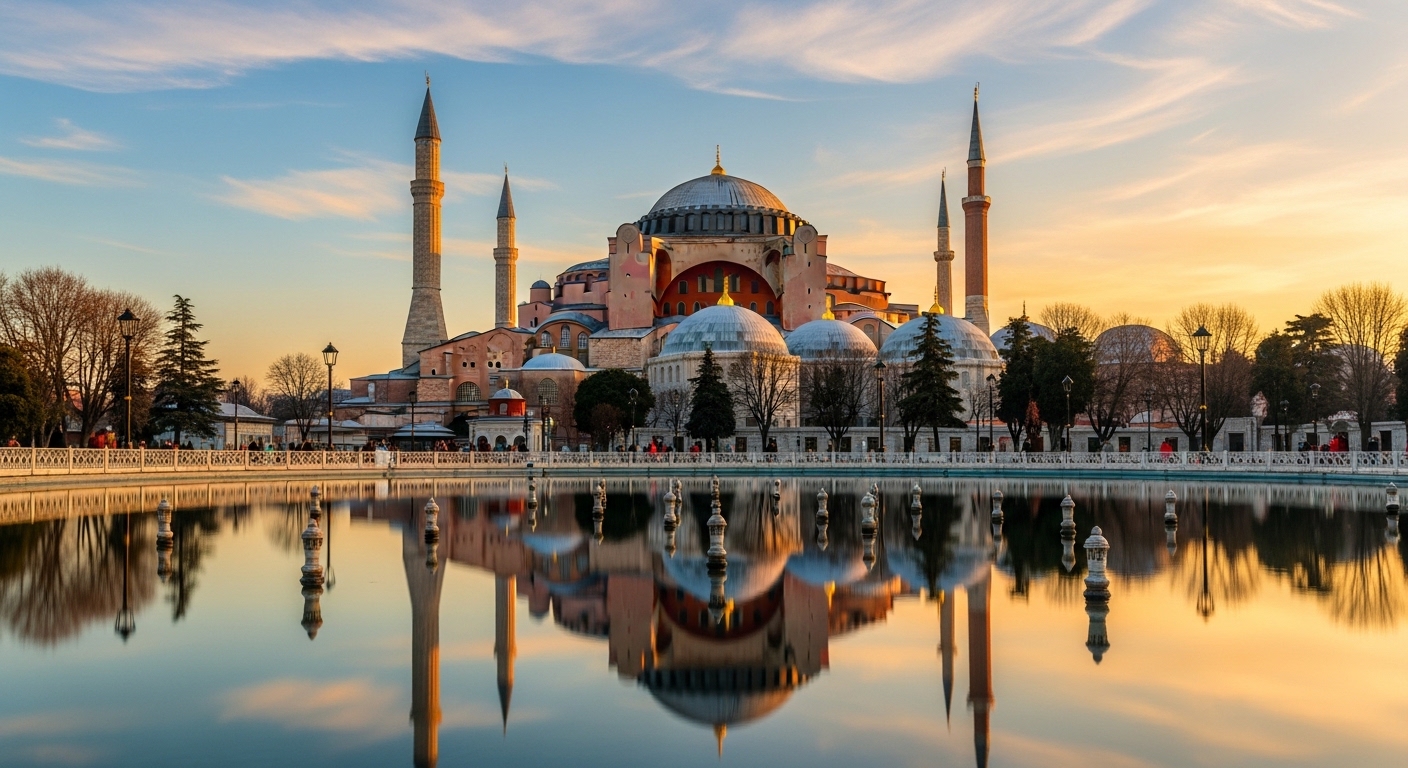
Hagia Sophia Mosque: A Timeless Icon of Faith, Power, and Architecture
Introduction to Hagia Sophia
Standing proudly in the heart of Istanbul, Hagia Sophia Mosque is not just a building—it’s a living story carved in stone, brick, and gold. If walls could talk, these would whisper tales of emperors, sultans, prayers, wars, art, and revolutions. For nearly 1,500 years, Hagia Sophia has been at the crossroads of civilizations, serving as a cathedral, a mosque, a museum, and once again a mosque. Few structures on Earth have witnessed such dramatic transformations.
What makes Hagia Sophia so special? Is it the massive dome that seems to float above the earth? Is it the glittering mosaics that shimmer like ancient stars? Or is it the fact that it embodies both Christianity and Islam under one roof? The answer is all of the above—and more.
Hagia Sophia isn’t merely an architectural masterpiece; it’s a symbol of power and spirituality. Built in 537 AD under the Byzantine Emperor Justinian I, it stood as the world’s largest cathedral for almost a thousand years. After the Ottoman conquest of Constantinople in 1453, it transformed into a mosque, reshaping its identity yet preserving its grandeur. In 1935, it became a museum, only to return to its status as a mosque in 2020.
This monument bridges continents—literally and culturally. Positioned between Europe and Asia, it represents the blending of East and West. Whether you approach it as a believer, historian, traveler, or architecture lover, Hagia Sophia leaves you speechless. It’s not just seen—it’s felt.
Let’s step inside history and explore every layer of this extraordinary structure.

The Historical Origins of Hagia Sophia
The story of Hagia Sophia begins long before the structure we see today. The original church was commissioned in 360 AD during the reign of Emperor Constantius II. However, it didn’t survive long. Political unrest and riots led to its destruction. A second church was built in 415 AD, but it too was burned down during the Nika Revolt in 532 AD—a violent uprising that shook Constantinople.
Enter Emperor Justinian I. Determined to create something that would surpass all previous churches, he envisioned a structure so magnificent it would reflect the glory of the Byzantine Empire. According to legend, when the completed building was unveiled in 537 AD, Justinian declared, “Solomon, I have surpassed thee!” It was an ambitious claim—but standing beneath that dome, you might understand his confidence.
The architects, Anthemius of Tralles and Isidore of Miletus, were not ordinary builders. They were mathematicians and engineers. Instead of relying solely on traditional methods, they applied advanced geometric principles. The result? A revolutionary design that changed architecture forever.
Construction took just five years—an astonishing achievement even by modern standards. Thousands of workers labored day and night. Precious marbles were imported from across the empire. Columns were taken from ancient temples. The building was not just constructed—it was assembled like a masterpiece.
From the beginning, Hagia Sophia was meant to impress, to dominate the skyline, and to symbolize divine wisdom—exactly what its name means in Greek: “Holy Wisdom.”
The Construction of the Third Hagia Sophia
When Emperor Justinian I decided to rebuild Hagia Sophia after the devastating Nika Revolt of 532 AD, he wasn’t aiming for a simple reconstruction. He wanted a masterpiece—something so bold, so unprecedented, that it would silence critics and immortalize his reign. And that’s exactly what he got.
The third Hagia Sophia, the one we see today, was constructed between 532 and 537 AD. Think about that for a moment. Just five years to build one of the most influential architectural wonders in human history. Even with modern machinery, that timeline would be ambitious. Back then? It was nearly miraculous.
The architects, Anthemius of Tralles and Isidore of Miletus, were brilliant minds in mathematics and physics. They approached the project like engineers solving a complex equation rather than traditional builders stacking stones. Their goal was clear: create a massive central dome that appeared to float above an enormous open space.
To achieve this, they introduced a revolutionary concept called pendentives—curved triangular sections that transition the weight of a circular dome onto a square base. It was an architectural breakthrough that changed the course of world architecture forever. Without this innovation, structures like the Blue Mosque or even St. Peter’s Basilica might never have existed in their current forms.
The scale of the project was staggering. Historical records suggest that over 10,000 workers were involved. Materials were gathered from all corners of the Byzantine Empire:
- Marble from Proconnesus (modern-day Marmara Island)
- Green stone from Thessaly
- Purple porphyry from Egypt
- Columns salvaged from ancient pagan temples
The message was clear: this wasn’t just a church—it was a symbol of imperial dominance. Every stone, every column, every mosaic declared the power of Constantinople.
When it was finally completed, the structure was unlike anything the world had seen. Visitors described it as heaven on earth. And honestly, standing inside today, that description doesn’t feel exaggerated at all.
Architectural Genius Behind Hagia Sophia
Hagia Sophia isn’t just beautiful—it’s brilliant. It represents a turning point in architectural history. Before its construction, no building had successfully combined such a massive dome with such a vast open interior space. It wasn’t just a place of worship; it was an engineering experiment on a monumental scale.
The building measures approximately 82 meters long and 73 meters wide. But numbers alone don’t capture the experience. When you step inside, what hits you first isn’t the size—it’s the feeling of openness. There are no heavy visual barriers. The space flows effortlessly, almost like air.
The genius lies in its structural balance. The central dome, massive and commanding, rests on four giant piers. Semi-domes cascade outward, distributing weight and creating a sense of harmony. It’s like a perfectly choreographed dance between gravity and geometry.
Over the centuries, earthquakes have tested this design repeatedly. Istanbul sits in a seismically active zone, yet Hagia Sophia still stands. Yes, parts have collapsed and been reinforced, but the core design has endured. That resilience speaks volumes about the brilliance of its creators.
And then there’s the artistry. Marble panels line the interior walls, arranged in symmetrical patterns that resemble abstract paintings. The veining in the stone wasn’t random—it was carefully selected and mirrored to create visual balance. It’s as if the building breathes symmetry.
What truly sets Hagia Sophia apart is how it merges science with spirituality. The structure doesn’t just hold up a roof—it creates an atmosphere. It makes you look up. It makes you pause. It makes you feel small in the best possible way.

The Massive Central Dome
Let’s talk about the star of the show—the dome.
The central dome of Hagia Sophia spans about 31 meters (102 feet) in diameter and rises approximately 55 meters (180 feet) above the floor. When it was completed in 537 AD, it was the largest dome in the world. For nearly a thousand years, no one could match it.
But here’s the magic trick: it looks weightless.
Thanks to a ring of 40 windows at its base, natural light floods through, creating the illusion that the dome is floating on a halo of light. Imagine standing beneath it. Sunlight streams in, illuminating golden mosaics, and the dome seems suspended in the sky. It’s not just architecture—it’s theater.
Of course, the original dome wasn’t perfect. It collapsed in 558 AD after an earthquake. Instead of giving up, the Byzantines rebuilt it slightly higher and stronger under the supervision of Isidore the Younger. That redesigned dome is what still stands today.
The dome symbolizes the heavens in both Christian and Islamic traditions. For Byzantine worshippers, it represented the vault of heaven. For Muslims praying beneath it centuries later, it echoed the vastness of Allah’s creation. Different faiths, same awe.
From a structural standpoint, the dome works because of the pendentives and the careful distribution of weight through semi-domes and buttresses. It’s like an upside-down bowl perfectly balanced on invisible supports.
Even today, architects study Hagia Sophia’s dome to understand how ancient builders achieved such stability with limited technology. It’s a reminder that human ingenuity didn’t begin in the modern era—it flourished long before.
Marble, Columns, and Interior Design
Walk into Hagia Sophia, and you’ll quickly realize it’s not just about the dome. The interior design is equally mesmerizing.
The walls are covered in massive marble slabs, many cut and arranged so that the natural veins mirror each other like butterfly wings. This technique, known as book-matching, creates symmetrical patterns that almost look intentional paintings by nature itself. You don’t just see marble—you see art formed over millions of years.
The columns tell their own story. Many were repurposed from older Roman temples, bringing layers of history into one unified space. Some columns are made of green Thessalian marble, others from purple porphyry associated with royalty. Each one carries symbolic weight.
Gold mosaics once covered much of the upper walls and ceilings. Though some were plastered over during the Ottoman period, many have been carefully restored. These mosaics depict Christian figures like Christ Pantocrator, the Virgin Mary, and various emperors offering gifts.
When Hagia Sophia became a mosque in 1453, Islamic elements were added rather than removing everything Christian. Large round medallions bearing the names of Allah, Prophet Muhammad, and the first caliphs were installed. A mihrab (prayer niche) was added, slightly angled toward Mecca. A minbar (pulpit) completed the transformation.
What’s fascinating is how these elements coexist. You might see a Byzantine mosaic above and Islamic calligraphy below. Instead of clashing, they create a dialogue between civilizations.
The interior feels layered, like a historical palimpsest. Every corner whispers a different century. Every column feels like a bridge between eras.
Light and Spiritual Atmosphere
If architecture is the body of Hagia Sophia, then light is its soul.
The builders understood something profound: light shapes emotion. With more than 100 windows strategically placed throughout the structure, sunlight pours in from multiple angles. The 40 windows at the base of the dome are especially dramatic. They create that famous floating effect, making the dome seem detached from the physical world.
But it’s not just about brightness. It’s about mood.
As the sun moves across the sky, the interior transforms. Morning light feels gentle and reflective. Midday light is powerful and illuminating. Evening light casts warm golden tones across marble and mosaic. It’s almost like the building has different personalities throughout the day.
In Byzantine times, candles and oil lamps added to this glow, reflecting off gold mosaics and creating a shimmering atmosphere. Imagine hundreds of flickering lights dancing across golden surfaces. It must have felt like stepping into another dimension.
For Muslims praying inside today, that same light enhances spiritual focus. It softens the vastness of the space, making it feel intimate despite its size. Light becomes a silent guide, drawing eyes upward and hearts inward.
There’s a reason visitors often fall quiet when they enter. It’s not just respect—it’s instinct. The space commands reflection. It encourages contemplation.
Hagia Sophia teaches a powerful lesson: architecture isn’t just about stone and structure. It’s about creating experiences. And through its masterful use of light, it continues to inspire awe nearly fifteen centuries later.
Hagia Sophia as a Byzantine Cathedral
For nearly 900 years, Hagia Sophia stood as the spiritual heart of Eastern Christianity. Imagine that—almost a millennium of prayers, coronations, chants, incense, and imperial ceremonies echoing beneath that golden dome. It wasn’t just a church. It was the church of the Byzantine Empire, the epicenter of Orthodox Christianity.
When it was completed in 537 AD, Hagia Sophia became the cathedral of Constantinople, the capital of the Byzantine Empire. It served as the seat of the Patriarch of Constantinople, the highest religious authority in Eastern Christianity. Major religious celebrations took place here—Easter, Christmas, imperial weddings, and grand liturgies that blended theology with imperial grandeur.
Byzantine emperors were crowned inside Hagia Sophia. Think about the symbolism. The emperor didn’t just rule politically—he ruled with divine approval. Being crowned beneath that immense dome, which symbolized heaven itself, reinforced the idea that the emperor’s authority came directly from God. The architecture amplified the message. The vastness of the space made individuals feel small, reminding them of divine power.
The interior during Byzantine times was even more dazzling than it appears today. Walls and ceilings were covered in shimmering gold mosaics depicting Christ, the Virgin Mary, angels, saints, and biblical scenes. The mosaic of Christ Pantocrator—Christ as ruler of all—was especially powerful. His gaze followed worshippers, reminding them of divine presence.
The liturgy inside Hagia Sophia was also unique. The acoustics created an almost mystical sound. Chants would rise, echo, and linger. Some historians describe the sound as heavenly, almost as if the building itself was singing.
For Christians of the Byzantine world, Hagia Sophia wasn’t just a place to attend church—it was a living representation of the Kingdom of Heaven on Earth. And for centuries, it defined what a cathedral could be.
The Ottoman Transformation into a Mosque
Everything changed in 1453. The Ottoman Sultan Mehmed II conquered Constantinople, bringing an end to the Byzantine Empire. It was a turning point not just for a city—but for world history. And Hagia Sophia stood at the center of it all.
Instead of destroying the cathedral, Mehmed II made a bold decision: he converted Hagia Sophia into a mosque. This wasn’t random. It was strategic. By transforming the most important Christian cathedral into an imperial mosque, he sent a clear message—the Ottomans were now the dominant power.
Yet what’s fascinating is that Hagia Sophia wasn’t stripped of its past entirely. Many mosaics were plastered over rather than destroyed. Structural elements remained untouched. The Ottomans respected its architectural brilliance. They didn’t see it as something to erase, but something to inherit.
The transformation included several additions:
- Minarets were constructed to call Muslims to prayer.
- A mihrab was added, indicating the direction of Mecca.
- A minbar (pulpit) was installed for sermons.
- Massive circular medallions featuring Arabic calligraphy were hung inside.
Islamic calligraphy replaced figural imagery in visible areas, aligning the space with Islamic tradition. Over time, Ottoman architects like Mimar Sinan reinforced the structure with buttresses to protect it from earthquakes, preserving it for future generations.
For nearly 500 years, Hagia Sophia served as one of the most important mosques in the Ottoman Empire. Sultans prayed there. Victories were celebrated there. It became a symbol of Islamic power, just as it had once symbolized Byzantine Christianity.
And yet, despite the transformation, the building remained layered. Beneath plaster and paint, Christian mosaics waited. Above Islamic inscriptions, Byzantine geometry endured. It became a silent dialogue between faiths.
Hagia Sophia as a Museum (1935–2020)
In 1935, another dramatic shift occurred. Mustafa Kemal Atatürk, founder of the modern Turkish Republic, made the decision to convert Hagia Sophia into a museum. This move was deeply symbolic. Turkey was embracing secularism, redefining itself as a modern nation-state rather than an Islamic caliphate.
By turning Hagia Sophia into a museum, the building became a shared cultural heritage site rather than an exclusively religious space. It was no longer only a mosque or a cathedral—it was history itself, open to everyone.
Restoration efforts began almost immediately. Plaster covering Christian mosaics was carefully removed. Stunning images of Christ, the Virgin Mary, and Byzantine emperors re-emerged after centuries of concealment. At the same time, Islamic elements were preserved. The giant calligraphic medallions remained in place.
For visitors, this period offered a unique experience. You could stand inside and see both Christian and Islamic artistry side by side. It felt less like a battleground of religions and more like a museum of civilizations.
During these 85 years, millions of tourists visited annually. Scholars studied its architecture. Historians analyzed its layers. Travelers walked in with cameras and walked out with goosebumps.
The museum era allowed Hagia Sophia to become a global symbol of cultural fusion. It wasn’t claimed by one faith—it belonged to humanity. That neutrality shaped how the modern world perceived it.
But history, as always, wasn’t finished yet.
Reconversion into a Mosque in 2020
In July 2020, Hagia Sophia was officially reconverted into a mosque. The decision sparked global debate. Some celebrated it as a restoration of historical identity. Others viewed it as a controversial political move. Regardless of perspective, the moment marked yet another transformation in the building’s long life.
The reconversion meant that daily Muslim prayers resumed inside Hagia Sophia after 85 years. However, the structure remains open to visitors outside prayer times. Christian mosaics are covered with curtains during Islamic worship but remain visible at other times.
The global reaction was intense. Religious leaders, political figures, and historians weighed in. For some Muslims, it represented the revival of Ottoman heritage. For many Orthodox Christians, it felt like a loss. For historians, it was another chapter in a story that has never stood still.
But here’s something important: Hagia Sophia has always evolved. Cathedral. Mosque. Museum. Mosque again. Its identity has never been static. It mirrors the shifting powers and cultural landscapes around it.
The building itself remains unchanged in essence. The dome still rises. The marble still gleams. The light still filters through 40 windows. Faiths may alternate, governments may change, but Hagia Sophia stands—steady, layered, enduring.
Perhaps that’s its greatest lesson: history is not frozen. It moves. And Hagia Sophia moves with it.
Religious Significance in Islam
Since 1453, and again since 2020, Hagia Sophia has held deep spiritual meaning in Islam. For Muslims, its conversion symbolized the fulfillment of a prophecy attributed to the Prophet Muhammad regarding the conquest of Constantinople.
As an imperial mosque during the Ottoman era, Hagia Sophia became a model for future mosque architecture. The addition of minarets allowed the call to prayer (adhan) to echo across the city. The mihrab directs worshippers toward Mecca. The spacious interior accommodates thousands during Friday prayers.
But beyond physical features, its spiritual atmosphere matters most. Imagine kneeling in prayer beneath that vast dome. The sense of scale reminds worshippers of divine greatness. The light filtering down feels almost symbolic of mercy descending from above.
Islamic calligraphy plays a major role in its religious identity. The large round medallions inside display the names of:
- Allah
- Prophet Muhammad
- Abu Bakr
- Umar
- Uthman
- Ali
- Hasan and Husayn
- These names connect the space directly to Islamic tradition and history.
Today, during Ramadan or major Islamic holidays, Hagia Sophia fills with worshippers. The building once again resonates with Quranic recitation. The blend of ancient architecture and living faith creates a powerful spiritual experience.
For Muslims, praying inside Hagia Sophia isn’t just about location—it’s about history, continuity, and reverence.
Christian Symbolism Within the Structure
Despite its current status as a mosque, Hagia Sophia still holds immense significance for Christians—especially Eastern Orthodox believers.
Many of its most important mosaics remain intact. The Deësis mosaic, depicting Christ flanked by the Virgin Mary and John the Baptist, is considered one of the finest examples of Byzantine art. The mosaic of the Virgin and Child in the apse radiates calm authority. These images survived centuries of change.
For Orthodox Christians, Hagia Sophia represents the golden age of Byzantium. It symbolizes a time when Constantinople was the spiritual capital of Eastern Christianity. Even though it no longer functions as a cathedral, it remains sacred in memory and tradition.
What makes Hagia Sophia unique is that Christian symbolism was never entirely erased. Instead, it was layered. Covered, uncovered, preserved. It’s like a manuscript written over but never fully destroyed.
Standing inside, you can look up at Islamic calligraphy and turn your head to see a mosaic of Christ. That coexistence is rare in world architecture. It’s not just history—it’s dialogue carved into stone.
Hagia Sophia continues to hold emotional weight for millions of Christians worldwide. It represents heritage, faith, and artistic achievement that transcends time.
Artistic and Cultural Fusion
Step inside Hagia Sophia and you’ll immediately sense something unusual. It doesn’t feel purely Byzantine. It doesn’t feel entirely Ottoman. It feels… layered. Like a conversation frozen in architecture. That’s because Hagia Sophia is one of the most powerful examples of artistic and cultural fusion in the world.
Let’s break it down. On one side, you have glittering Christian mosaics—Christ Pantocrator gazing solemnly from above, the Virgin Mary holding the infant Jesus, angels stretching their wings across golden ceilings. These images reflect centuries of Byzantine theology and artistic mastery. Gold tesserae catch the light in a way that feels almost alive, creating movement in stillness.
Now turn slightly. You’ll see enormous circular medallions inscribed with Arabic calligraphy. The names of Allah and Prophet Muhammad stand boldly against dark backgrounds. Elegant Islamic geometric patterns decorate arches and panels. The mihrab points toward Mecca. The minbar stands ready for sermons.
What’s fascinating is that these elements don’t cancel each other out. They coexist. Instead of erasing history, Hagia Sophia absorbed it. It’s like a canvas that was never wiped clean—only painted over with respect for what came before.
This fusion isn’t accidental. The Ottomans admired Byzantine engineering and aesthetics. They didn’t demolish Hagia Sophia; they studied it. Ottoman architect Mimar Sinan even used it as inspiration for his own masterpieces. That’s cultural continuity, not destruction.
Hagia Sophia represents something rare: a building that holds two major world religions within its walls. In a world often divided by belief, this structure stands as proof that history is more intertwined than we like to admit.
It’s not perfect harmony. It’s not without tension. But it’s real. And that authenticity makes it one of the most powerful cultural symbols on Earth.
Engineering Marvels That Defied Time
Let’s be honest—Hagia Sophia shouldn’t still be standing. Istanbul sits near active fault lines. Earthquakes have shaken the city repeatedly over the past 1,500 years. And yet, here it is. Weathered. Cracked in places, yes—but still magnificent.
How?
The answer lies in brilliant engineering combined with centuries of reinforcement. The original architects used lightweight bricks and mortar mixtures that were flexible enough to absorb seismic movement. The structure wasn’t rigid like a modern concrete block—it had a subtle give to it, almost like a tree bending in the wind.
After the dome collapsed in 558 AD, it was rebuilt with a steeper curve to better distribute weight. Later, during the Ottoman era, Mimar Sinan strengthened the building further by adding external buttresses. These supports helped stabilize the walls and counter the outward thrust of the massive dome.
Think of Hagia Sophia as a living organism. When it weakened, architects didn’t abandon it—they adapted it. Reinforced it. Evolved it.
The pendentive system remains one of its most revolutionary features. This technique allowed a circular dome to sit atop a square base—something no one had mastered at that scale before. Without pendentives, the dome would have crushed the walls beneath it.
Even modern engineers study Hagia Sophia. Its survival isn’t luck. It’s a combination of mathematical precision, material science, and continuous maintenance.
In many ways, Hagia Sophia is like a seasoned warrior—scarred but unbroken. Each crack tells a story. Each reinforcement represents human determination to preserve something extraordinary.
Visiting Hagia Sophia Today
If you ever find yourself in Istanbul, visiting Hagia Sophia isn’t optional—it’s essential. Located in the historic Sultanahmet district, it stands within walking distance of the Blue Mosque, Topkapi Palace, and the Basilica Cistern. You can easily spend an entire day exploring this area alone.
Since its reconversion into a mosque in 2020, entry remains free. However, there are a few things to keep in mind:
- Visitors must remove their shoes before entering the prayer area.
- Modest dress is required (women may need to cover their hair).
- Access may be limited during prayer times.
- Certain areas may be restricted to preserve the structure.
When you step inside, don’t rush. Give yourself time. Look up. Then look around. Notice how the floor slopes slightly from centuries of wear. Observe the marble patterns on the walls. Watch how light shifts as clouds move outside.
Tour guides are available, but even without one, the building speaks for itself. You’ll hear whispers of multiple languages around you—Arabic, Turkish, English, Greek, Spanish. That alone tells you something. Hagia Sophia belongs to a global audience.
Try visiting at different times of day if possible. Morning light feels serene. Late afternoon creates dramatic shadows beneath the dome.
Above all, allow yourself to feel the weight of history. You’re standing in a space where emperors were crowned, sultans prayed, revolutions unfolded, and millions of ordinary people sought hope.
That’s not just tourism. That’s time travel.
Hagia Sophia’s Influence on World Architecture
Hagia Sophia didn’t just impress people—it influenced them. Its architectural DNA can be found across continents.
When the Ottomans converted it into a mosque, they were so captivated by its design that they modeled future imperial mosques after it. The famous Blue Mosque (Sultan Ahmed Mosque), located just across the square, clearly mirrors Hagia Sophia’s central dome and cascading semi-domes. Ottoman architect Mimar Sinan studied Hagia Sophia extensively before designing mosques like the Süleymaniye Mosque.
But the influence doesn’t stop in Turkey.
The concept of a massive central dome supported by pendentives spread to Europe. Renaissance architects admired Byzantine engineering. Structures like St. Peter’s Basilica in Rome and Florence Cathedral echo ideas pioneered in Constantinople centuries earlier.
Hagia Sophia proved that vast interior spaces without heavy columns were possible. It redefined what sacred architecture could look like. Instead of dark, segmented interiors, it introduced open, unified spaces flooded with light.
Its legacy can be summarized in three major influences:
- Structural innovation – Perfecting the pendentive dome system.
- Spatial design – Creating vast, uninterrupted interiors.
- Symbolic scale – Using architecture to project divine and imperial power.
In a way, Hagia Sophia is the architectural ancestor of countless domed buildings worldwide. Its design rippled outward like waves from a stone dropped into water.
Even after 1,500 years, architects continue to study it—not as a relic, but as a masterclass.
Controversies and Debates Surrounding Hagia Sophia
It’s impossible to talk about Hagia Sophia without acknowledging the debates that surround it. This building has never been neutral. It has always carried political, cultural, and religious weight.
The 2020 reconversion into a mosque reignited global conversations. Some argued it was a sovereign decision reflecting Turkey’s historical continuity. Others believed it reduced the monument’s universal character as a museum. International organizations expressed concern about preservation and accessibility.
But controversy isn’t new for Hagia Sophia. Its very existence is rooted in conquest and transformation. When it was converted into a mosque in 1453, that too was controversial—for Christians. When it became a museum in 1935, some Muslims opposed the decision.
In other words, Hagia Sophia has always stood at the center of identity debates. Who does it belong to? A nation? A religion? Humanity?
The truth is complicated. It belongs to all of those in different ways.
What makes Hagia Sophia unique is that it embodies history rather than hiding it. You can see the layers. You can feel the transitions. It forces us to confront the reality that civilizations rise and fall—but culture accumulates.
Debate may continue. Opinions may differ. Yet the building remains, quietly observing human arguments the way it has for centuries.
Why Hagia Sophia Continues to Captivate the World
So why does Hagia Sophia still fascinate us after 1,500 years?
It’s not just the dome. Not just the mosaics. Not just the political drama.
It’s the story.
Hagia Sophia represents resilience. It survived riots, earthquakes, conquests, religious shifts, and modern politics. It adapted without disappearing. Few structures can claim such endurance.
It also represents duality. East and West. Christianity and Islam. Empire and republic. Destruction and preservation. Instead of choosing one identity, it carries them all.
And maybe that’s why it feels so human.
We, too, are layered. We evolve. We carry our pasts even when we change directions. Hagia Sophia mirrors that complexity on a monumental scale.
Standing beneath its dome, you don’t just see architecture—you feel time pressing gently against your shoulders. You realize that generations before you stood in that exact spot, looking up in awe.
That shared human experience—that’s the magic.
Hagia Sophia isn’t just a building in Istanbul. It’s a symbol of civilization itself.
Conclusion
Hagia Sophia Mosque stands as one of the most extraordinary structures ever built—not simply because of its size or beauty, but because of its story. From its origins as a Byzantine cathedral to its transformation into an Ottoman mosque, from its secular chapter as a museum to its reconversion into a mosque in 2020, it has continuously evolved while preserving its essence.
It represents architectural genius, cultural fusion, religious devotion, and historical complexity all at once. Few monuments in the world can claim such layered identity.
And perhaps that’s its greatest lesson: greatness isn’t about remaining unchanged. It’s about enduring change without losing your foundation.
Hagia Sophia has done exactly that—for nearly fifteen centuries.
Frequently Asked Questions (FAQs)
1. When was Hagia Sophia originally built?
Hagia Sophia was completed in 537 AD during the reign of Byzantine Emperor Justinian I. It took approximately five years to build.
2. Why was Hagia Sophia converted into a mosque?
After the Ottoman conquest of Constantinople in 1453, Sultan Mehmed II converted it into a mosque to symbolize the new Islamic rule.
3. Is Hagia Sophia currently a mosque or a museum?
As of 2020, Hagia Sophia functions as a mosque, but it remains open to visitors outside prayer times.
4. What makes Hagia Sophia architecturally unique?
Its massive central dome supported by pendentives, vast open interior space, and innovative engineering make it a groundbreaking architectural achievement.
5. Can tourists visit Hagia Sophia today?
Yes, visitors can enter for free, but modest dress is required, and access may be limited during prayer times.

Have Question Or Suggestion ?
Please Share Your Thought, To Make It Real